
Winery Story
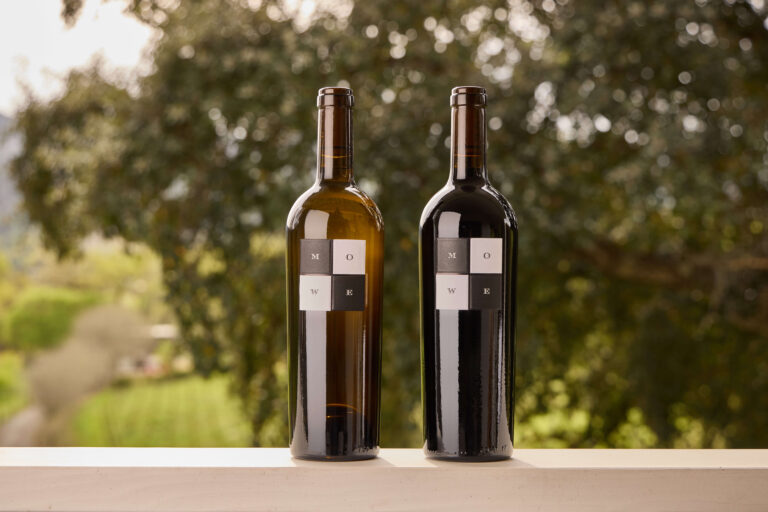
MOWE
Amid the headwinds of today’s wine industry challenges, while many of the big corporates are running for cover, enter Dustin and Renee Mowe, a husband-and-wife team from rural Shasta County, California, who founded MOWE Napa Valley from their St. Helena home in 2022. They do not pretend the current wine market is anything other than what it is. But ask Dustin whether MOWE was a calculated play on a soft market, and he is blunt: "The reality is that we did not start MOWE because we identified a market opportunity," he says. "We started it because it was a dream Renee and I had carried for a very long time."
Someday, Today
Neither Mowe grew up around wine. Renee was raised in Redding; Dustin came from Burney, a logging town of about 3,000 people roughly 45 minutes east, near the Oregon border. “Having grown up in a small rural town, wine wasn’t part of my upbringing,” he recalls. He didn’t taste it until he was 19 or 20. The conversion came on a tour of Niebaum-Coppola, courtesy of one of his first friends in Napa. “After that tour and tasting, I was captivated,” he says. “I remember being struck not only by the wine itself, but by the passion everyone seemed to have for what they were doing.”

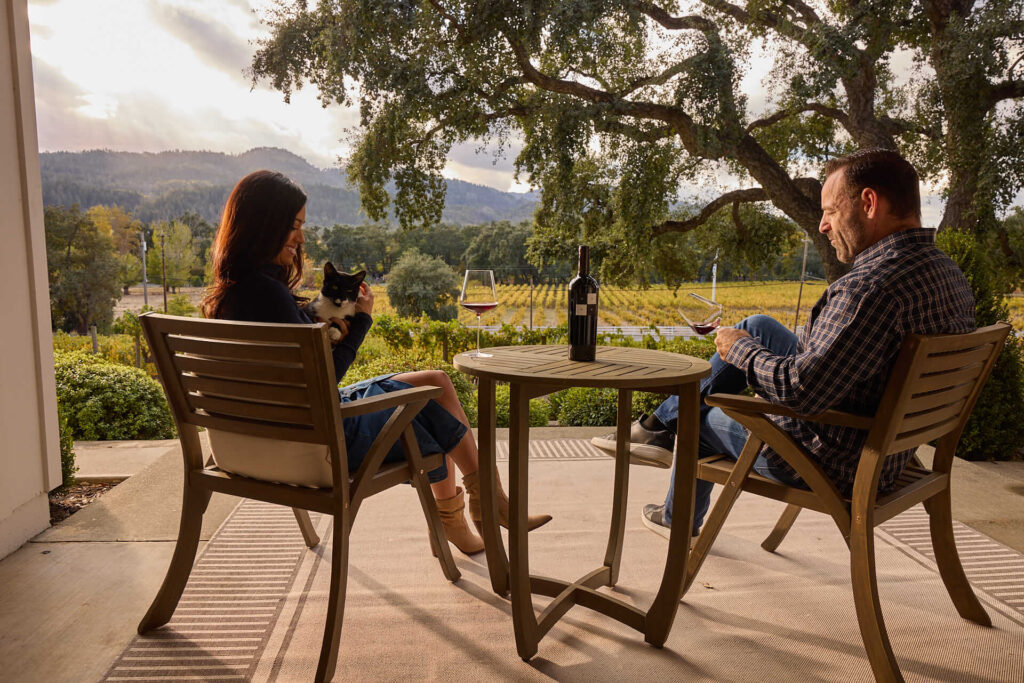
Renee and Dustin Mowe
The romance with Renee moved faster than the wine career did — a chance meeting at a salon, a first date at Zuzu in downtown Napa, and a wedding nine months later. “It was a fast-track romance,” Dustin says.
The wine, in a sense, took 27 years. Dustin is the CEO of Portocork, the Napa-based cork company, and has spent nearly three decades supplying closures to many of the valley’s most respected producers. It is a peculiar vantage point: because the cork ultimately touches the wine, his customers are the winemakers themselves. “For more than two decades, I have had a front-row seat to many of Napa Valley’s most respected wineries and vineyards,” he says. Technically curious by nature, he spent those years asking questions about fermentation, viticulture, cooperage, and blending. Winemaker friends kept asking when he’d start his own label. “My answer was always, ‘Someday,'” he says. “Renee likes to tease that it was never ‘if,’ it was always ‘when.'”
The “when” arrived in 2020. As COVID briefly cooled the real estate market, the Mowes bought a St. Helena property with a vineyard attached — one acre of Cabernet Sauvignon, all Spottswoode clone, planted by the legendary David Abreu at the base of Glass Mountain, with an existing grape contract to Spottswoode, Dustin’s favorite winery. Even the landscaping seemed to be sending a message. “It had 3 cork trees growing in the front, which was kinda like a sign,” he says.
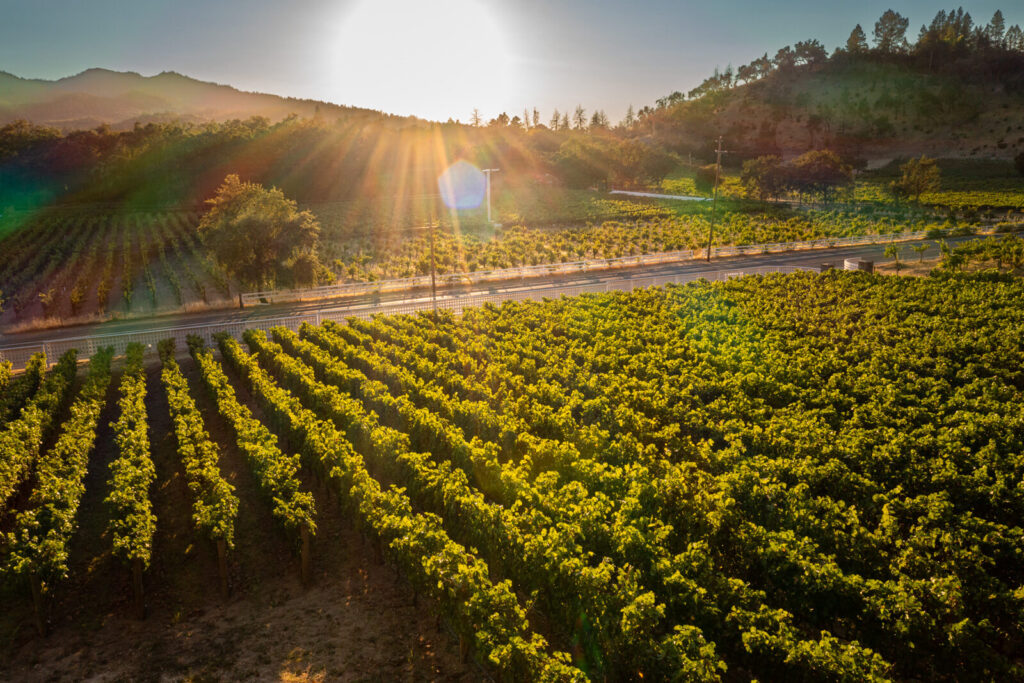
MOWE’s Home Estate Vineyard in St. Helena
The deciding moment came in the cellar. Aron Weinkauf, Spottswoode’s winemaker, offered Dustin a taste of the 2021 vintage made from their fruit, before it was blended away into something larger. “It was incredible,” Dustin says. “That’s when I called Renee and said, ‘We gotta do this!'”
MOWE’s first vintage, 2022, arrived with a trial by fire — literally. The brutal Labor Day heat dome hit Napa just as the fruit hung unripe. “We saw the heat coming, but our fruit wasn’t ripe,” Dustin says. “There was no way we could pick before the heat.” He called his friend Maayan Koschitzky for advice, bought a stack of long hoses and a mister, and went to work. “I hand-sprayed the vineyard every hour through the heat event,” he says. They held off picking until the pyrazines blew off, harvested on September 12, and the gamble paid off. “The fruit was like it had never been through the heat.”
That episode crystallized a house style. MOWE harvests on the early side. “We are aiming for that style that comes from just-fresh-fruit,” Dustin says — restraint over the big, jammy archetype that built Napa’s modern reputation. The Cabernet sees long macerations (36 days on skins for the 2023), a choice many vintners avoid for fear of harsh seed tannins. Dustin isn’t worried: with fully ripe seeds, he argues, the extended time on skins yields a finer grade of tannin, not a coarser one.
The wines are made at Lithology by Matt Sands, a close friend whose style Dustin loves. The home vineyard has been dry-farmed since 2023, with no added fertilizer and organic farming throughout. The second wine, a Coombsville Sauvignon Blanc — planted by Annie Favia during her time at Abreu, from Clone 1 and Musque — is aged an unusually long 19 months in barrel and bottled unfined and unfiltered.
The throughline is a refusal to blend in. “There are hundreds of wines in Napa — we don’t want to be like everyone else,” Dustin says. “We want to respect the site and this Spottswoode clone. Elegance but with power. We’re trying to make the style of 1990s Spottswoodes.”
It is a philosophy that happens to align with where the market is drifting. Sauvignon Blanc, too, is gaining traction at a moment when buyers are hunting for freshness and value.
MOWE recently pushed in its chips, acquiring 10.5 acres of the historic AIDA Vineyard — a site first planted in 1911 and widely regarded as one of Napa’s grand crus — with Cabernet-dominant blocks planted by David Abreu in 2007, plus slices of Cabernet Franc and Merlot. Silverado will continue managing the vineyard, Matt Sands will continue making the wine, and the AIDA name will stay for now. “We pushed all our chips in for this AIDA purchase, because we really wanted to lean into starting a family project,” Dustin says.
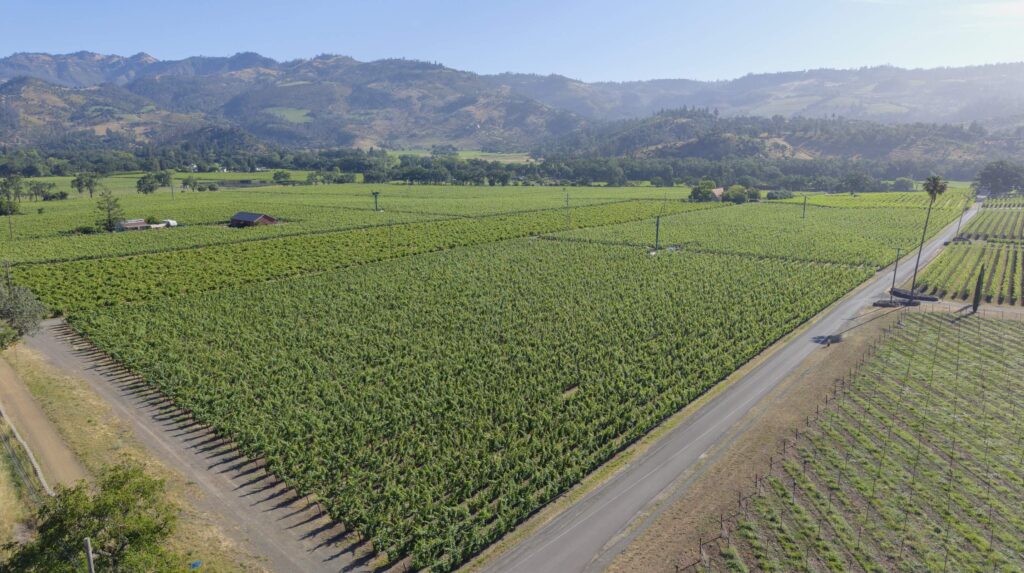
AIDA Vineyard
The long-term intention is what sets the Mowes apart from many of the big corporates. “We are not approaching these vineyards as investors,” he says. “We are approaching them as stewards.” With their daughter wanting to get into the business and their son planning to study wine, the Mowes describe a project measured in generations.
That outlook also shapes how MOWE thinks about the corporate money that has poured into Napa — with some deep-pocketed buyers now heading for the exits. Dustin doesn’t see them as the competition. “We really don’t try to compete with them,” he says. “What small family-owned wineries have is focus, flexibility, and a deeply personal connection to what they are building.” He ticks through the difference: “We are in the vineyards. We host the tastings. We answer the emails.” And the deciding advantage, as he sees it: “Perhaps most importantly, we are able to think in generations rather than quarters. The decisions we make today are not based on earnings reports.”
If there is an opportunity in this bruised market, Dustin locates it in authenticity rather than arbitrage. “Consumers today have more choices than ever, but they are also looking for authenticity,” he says. “They want to know who is behind a wine, why it exists, and what makes it different. They want a connection.” That maps almost exactly onto what industry analysts now identify as the dividing line between wineries that are growing and those bleeding sales: the resilient ones have shifted from transactional selling toward genuine hospitality and customer loyalty.
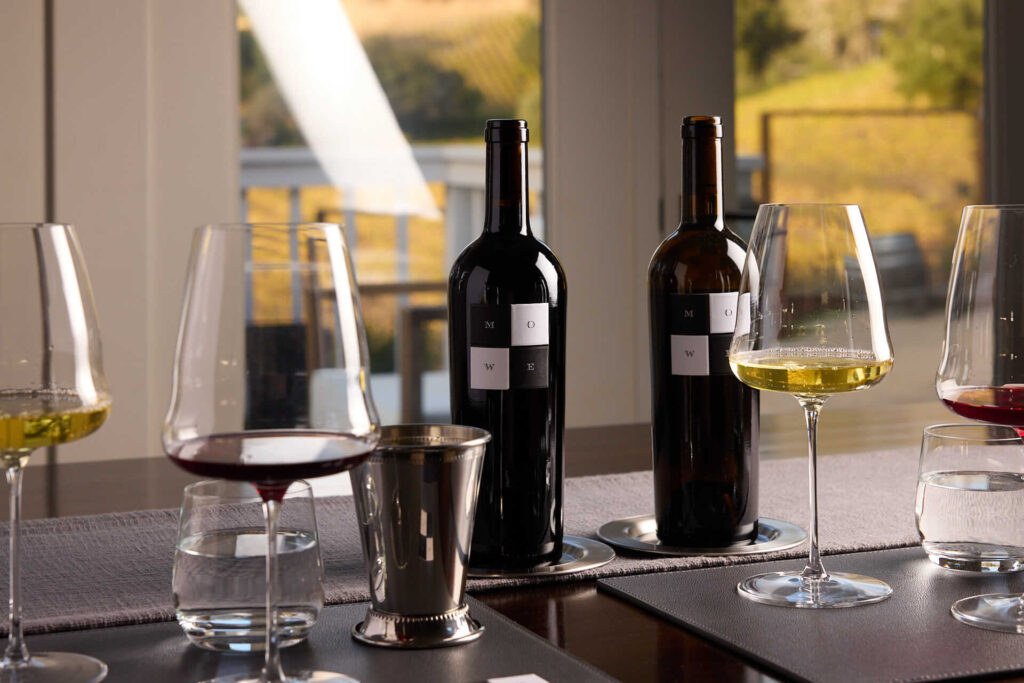
So far, the connection is doing the selling. MOWE is entirely direct-to-consumer, and demand has outrun supply. “Our 2022 sold out in 5 days, the 2023 sold out in 4 days,” Dustin says. There is no shortcut in his telling — he began showing the first wine just six months after harvest and credits an apprenticeship’s worth of advice from mentors like the MacDonald brothers, Roy Piper, and Bruce Phillips, small producers who proved a vineyard-first, quality-obsessed path still works. “We know there are no shortcuts,” he says.
For all the talk of strategy, Dustin keeps returning to people. “MOWE has never been just Renee and me,” he says, pointing to winemaker Matt Sands — “Matt Sands and I speak or text almost every day” — and to Maayan Koschitzky, a friend since the day he arrived in the U.S. from Israel, who found them the Sauvignon Blanc vineyard he’d worked for years. The brand, Dustin says, is the sum of a long career spent learning from Napa’s best.
It is also, in the end, a small-town story transplanted to one of the world’s most expensive zip codes — which may be why the Mowes describe their tasting experience the way they do: “We often say that people arrive as guests and leave as friends.”
Winery Information
Region: USA, California, Napa Valley, St. Helena
Address: 3424 Silverado Trail N, St Helena, CA 94574, United States
Open for Tastings: By Appointment Only
Major Grapes: Cabernet Sauvignon, Sauvignon Blanc
Vineyard Size: 11.5 acres
Own Winery: No
DTC Mailing List: Yes
Vineyard Sustainability: Organic
Year Established: 2022
Owner: Dustin and Renee Mowe
Winemaker: Matt Sands
Website: https://mowenapavalley.com/
Most Recent Reviews for this Winery
Published: June 2026