
Winery Story
Favia
Favia is growing. Founded by winemaker Andy Erickson and viticulturist Annie Favia, this boutique label has been made from the couple's historic Coombsville property since its first commercial vintages in the early 2000s. Now, following a landmark partnership with the Huneeus family on a prime Oakville estate, Favia is entering its most ambitious chapter yet: a newly planted vineyard between two of the valley's most storied neighbors, a purpose-built winery breaking ground this year, and the return of a wine not bottled since 2012.
The Art of Growing
Annie Favia loves growing things.
“I’ve had a special connection with plants since I was a small child,” she tells me. “Being outside amongst plants has always felt the most natural and right to me. California native plants are incredible—so tough and beautiful. The fact that they receive no water at all except what they scavenge from deep in the soil for half to three-quarters of the year makes me admire and respect them so much. I also grow cut flowers, vegetables, fruit, nuts, olives for olive oil, and, of course, herbs for my herbal tea company, ERDA TEA.”
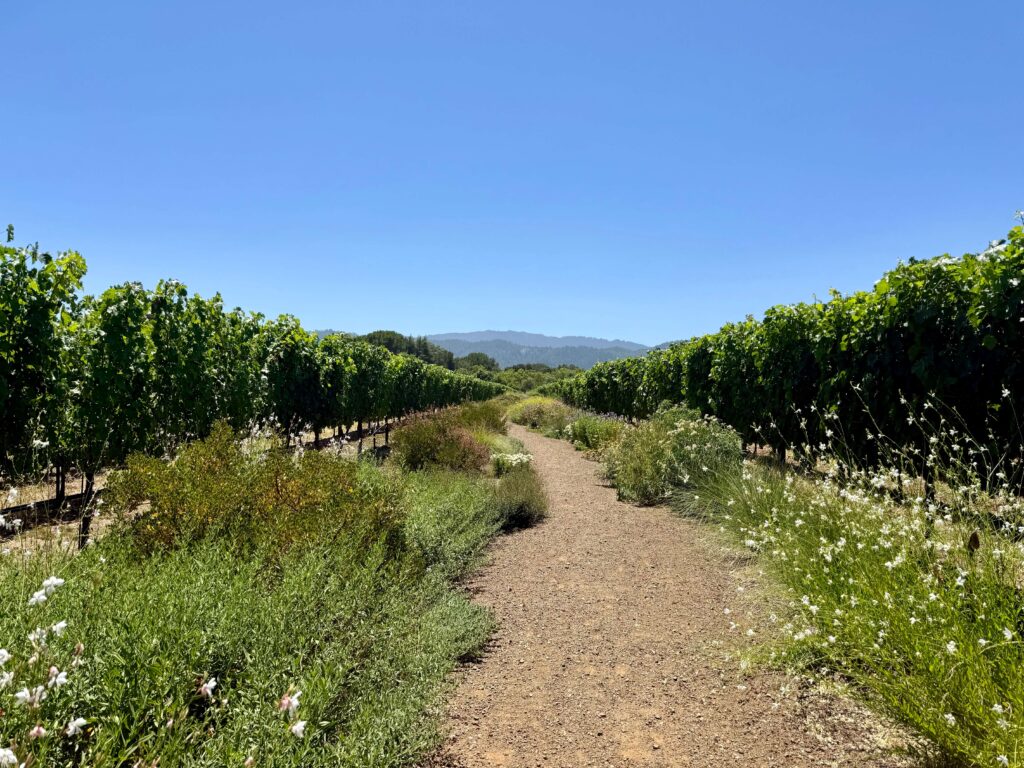
Annie met Andy Erickson in 1995. “I went to a friend’s house for dinner, and Andy happened to be his roommate,” she says. “Love at first sight!”
Andy was then at the start of his wine career, having taken a circuitous route to it. A pre-med student turned political science major, he spent a formative summer studying at the United Nations in Geneva while living with a food-and-wine-obsessed family just across the French border. “I fell in love with the whole thing, not knowing at all that winemaking could be a vocation,” he recalls. Back in the States, he took a job at a San Francisco advertising agency whose clients included a group of Napa wineries. “I ended up going to meetings in Rutherford, staring out the window, and realizing that I should be out there and not in here. I quit my job to pursue the wine business.”
In 1994, Andy arrived in Napa Valley to work harvest at Stag’s Leap Wine Cellars, followed by a stint with John Kongsgaard at Newton and an enology degree from UC Davis. From there, he joined Bob Levy as assistant winemaker at Harlan Estate. Around the same time, Annie began a decade-plus tenure as a viticulturist for David Abreu, farming some of the valley’s most celebrated sites.
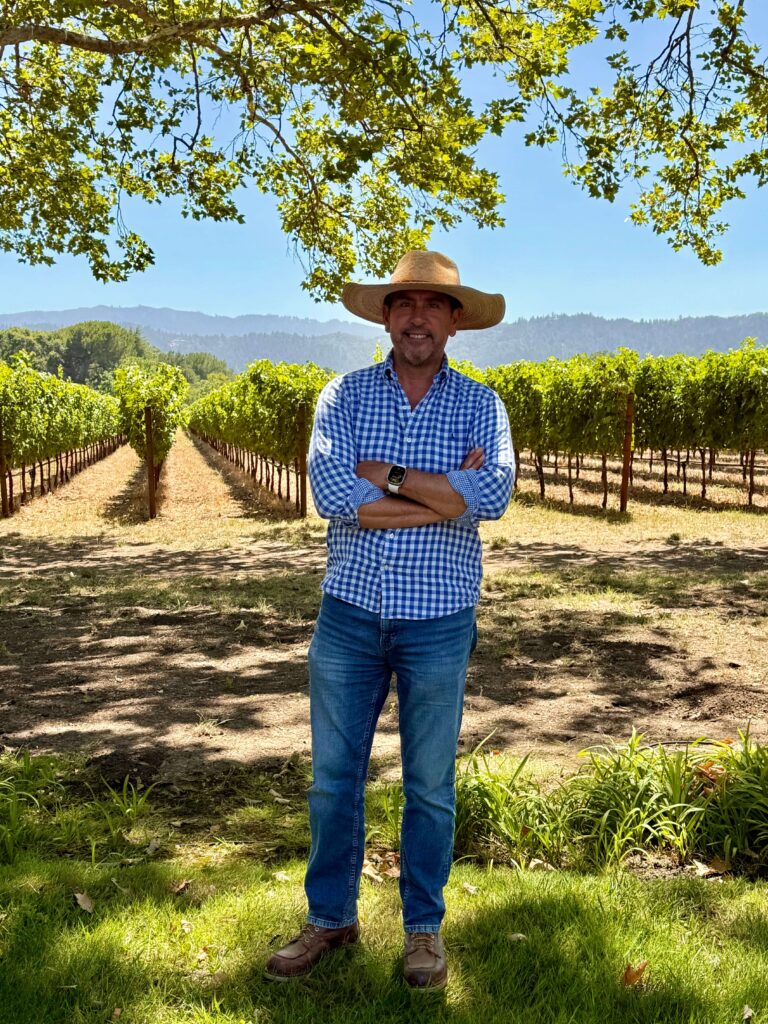
Andy Erickson
By the mid-2000s, Andy had left Harlan to consult for a handful of Napa wineries as well as Jonata in Santa Barbara County, then owned by Charles Banks and Stan Kroenke. When the pair purchased Screaming Eagle in 2006, Andy came on board as winemaker, a post he has since left. Today, he consults for Dalla Valle, Mayacamas, Arietta, Ellman Family Vineyards, Arborum, Cervantes Family Cellars, and a couple of yet-to-be-released projects.
Alongside those high-profile careers, the couple quietly built a project of their own. “We actually started by working with fruit from Coombsville in 1999,” says Andy. “At first, we were only going to make Cabernet Franc. That was our passion. In the very beginning, we made the wine in plastic bins in our garage.”
They later purchased the former Antonio Carboni Winery and Italian Gardens in Coombsville, a property dating to the 1880s, which became both their home and the creative heart of Favia. In 2006, Annie’s work with Abreu opened the door to exceptional Cabernet Sauvignon to blend with their Cabernet Franc. “We tasted all the components, and the Cabernet Sauvignon was so delicious we decided to bottle it on its own,” Andy says. “Originally, we blended the Coombsville and Oakville fruit sources together. Then the vineyards started to speak individually, so from 2013, we bottled them separately.”
The result is Favia’s core quartet. “Cerro Sur” and “La Magdalena” honor the couple’s founding passion, Cabernet Franc. “Cerro Sur comes from the southern part of the valley, out on Wooden Valley Road. It’s about 75% Cabernet Franc,” Andy explains. “La Magdalena comes from Oakville Ranch—roughly half Cabernet Franc, half Cabernet Sauvignon. These wines were why we got into this. We love Cabernet Franc!” They are joined by two single-AVA Cabernet Sauvignons: Oakville, from the dynamite-blasted, iron-red rocky soils of Oakville Ranch, farmed with Phil Coturri; and Coombsville, from Meteor Vineyard. Since 2022, Cerro Sur has also been offered internationally through La Place de Bordeaux, bringing Favia to a global fine-wine audience.
The Oakville Estate
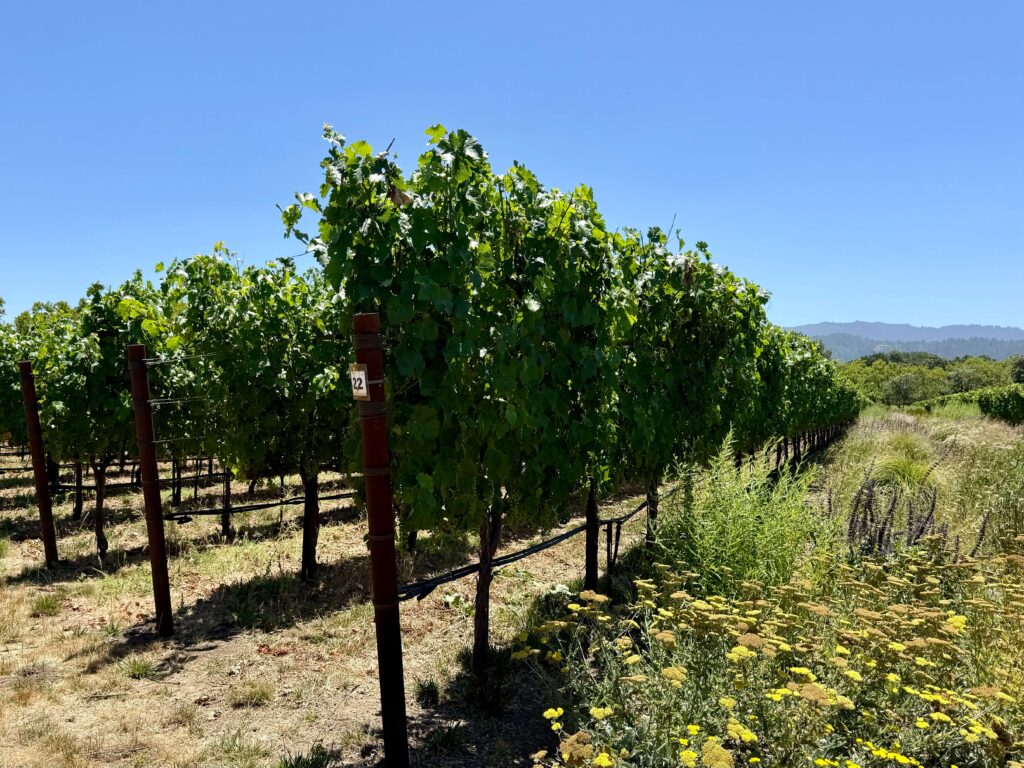
2022 marked Favia’s twentieth vintage, and with it came a proposal. The Huneeus family—of Quintessa, Faust, and Flowers—approached Annie and Andy about joining forces on a choice Oakville parcel they had purchased in 2018: the former Swanson estate on the north side of Oakville Cross Road, neighbored by Opus One and Groth. The offer meant access to extraordinary land, but also, for the first time, sharing the Favia brand.
“Annie and I had worked for two decades creating what had become a beloved family business,” Andy tells me. “We were very protective of what we had created. It wasn’t that we were not interested in growing Favia; it was more that we had never considered having partners. But, having known the Huneeus family for almost 30 years and knowing the incredible beauty and potential of the Oakville property, we pretty quickly convinced ourselves that there was a conversation to be had. There are so many synergies—in the commitment to organic farming, in the alignment on the wines we were making, and in our work ethic and the commitment to family.”
The estate totals 86 acres, with 68 plantable—and, increasingly rare and valuable in Napa, it came with a winery permit. Unusually, the Huneeus family had allowed the site to lie fallow after clearing the old Swanson vines, giving Annie a nearly blank canvas. Replanting, which she has overseen since the partnership, is now essentially complete: a little over 60 acres of vines, primarily Cabernet Sauvignon, with Cabernet Franc (of course), Merlot, Sauvignon Blanc, and a small trial of Malbec. Old river washes discovered during planting left gravelly ribbons through the predominantly clay-loam site—prime ground for the couple’s beloved Franc.
“The new Oakville property is directly in the heart of the Napa Valley,” Annie says. “You can feel it when you are on the land. The Mayacamas and Vaca ranges hug us, and soils and minerals from both ranges have been depositing on our land for hundreds of thousands of years. It’s really cool!”
Her farming philosophy carries over intact. “I want to leave any land we are on in a better state than when we found it. Our land has been CCOF-certified organic for many years, and we practice biodynamic and regenerative principles. Having a holistic approach to our land and the surrounding environment is the only responsible thing to do, in my opinion.”
A New Winery
Ground is being broken on the new estate winery—a compact, three-building circular design—with the goal of crushing the 2028 harvest on site. In the meantime, the wines are being made at the Eleven Eleven facility near downtown Napa. The couple’s vision for the building mirrors their vision for the land.
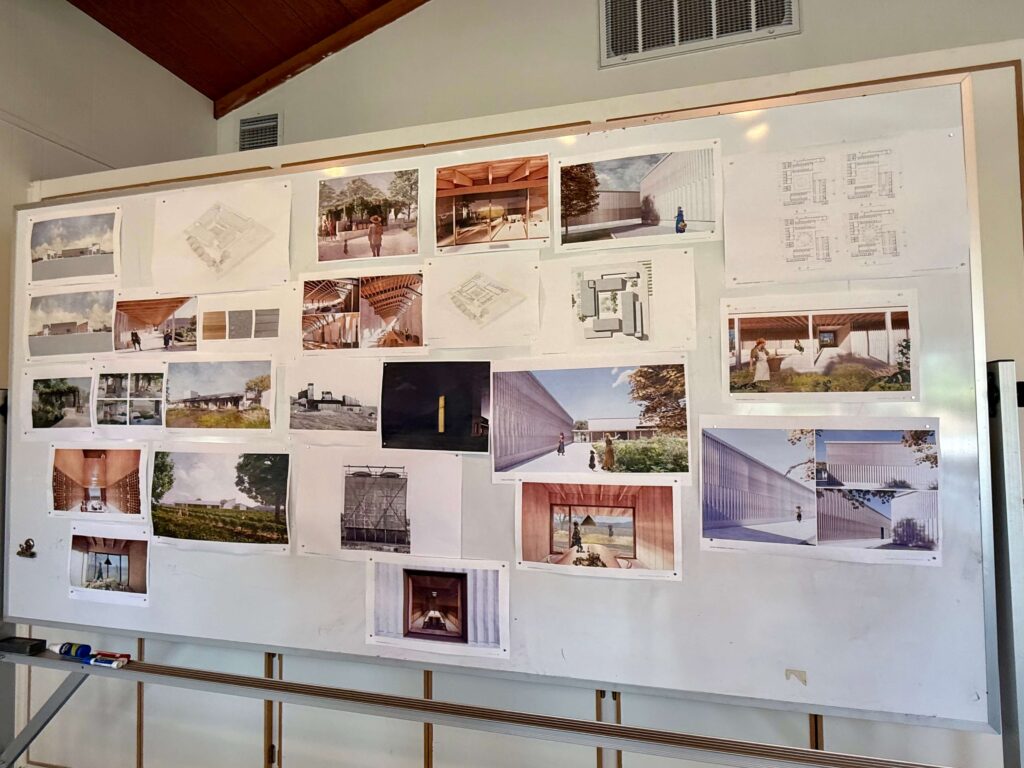
Building Plans for the new Favia Winery
“We really want to emphasize the connection to the land,” says Andy, “and highlight that winemaking is a craft more than it is a science. We want the winery to blend into the environment, and we want the workspaces to feel more like a craftsman’s studio than a production facility. When people come to visit, we want them to feel they are spending time on a farm. And Annie has the greenest thumb on the planet, so we want to share the bounty of the gardens, orchards, and native plantings that will inhabit the property.” Tastings will remain by appointment, in the same thoughtful spirit as the couple’s Coombsville hospitality.
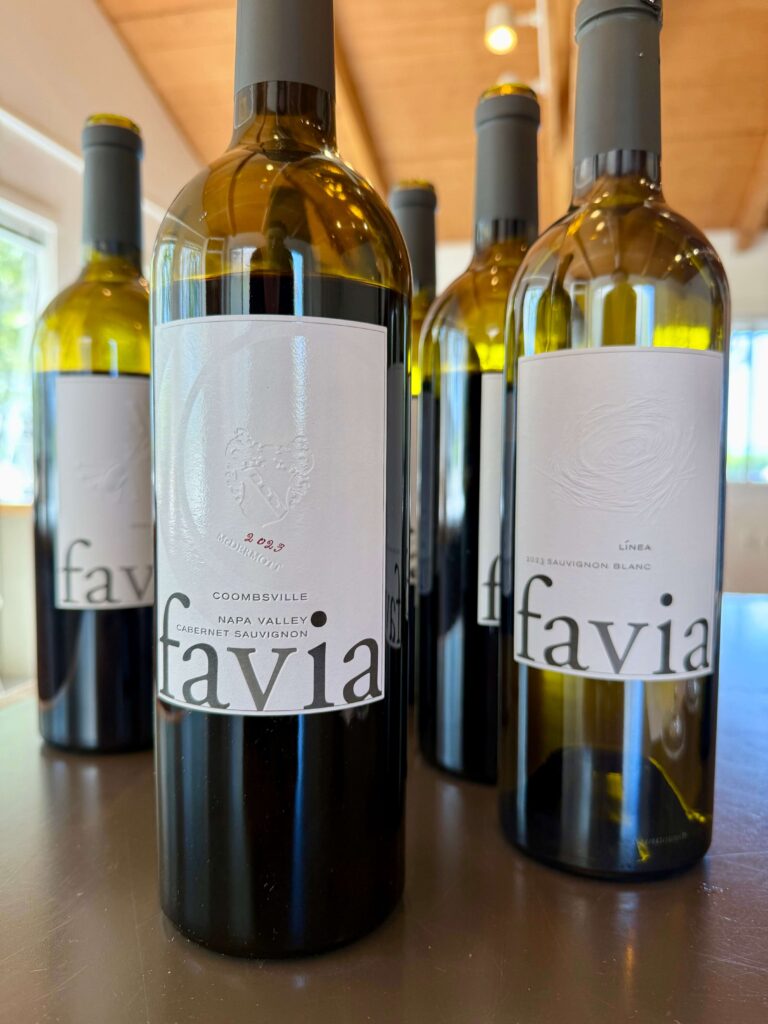
The first fruit of the partnership is already in bottle. With the 2023 vintage—released in early 2026—Favia has revived its Napa Valley Cabernet Sauvignon, the appellation blend last produced in 2012. Marrying young-vine fruit from the Oakville estate with Coombsville sources, it deliberately reunites the two AVAs that first defined the label: Oakville lending power, breadth, and floral lift; Coombsville contributing savory freshness, minerality, and structure. It is a formula with deep Napa roots—for generations before Coombsville earned its own appellation, up-valley producers quietly blended in its cooler-climate fruit. At roughly 3,000 cases, the debut release exceeds Favia’s entire historical annual production of around 2,000 cases, and at a price well below the single-vineyard wines, it makes Favia accessible to a far wider audience without diluting the couple’s minimal-intervention approach: careful tannin management, twenty months in barrel, bottled unfined and unfiltered.
From plastic bins in a garage to an estate in the heart of Oakville, Favia’s story has always been one of patient, deliberate growth—of vines, of wines, and of a shared life’s work. The next vintages and the new winery rising on Oakville Cross Road promise the most exciting chapter yet. I, for one, cannot wait to follow it.
Winery Information
Region: USA, California, Napa Valley
Address: 2031 Coombsville Rd, Napa, CA 94558
Open for Tastings: By Appointment Only
Major Grapes: Cabernet Franc, Cabernet Sauvignon, Sauvignon Blanc
Vineyard Size: 60 acres
Own Winery: No
DTC Mailing List: Yes
Vineyard Sustainability: Organic
Year Established: 1999
Owner: Annie Favia and Andy Erickson
Winemaker: Andy Erickson
Website: https://www.faviawines.com/
Most Recent Reviews for this Winery
Published: July 2026