
Winery Story
Aubert
Aubert is widely regarded as one of the top Chardonnay producers in the United States and a benchmark estate on the world stage. Its founder, Mark Aubert, built his early career in the 1990s alongside some of Napa Valley’s most influential winemakers, including Helen Turley at Peter Michael Winery and Colgin. Known initially for his Cabernet Sauvignon work, Aubert made a decisive pivot in 2000 when he launched his eponymous label with a singular focus: Chardonnay and Pinot Noir.
The Citrus Circus
“I’m a Napa Valley boy—my family moved here in 1969,” he said. “But I’ve always wanted to make the cult Chardonnays and Pinots of Sonoma.” This orientation toward Sonoma’s coastal terroirs has shaped the identity of Aubert’s wines for a quarter century.
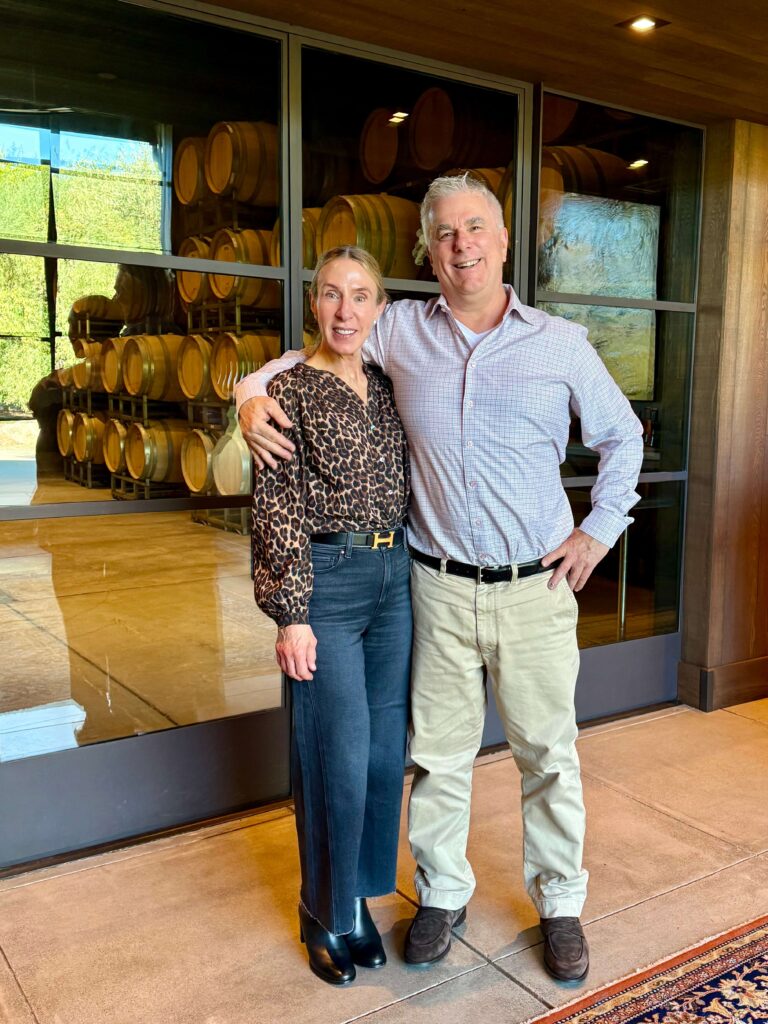
Teresa and Mark Aubert
Although the winery itself is in Calistoga, only one of Aubert’s estate vineyards—Sugar Shack in Rutherford—is in Napa Valley. Sugar Shack, planted to roughly seven acres of the Montrachet clone, is what Aubert calls “the citrus circus” clone for its vivid, high-toned expression. It is one of five estate vineyards owned by Aubert. The remaining four—Lauren, CIX, Park Avenue, and Powder House—sit in the cooler Sonoma Coast, where maritime influence tempers ripening and preserves acidity.
In addition to the estate sites, Aubert sources fruit from several of California’s most respected growers: Larry Hyde & Sons and Hudson in Carneros; UV-SL and UV Vineyard, farmed by the family of the late Ulises Valdez in the Sonoma Coast; and Eastside in the Russian River Valley. These parcels form the backbone of nine distinct single-vineyard Chardonnay bottlings each year, alongside three Pinot Noirs—one from CIX Estate and two from the Valdez sites, UV and UV-SL.
What distinguishes Aubert within California’s luxury-wine landscape is its near-singular emphasis on Chardonnay. In a region where Cabernet Sauvignon dominates production and reputation, Aubert has demonstrated that Chardonnay—when farmed for low yields, picked with precision, and handled meticulously in the cellar—can stand shoulder-to-shoulder with the state’s most coveted reds in both critical acclaim and collector demand.
From the outset, Aubert has been emphatic about the stylistic throughline of his wines: full-bodied, concentrated, and textural, often exceeding 15% alcohol. Yet the wines rarely read as heavy. Their balance and freshness routinely surprise tasters who assume they sit at least a degree lower in alcohol. “The Aubert style has not changed since 2000,” he said. “The Chardonnay grapes are picked at midnight—the coolest time. Then it’s a race against the clock. We want the juice in the barrel within four to five hours.”
This speed is intentional. Aubert employs highly protective handling to retain purity of fruit and avoid oxidative or phenolic harshness. “If you’re not careful with the preparation, you lose the fruit,” he noted. The juice is pressed and transferred directly to barrel without settling. Lees stirring is avoided entirely. Instead, the team relies on naturally long, slow fermentations that can take up to six months to complete. Full malolactic fermentation is embraced for texture and breadth.
Time in barrel is shorter than many expect. The wines age for roughly ten months in French oak—typically a significant proportion new—before being racked to stainless-steel tanks, where they finish élevage. Bottling occurs in December, unfiltered, after approximately fifteen months total in wood and tank. “I treat everything the same to bring out the continuity across the vineyards,” Aubert said. The goal is not to impose a stylistic signature through technique but to allow each site’s character to emerge vividly and consistently.
Across his vineyard holdings, Aubert maintains strict control over yield, clonal material, and canopy management. Vineyard work begins with the assumption that concentration and balance must be established long before harvest. That discipline extends equally to purchased fruit. Many of Aubert’s growers have worked with him for decades, adapting farming to match his expectations for physiological ripeness and acid retention.
Twenty years after its founding, Aubert remains surprisingly focused: no Cabernet Sauvignon, no distractions, and no stylistic experimentation just for the sake of it. Instead, the estate continues to develop a style of California Chardonnay that is boldly rich yet strikingly fresh, guided by precise farming and a cellar approach that emphasizes protection, patience, and consistency. The outcome is a collection of Chardonnays and Pinot Noirs that have earned a reputation as some of the most desirable wines in the country—and that support Mark Aubert’s view that, with the right grapes and coastal sites, California can produce white wines of genuine worldwide recognition.
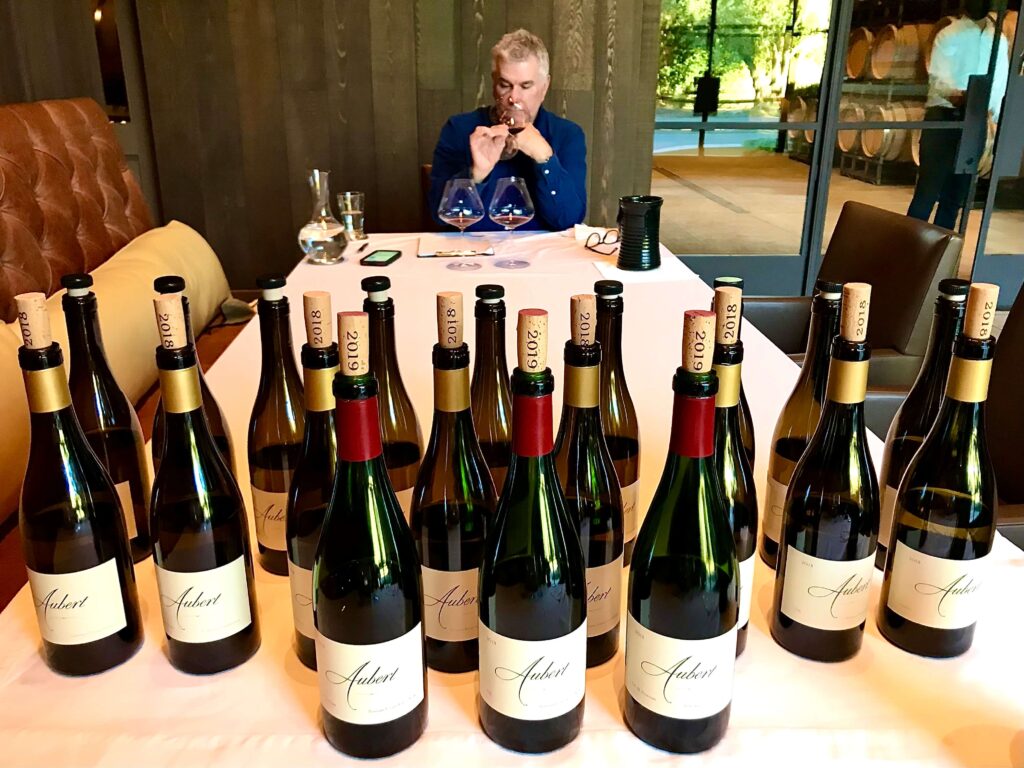
Mark Aubert
The 2020 Vintage
The 2020 Chardonnays were bottled in December 2021.
2020 was a challenging vintage in Napa and Sonoma. Apart from lockdown conditions, it was a relatively hot vintage with a brutal heatwave that hit northern California over Labor Day weekend that year. Then there was the risk of smoke taint from LNU Lightning Complex and Glass fires. Thus far, I haven’t found any 2020 smoke-tainted white wines. This is likely because the white grapes were harvested earlier than the reds and the skin contact during winemaking is minimal.
“Our harvest was very early in 2020,” said Aubert. “Sugar Shack came in on August 17th. I was resistant to adjusting my winemaking in any way. We just kept doing what we do. I’m thrilled with the results. The 2020 Chardonnays all have that healthy yellow-green tint that I love.”
Mark Aubert’s 2020 Chardonnays do not miss a beat and are right up there with some of the finest he has ever produced. But the Pinot Noirs were not so fortunate.
“No single vineyard Pinot Noir was made in 2020,” said Aubert. “Our customers know we would never bottle anything with smoke taint.”
There were two Chardonnay labels that Aubert could not produce in 2020, but not because of smoke taint. “There’s no Eastside or Hudson vineyards in 2020,” commented Aubert. “There was a freak frost event that happened in April 2020. So, we declassified what little fruit we had.”
The 2021 Vintage
“2022 and 2021 were almost identical in terms of vintages for us,” Mark said. “In both years, we were still in a drought. The conditions throughout the growing seasons were very dry. We started picking in August and finished in the middle of September. In 2022, the majority of our fruit was in when the heatwave hit on September 6th.”
2021 was a moderately warm, dry growing season that produced wonderfully intense, effortlessly balanced Sonoma Chardonnays and Pinots.
“There’s a tension and typicity to 2021 that I love and a sweet tone,” said Mark. “We’re really excited about this vintage. The wines are clearly tied to their sites. The 2021s had lower pHs than the 2020s and should age incredibly for 20 or more years.”
The 2021 Pinots were bottled in June 2022. “2021 for the Pinots was easy; everything fell into place. There were drought conditions, so the bunches were small, and the wines have more concentration.”
I found the 2021 Pinot Noirs to be among the finest Aubert has produced.
The 2022 Vintage
2022 was indeed similar to 2021 until it wasn’t. The big difference was the devastating heatwave in early September that year, starting around Labor Day. Temperatures over 100 degrees F held for six consecutive days, spiking at 120 degrees in parts of Napa Valley.
“Yes, it hit the 100+ F temperatures during the day in Sonoma,” replied Mark. “But then cooled down quickly at night. We were careful with leaves covering fruit, and we came off unscathed. We were helped a little by it being a drought because everything rushed to ripeness. But everything was paced out since we started the harvest early. Thank God it was an early vintage! Our vineyards are such that we never want the fruit to be too exposed to the sun to risk sunburn. But the young vines were declassified in 2022. We put this fruit out for bulk. Overall, the alcohols are a little lower in 2022. The late spring rain got more nitrogen in the grapes, so the ferments were very smooth this year. Chardonnay is so adaptable; it can handle the heat. The drought intensified the flavors. And the locations of the vineyards are so important. These 2022s are incredibly fresh. They have all the underpinnings of everything we like. With this vintage, we’re already seeing wonderful clarity in the wines. All the Chardonnays were racked from barrel a week ago and are now in tanks until December. This method has not changed since I started in 2000. My life’s work is to make these Chardonnays that age. They really need five years in bottle to show their best.”
Mark’s Pinot Noirs spend less time in barrel than the Chardonnays. The 2022 Pinots were bottled in June 2023.
“Some people had problems with color for the Pinots in 2022, but not us. The musts had loads of nutrients, and the ferments just took off. It’s a wild ride to watch it go! We do open-top fermentations; we really splash the juice and wine around. We don’t use heavy toast barrels anymore. 2022 has great acidity. We’re very careful with the use of SO2. We want to keep the wines bright but don’t want premox (premature oxidation). Also, from this year, we’re using new, lighter-weight glass for the Pinots. The old DRC-type bottle was just too heavy. We are now using this Champagne green color, which needs to be ordered in advance, but it looks nice.”
I’ve found the quality of Mark’s Pinots to be on an upward trajectory in recent years. Truthfully, I was surprised at how good the 2022 Aubert Pinot Noirs are, given the heat challenges of this vintage.
At the end of the tasting, Mark told me the exciting news that he has purchased two new estate properties, which are currently being developed.
One is a Pinot Noir vineyard in Sebastopol, all planted to Calera clone. Another is in Occidental, two ridges over from the UV-SL vineyard.
“Location, location, location is key for me,” Mark stressed. “I don’t want to make 1er Cru. I don’t want to make AVA. I only want to make Grand Cru. Eventually, we’ll have more estates than growers, but we love our growers.”
The 2023 Vintage
2023 was a growing season anomaly in northern California. It was cool. Following a series of vintages dogged by heat domes, everyone in Napa and Sonoma counties spent much of the summer of 2023 bracing for a scorching heat event that never transpired. There was only a day that barely tipped 100 degrees F in early July in Napa Valley, but otherwise, daytime highs were firmly in the 80s and 90s. On top of the relatively cool temperatures, Sonoma and Napa returned to the foggy summer mornings of yore. Most areas were regularly blanketed with mist from early morning until 10 or 11 a.m.; sometimes, the sun didn’t break through until after noon. In the run-up to harvest, more than a few growers were panicking that the fruit might not achieve full ripeness, but those who had their yields in balance, like Mark Aubert, kept their heads and played it cool.
“The 2023 Chardonnays are some of the best I’ve ever made,” said Mark Aubert. “It’s the vintage. As long as you were very diligent with yields, you could get amazing flavor and intensity in 2023. It was like a long piece of music. Our average hang time was 2 to 4 weeks longer than usual.”
I visited Mark to taste his 2023s just after he had finished putting his 25th harvest to barrel: the 2024s. Much has changed since his inaugural vintage—2000. “We now have five estate vineyards and the best growers,” smiled Mark. “We’re in a good place.”
Among the new wines in the 2023 line-up is an old friend: Hudson Vineyard Chardonnay is back. I have always loved tasting a Hudson next to a Hyde Vineyard—the vineyards are close, and the quality of each is among the best, yet the wines are so different. The 2023 Hudson is impressive for its showy flamboyance, but Aubert’s Hyde Vineyard in 2023 is simply mind-blowing. If I had the 2023 Chardonnay Larry Hyde & Sons Vineyard (from the Hydes’ smaller parcel on the south side of the Sonoma Highway) served to me blind, I would be inclined to guess it a Coche-Dury Corton-Charlemagne. It’s not just the quality of the wine but the style and its insane level of intensity. It’s an absolute must-try!
“The 2023 Park Avenue Estate is the newest Pinot in our family,” said Mark.
Aubert bought the Park Avenue Vineyard in 2013. It’s located right in between the Lauren and CIX vineyards. A neighbor who owned these 12 acres next to Lauren, previously planted with apples, passed away. There is a long road leading up to the vineyard, hence the name Park Avenue. The Chardonnay here is mainly Hyde Clone with a little bit of Montrachet on 101-14 and 420A rootstocks.
“This is an ancient seabed that, unusually, has iron in the profile,” said Mark. “Our Pinot Noir planted here is 100% Calera Clone. This vineyard is in Sebastopol and is the coolest of the Pinot vineyards we farm. We declassified the first two harvests; this 2023 is the first vintage we’ve bottled.”
The 2023 Chardonnays are already well-defined, bright, and expressive—compellingly complete.
The 2023 Pinot Noirs were bottled in the summer of 2024. These are right up there with the very best Aubert has made to date.
As for the 2024 harvest, although it was a warmer vintage and there were a few heat spikes throughout the 2024 growing season with very little fog to speak of, there was one notable similarity between 2023 and 2024.
“2024 was potentially a huge crop,” said Mark. “You had to drop some fruit. Some people will have got caught out. We’re very dogmatic with our growers when it comes to yields. It’s my way or the highway. Our Pinot skins were perfect in 2024. The color came very easily this vintage. We think the 2024 Pinots could be even better than the 2023s.”
That’s saying something because Aubert’s 2023 Chardonnays and Pinots will be tough acts to follow.
Production at Aubert remains relatively small, but there’s hope for more wine for Sugar Shack lovers. “We recently bought another three acres next to Sugar Shack, so production of that will increase,” he told me. “It was only around 500 cases before.”
So, fans can expect more of The Citrus Circus to go around in the future.
The 2024 Vintage
Mark Aubert described 2024 as a vintage defined by balance, purity, and remarkably cooperative weather.
The year’s defining feature in Sonoma was its moderately hot temperatures: no days over 100°F until October, and a consistently ideal August sitting between 90–95°F, never pushing past the threshold that can stress vines or accelerate ripening. “We were done harvesting on September 24,” said Aubert.
For Aubert, this translated directly into the character of his Pinot Noirs. “The Pinots have lots of black cherry and black raspberry characters, yet the acidities are really good,” he said, a combination he attributes to the even ripening curve of the season. As always, the wines are aged in 40–50% new oak, and the 2024 Pinots were bottled in late June and early July of 2025.
Yield management played a crucial role. “The crop was really big in 2024—we put a lot of fruit on the ground,” Aubert explained, emphasizing the strict viticultural discipline that defines the estate. Today, about 60% of production is estate-grown, and he intends for that figure to rise as he continues to refine clonal material and site expression.
Aubert also stresses restraint in the cellar. He believes many producers rely too heavily on sulfur, which “clips” young wines. His approach—native fermentations and careful, minimal additions—preserves nuance and allows Chardonnay’s natural chemistry to shine. He points specifically to glutathione, a naturally occurring antioxidant in Chardonnay, calling it “an important factor in oxidative stability,” which allows for less sulfur use.
Overall, Aubert characterizes 2024 as a vintage of exceptional promise—generous yet controlled, expressive yet balanced.
The 2025 Vintage
Every so often, a California summer simply refuses to misbehave. In Sonoma County, 2025 opened with a wet winter that replenished the soils, followed by a mild spring and an early bloom. Then came the season’s defining feature—a cool, fog-laden July and a moderate August, with none of the scorching spikes that have punctuated so many recent vintages. Ripening proceeded at a stately pace, flavors building ahead of sugars, and only the threat of October rain set pickers hurrying through the final blocks. For thin-skinned Chardonnay and Pinot Noir, it was about as close to ideal as the coast allows.
Mark Aubert summed it up with characteristic understatement: “2025 was a lot like 2023 and 2024. It was a Goldilocks vintage for crop loads.” Pinot Noir yields were down 20% from 2024, “but 2024 was a generous year.” His verdict? “Overall, it was another classic vintage for us!”
The detail that caught my attention, though, was the calendar. “The 2025 harvest dates were very similar to 2016,” Mark noted. Having revisited Aubert’s 2016 Chardonnays alongside the new releases—the Lauren Estate still slowly unfurling a decade on—I take that as a very promising omen.
The 2025 Chardonnays
Tasted ahead of their December 2026 bottling, Aubert’s 2025 Chardonnays marry the vintage’s cool-climate tension with genuine depth. The 2025 Chardonnay Lauren Estate (100 points)—six acres planted in 1999 on an ancient seabed and named for Mark’s daughter—needs a little coaxing before it leaps from the glass with fresh pears, white peaches, lime blossoms, and struck flint; the palate vibrates with electric orchard fruit and finishes with epic length. The CIX Estate, from Montrachet-clone vines where the berries accumulate flavor very slowly, is densely stacked yet taut, while the Russian River Eastside—rocky, gravelly soils where the vines truly struggle—shimmers with sea spray, crushed rocks, and a racy line.
The 2025 Pinot Noirs
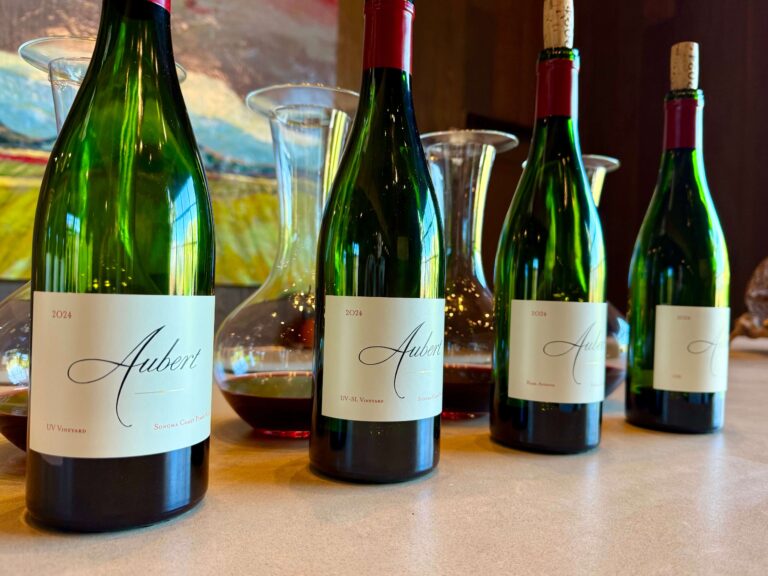
Bottled in late June and early July 2026, the Pinots carry the same fine-boned freshness. The headline is the debut 2025 Pinot Noir Park Avenue Estate, 100% Calera clone grown in Sebastopol, the coolest of the Pinot sites Aubert farms. “We declassified the first two harvests; this is the first vintage we’ve bottled,” Mark explained. It was worth the wait: strawberry-rhubarb pie, roses, and blood orange over crushed rocks, with very fine-grained tannins and great tension. The UV, planted in 2001 by the late Ulises Valdez Sr. on sand and dense clay, is the flamboyant one—black cherries, violets, and blueberry pie—while the UV-SL, just six miles from the Pacific, is tightly wound and earthy.
For Sonoma Chardonnay and Pinot Noir, 2025 is a vintage of poise rather than power—one that rewards patience. At Aubert, the run of classic years continues, with wines built to drink from 2027 through the early 2040s.
Winery Information
Region: USA, California, Napa Valley
Address: 333 Silverado Trail N, Calistoga, CA 94515
Open for Tastings: By Appointment Only
Major Grapes: Chardonnay, Pinot Noir
Vineyard Size: Sugar Shack (Rutherford)—7 acres; Lauren Estate (Sonoma Coast)—6 acres; Park Avenue—12 acres
Own Winery: Yes
DTC Mailing List: Yes
Vineyard Sustainability: NA
Year Established: 1999
Owner: Mark and Teresa Aubert
Winemaker: Mark Aubert
Website: https://www.aubertwines.com
Most Recent Reviews for this Winery
Published: November 2026