
Winery Story
Jericho Canyon Vineyard
A mule track above Calistoga, four years of hand-built terraces, and the winemaker who was put to work in them at the age of six.
The Walls of Jericho Canyon
Old Lawley Toll Road was cut for mules in the late 1800s to haul mercury down from the mines above Calistoga, and it has never entirely forgotten that. It narrows, climbs, doubles back on itself, and just as the asphalt begins to give out, you arrive at a barn, a farmhouse, and a wall of terraced vines rising into the Palisades: Jericho Canyon Vineyard. Your bearings go the way of the pavement, leaving the impression that you’ve left Napa Valley altogether, yet you haven’t. This is prime Cabernet territory.
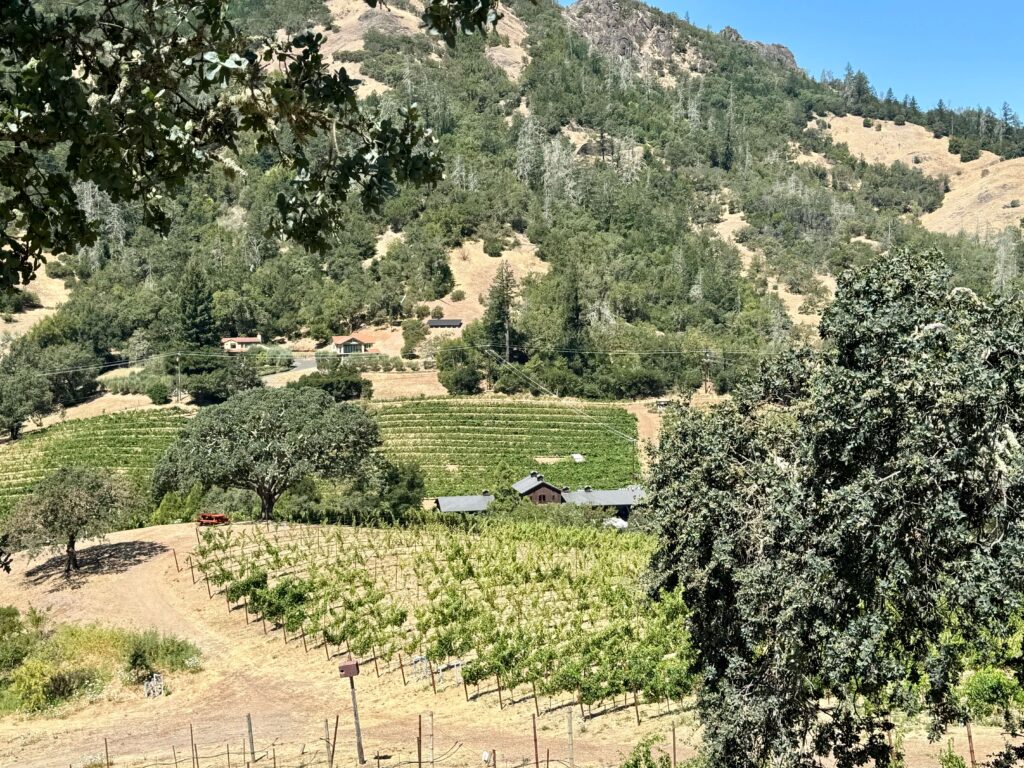
The Palisades—those rhyolitic outcrops that stretch for miles along the eastern ridge like a ruined battlement—close the canyon on one side. Mount Saint Helena fills the other. Jericho Creek takes the low ground between them. The effect is that of a walled room, and it is one of the very few places in this valley where you can stand outside and hear no highway at all.
It is also a wildly improbable place to plant a vineyard.
In the late 1980s, Dale and Marla Bleecher were living in San Mateo with two children and a third on the way. They had met in an Italian class at the University of Oregon and discovered, by coincidence, that both had lived in Italy. Dale had come home from three years there to set chokers and plant trees for the Oregon logging industry before concluding that a degree in Romance Languages might be the softer option. A career in Bay Area finance followed.
“They came to the conclusion that they wanted something different for themselves and their children,” Nicholas Bleecher, that third child, told me. “I think the ‘simpler life’ calls to many people, but few are willing to take the step to make it a reality.”
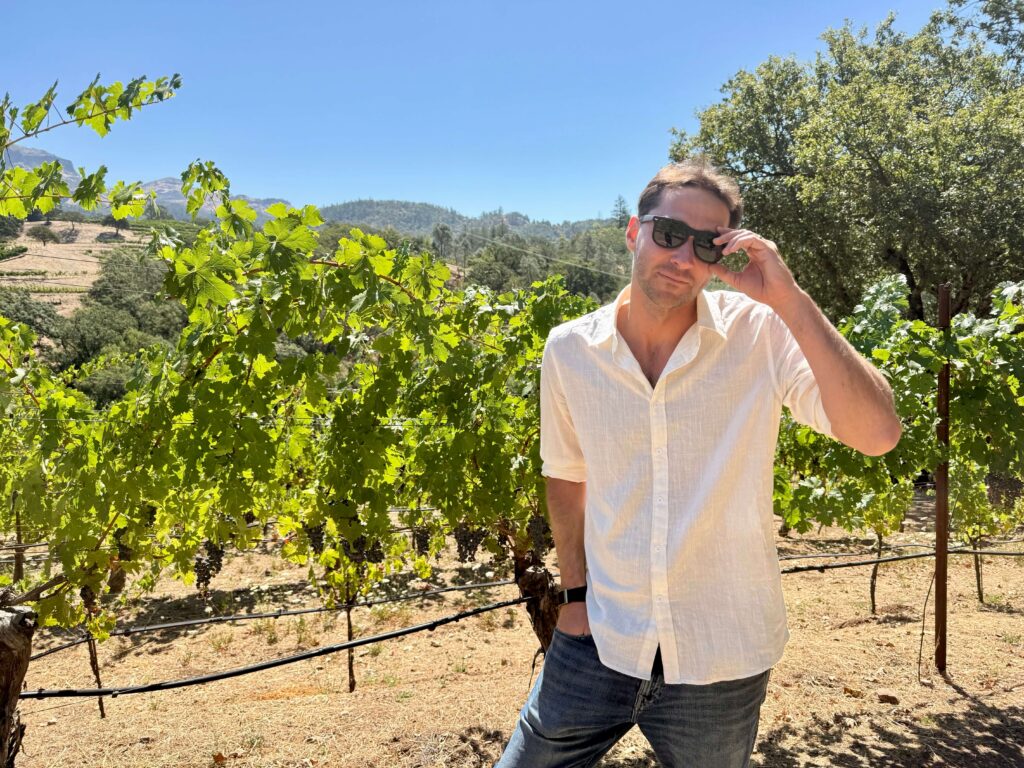
Nicolas Bleecher
The Bleechers took it. They spent three years looking at properties, and it was not an agent or a broker who finally found them what they wanted but a “for sale by owner” listing in the San Francisco Chronicle. One drive up the canyon settled it. In 1989 they bought a cattle ranch: roughly 135 acres to begin with, since grown to 300, along with a barn and a hundred-year-old farmhouse. Three children were moved out of the city and onto a working hillside.
What they had brought back from Italy was a conviction about slope. “At the time everyone was planting on the valley floor and flocking to Oakville flats, so moving to the hillside of Calistoga seemed like an unusual choice,” Nicholas said. “But they had spent a lot of time traveling through Europe, and, following old Italian wisdom, opted for the intensity one can only find in terraced vineyards.
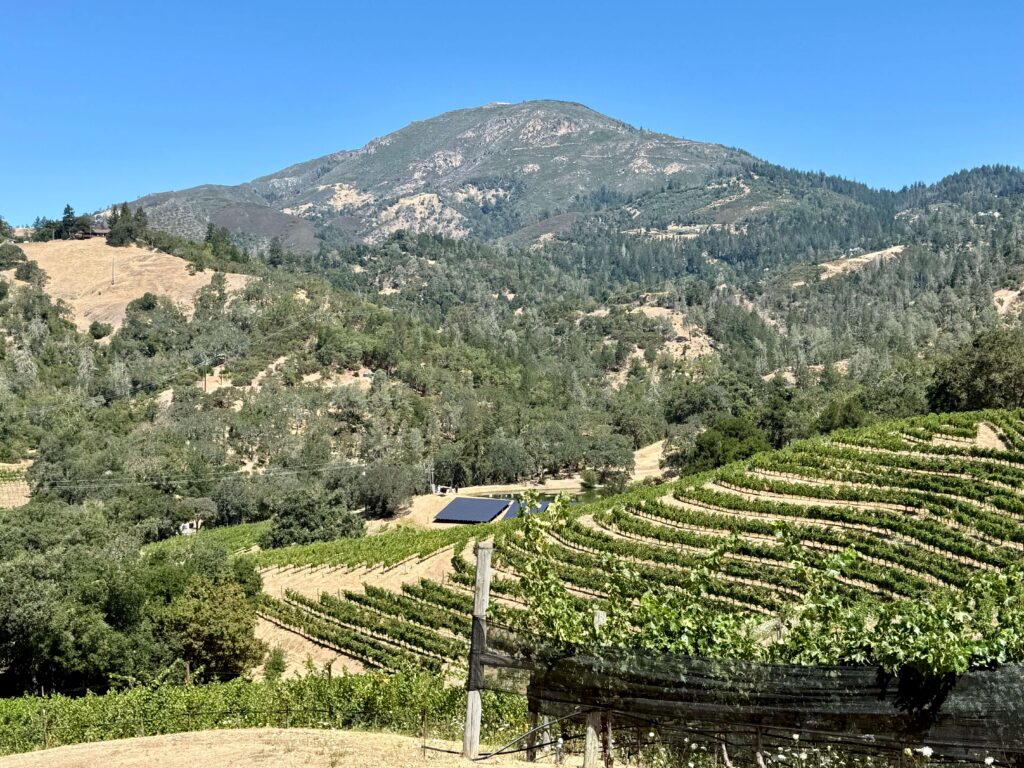
Conviction is one thing. Terracing volcanic rock is another. The Bleechers consulted five different specialists on terracing strategy and engaged a vineyard management company to develop the site. “Each consultant had a different idea, and the vineyard management company didn’t understand hillside development,” Nicholas said, “so in the end my parents put it together on their own.” They went to the Natural Resources Conservation Service for erosion control, to Crop Care Associates and the viticulturist Ed Kelly for planting and nutrition, and then they simply went outside. “The two of them spent four years outside on the hillsides with our original vineyard team, putting together one of the most difficult vineyards in the valley.”
The Vineyard
Of the 300 acres, only about 40 are planted. Close to 70 percent has been left as wildlife habitat. The terraces follow the contours rather than imposing a grid on them, stepping up the slope at intervals of eight to twenty feet, and they are worked entirely by hand. No tractor has ever climbed them. Every vine, every season, receives human attention: pruning, suckering, shoot positioning, thinning, leaf pulling, all of it calibrated to a sun exposure that changes not merely block to block but with every undulation of the hillside.
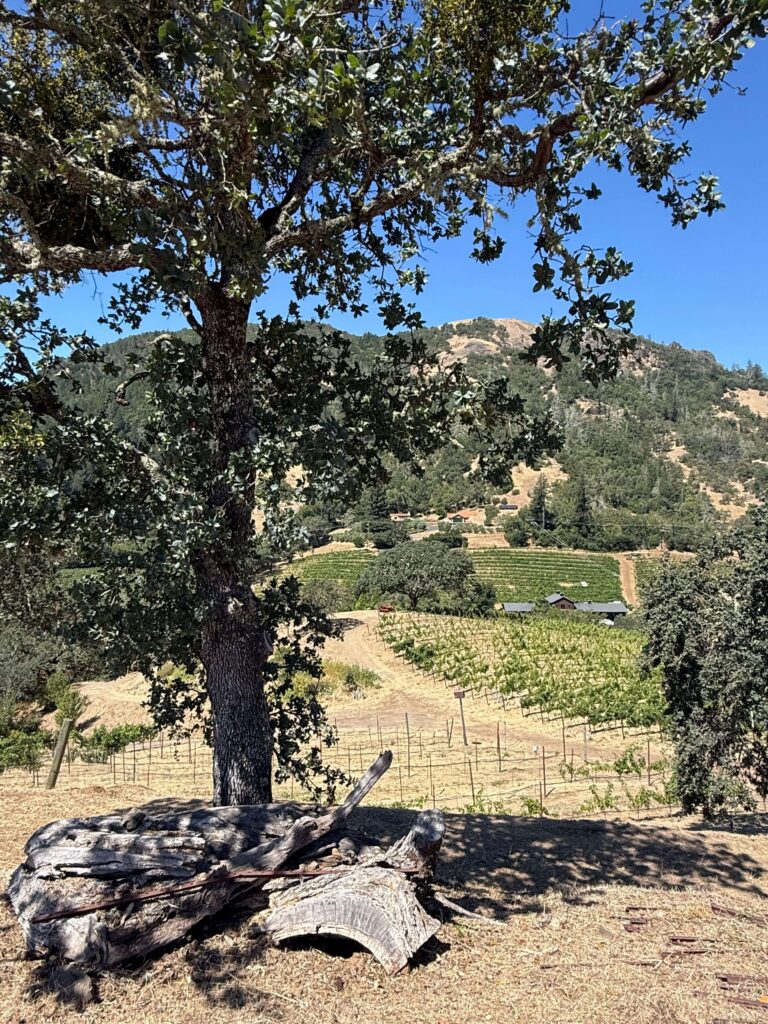
The plantings are mostly Cabernet Sauvignon, with Merlot, Cabernet Franc, Petit Verdot and a little Malbec, the oldest dating to 1989. The soils are volcanic, principally the gravelly clay loams of the Boomer series, thin and free-draining over fractured rhyolite. Yields can fall to around a ton per acre, startling even by mountain standards, and they explain a good deal about the density of what ends up in the glass.
Then there are the temperature swings. Calistoga is celebrated for the amplitude of its diurnal swing, and Jericho Canyon sits at the exaggerated end of that phenomenon. Summer afternoons routinely touch 100°F; the same instrument can read 50°F before dawn, a collapse of 40 to 50 degrees inside twelve hours as marine air is drawn up-valley and settles into the canyon overnight. This is the mechanism that preserves acidity in fruit ripened under punishing heat, and one of the most important facts about the site.
It also produces a counterintuitive harvest pattern. The highest terraces ripen first. The lowest, sitting in that pooled cold air, take an extraordinarily long time, and in some years are not picked until November. The fruit cannot be treated as a single crop and never is: picking runs across many separate dates, and the cellar handles as many as forty individual fermentations in a vintage.
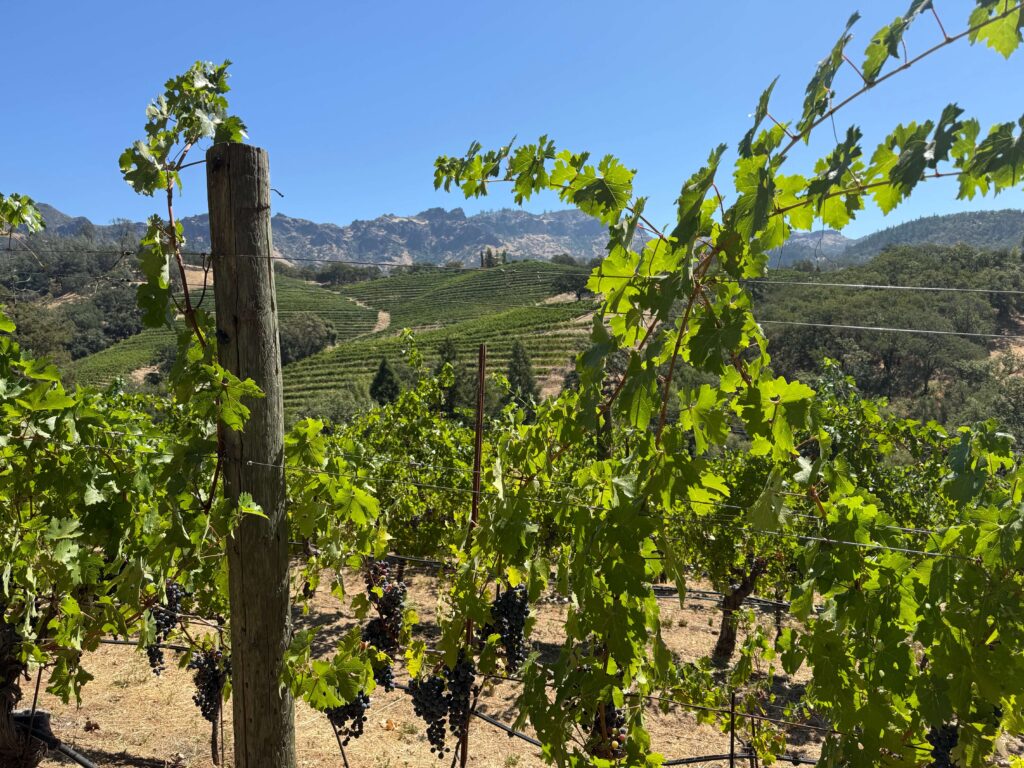
One further advantage is that Jericho Canyon has no real vineyard neighbors. Isolation has spared the estate much of the viral and disease pressure that has worked its way through the rest of the valley. The fires that reshaped Napa’s recent history missed the property in 2017; in 2020 they took the border fencing and left the vines untouched.
During my August visit, whatever grazing grass had come up in spring was a parched golden brown, mown to half-inch straws for fire protection. Nicholas jokes that the beef from those original cattle must have been very tough. Standing on that slope, I could see his point.
The Early Years
When they were kids, all three Bleecher children were required to put in three hours a day through the summers. Nicholas, the youngest, started earlier than most.
“I started working in the vineyard when I was six,” he said. “Needless to say, summer vacation didn’t have quite the same draw for me as other kids. But, looking back, the work ethic and the understanding of the vines and vineyard proved invaluable lessons.”
However, he did not grow up around winemaking. For most of the 1990s, Jericho Canyon was a grower, not a winery, and its client list amounted to a form of endorsement—fruit went to Chateau Montelena, Sterling, and Rudd, and David Ramey recognized what the canyon could do in the late 1990s and made vineyard-designated bottlings that became flagship reds for both Rudd Estate and Ramey Wine Cellars. The family began holding fruit back for itself in the early 2000s. The classically styled redwood winery and its adjoining caves were not completed until 2006, the summer Nicholas finished high school.
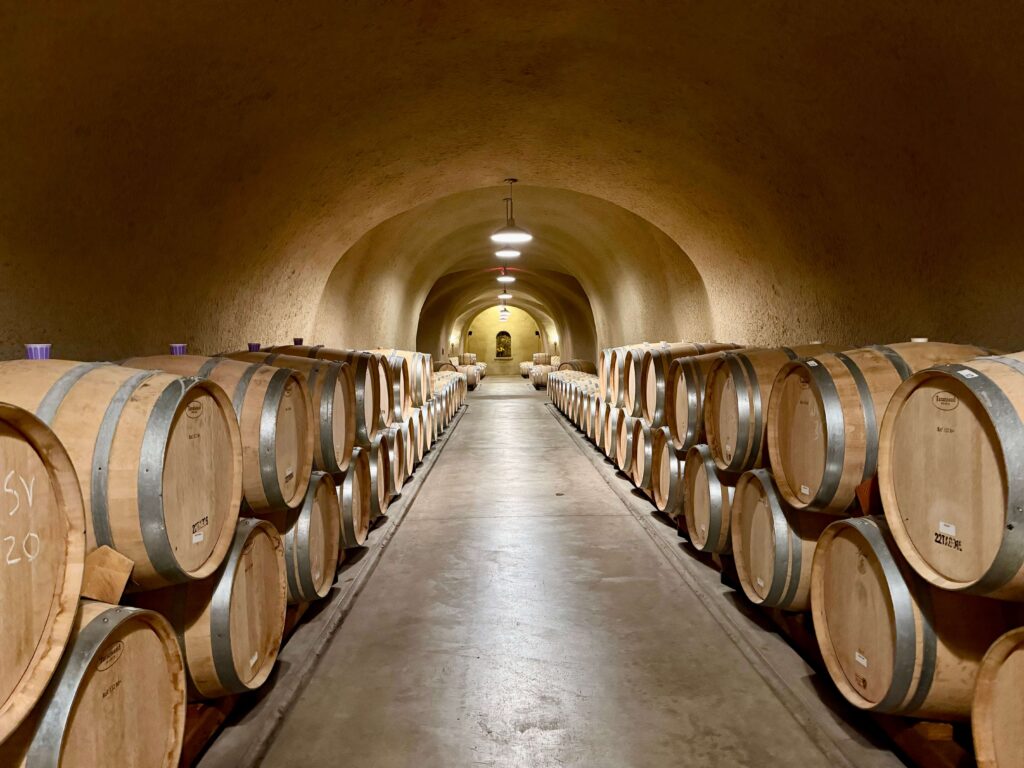
“Heading into my first year at UC Davis, I got to see the first estate harvest,” he said, “and, between weekends at the winery and my time at school, I was drawn in.”
He graduated from Davis in 2011 with degrees in viticulture, enology and managerial economics, and the plan was the conventional one: harvests abroad, then Bordeaux. The plan lasted about a year.
“The year I graduated from UC Davis, our assistant winemaker let us know he had taken a head winemaker job at a neighboring winery effective at the end of harvest, so my parents asked me to come try to learn as much from him as possible before he left to smooth any transitions.” That done, Nicholas left for New Zealand and a season at Pask in Hawke’s Bay. While he was away, his parents hired Aaron Pott as head winemaker; shortly after his return, Michel Rolland joined as well.
What he came home to was an unusually dense concentration of talent under one roof. At that point, roughly half of the winery’s production was custom crush. “Along with Aaron and Michel for our wine, we were crushing for Heidi and Bo Barrett for their personal labels and Thomas Brown, who was making The Grade,” he said. “While I had been intending to move on to a Bordeaux harvest after New Zealand, I realized the best opportunity available was learning from some of the top names in Napa all under one roof, so I decided I’d do a European harvest ‘next year.’ That was 2012.”
He never left. He took over Sauvignon Blanc production in 2013, started the rosé the same year, and assumed responsibility for all red production after the 2015 harvest. His eldest sister has since joined the business.
The Rolland appointment nearly didn’t happen. In 2012, when the Bleechers were hiring, a colleague suggested they meet him. “Given his reputation, my parents assumed his rates would be more than they were willing to spend, so they moved forward with hiring Aaron Pott,” Nicholas said. “They did, however, leave the door open and said if Michel was willing to meet, they would welcome the meeting.”
He was willing. The day after Nicholas got back from New Zealand, the family walked Rolland around the property and opened a few vintages. “As you know, he was one of the most genuinely pleasant people you can meet,” Nicholas said—and I did know, which makes writing about him in the past tense, after his death this March, that much sadder. Towards the end of the meeting, curiosity got the better of them, and they asked how he chose his clients.
“If I want to work with someone, I will give them a good price.”
Whether it was the property, the wines, or people chemistry, he wanted to work with them. What he brought was perspective. “Having worked in regions all over the world, in all sorts of conditions, Michel had the breadth of knowledge to address all sorts of situations that we felt were unique to us on our vineyard site in Napa, but were not unique to the world of wine.” That is as concise a statement of the value of a consultant as I have heard, and it cuts against the usual caricature of the flying winemaker imposing a house style.
At Jericho Canyon, the problem handed to Rolland was the oldest one in mountain viticulture: tannin. Rolland’s answer was barrel fermentation, and they began with a trial of four.
“Barrel fermentations are not easy,” Nicholas conceded. “What could be a single four-ton ferment becomes 16 individual fermentations, taking up an incredible amount of floorspace and time for cap management and monitoring.”
Total production at Jericho Canyon is around 2,000 cases, sold almost entirely direct to consumer. “Ten months of the year I take care of all our wine without assistance. But two months during harvest I have two or three interns to help me, and we’re still working 14-hour days to keep up.”
The result is a textural one, best described in his own words: “Rather than layering textures, oak and hillside tannin are able to strike a harmonious integrated balance when married from the start.” Anyone who has tasted enough mountain Cabernet will recognize what he is describing—the sensation of oak sitting on top of tannin. Fermenting in barrel dissolves the seam.
He has, however, allowed it to become a formula. “Nothing is set in stone. Certain areas of the vineyard express better with barrel fermentations, others a more classic approach, some extended macerations.” In some years, there have been more than 100 barrel ferments—enough to make every wine in the range entirely from them. “But, in the end, it’s all about what makes the best blend.”
Today, the Jericho Canyon red wines are between 50 and 100 percent barrel-fermented, depending on the vintage.
After the 2014 harvest, the family decided it was time to replant. Nicholas best summarizes the whole enterprise: “Growing vines on rock, while great for concentration, is an excellent test of patience.”
Since 2015, they have pulled and replanted one block a year. “By the time we finish block 20, it will be nearly time to begin replanting again.”
They started with the Cabernet Franc, which had an immediate consequence: Chimera, the estate’s Bordeaux blend, lost a component. Rather than patch it, they went the other way. “We decided to create something truly unique to us and split the wines into separate bottlings of Western and Eastern exposure fermentations. Same clones, same soil structure, similar vine ages, a few hundred feet apart, but one true Western and one true Eastern exposure. While we intended it to be temporary, as the blending varietals regrew, the wines have proven too unique year after year.”
Chimera is now returning alongside them, in very small quantities.
The Wines
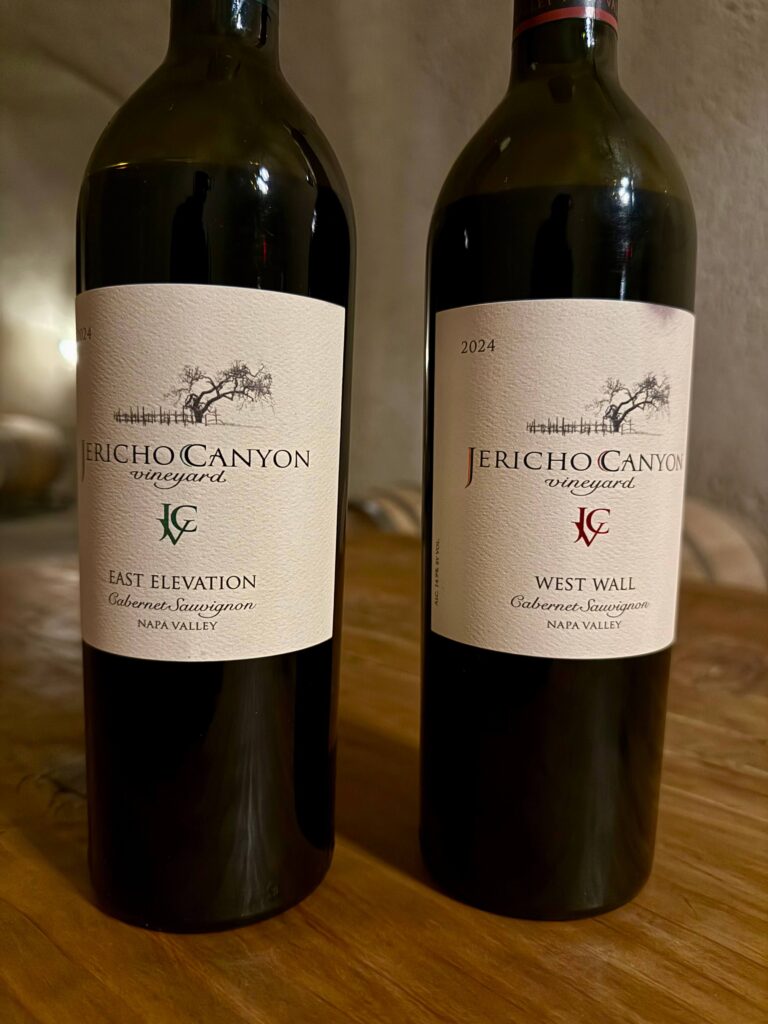
The range is organized around exposure, which is the most transparent way to read a canyon. East Elevation comes from terraces that take the morning sun and ripen slowly, giving the darker, firmer, more muscular expression. West Wall faces into the full heat of the afternoon and ripens earlier. Chimera, true to its name, blends Cabernet Sauvignon with Cabernet Franc, Merlot and Petit Verdot from across the estate.
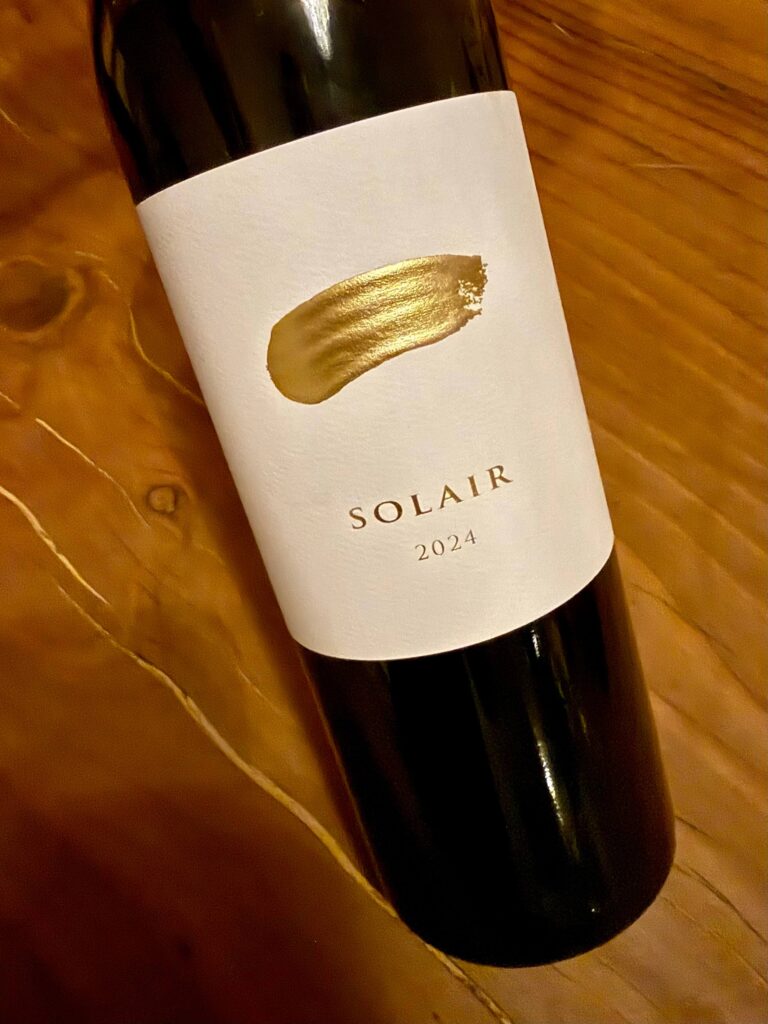
Above these sits the Reserve, which began as a selection from two blocks that consistently stood apart and has since become a barrel selection—the lots, as Nicholas puts it, that really shouldn’t be blended away. It is not made every vintage, on the principle that the other wines should not be sacrificed to it, which is a discipline more estates should adopt and fewer do. Solair goes further still: a selection of just two barrels, one from the lower bench soils and one from the upper rocky terraces, produced only in years the family considers exceptional.
The Sauvignon Blanc is sourced from Ryan’s Vineyard in Oak Knoll, fermented in stainless steel and neutral French oak and aged seven months on its lees. The Estate Rosé is a direct-press blend of mainly Cabernet, with no skin contact at all, fermented in neutral oak and aged in stainless steel.
As for the reds, the style strikes me as a compelling cross between Howell Mountain and the Calistoga valley floor: firm, fine-grained tannins wrapped around dense, muscular black fruit, with the acidity that only a nightly plunge in temperature can account for. They are not wines to be enjoyed too early, which bucks the valley’s trend. Give the Cabernets 4 to 5 years in bottle, at least, and a decade should be the sweet spot.
The Walls Are Holding
I have never entirely trusted the phrase hidden gem, which usually turns out to be neither. But there is something about the geography here that resists ordinary descriptions of this valley. Jericho Canyon is not visible from the Silverado Trail, nor is it on the way to anywhere. Following the less-traveled old mule trail, however, has led the Bleecher family to a terroir uniquely spectacular for producing cellar-worthy Cabernet of a style all its own.
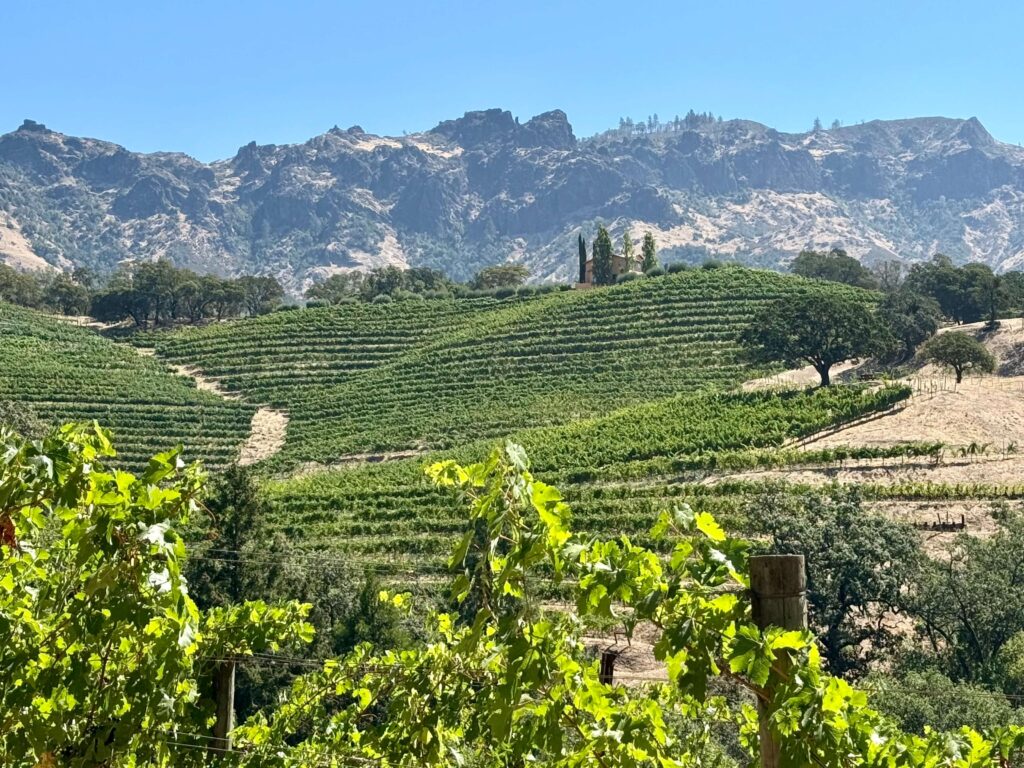
What this site has is a family that spent four years building terraces by hand, a winemaker who was pruning at six and, for ten months of the year, is the only person in the cellar, and a replanting schedule that will run until he is old and, hopefully, his children take over. The Cabernet Sauvignons are built like the site: vertical, tannic, slow to open, and among the best in the valley. Production is small, yet the wines are singularly stunning and worth the hunt. Almost everything is sold direct-to-consumer.
Winery Information
Region: USA, California, Napa Valley, Calistoga
Address: 3322 Old Lawley Toll Rd, Calistoga, CA 94515
Open for Tastings: By Appointment Only
Major Grapes: Cabernet Franc, Cabernet Sauvignon, Merlot, Sauvignon Blanc
Vineyard Size: 40 acres
Own Winery: Yes
DTC Mailing List: Yes
Vineyard Sustainability: NA
Year Established: 1989
Owner: Dale and Marla Bleecher
Winemaker: Nicholas Bleecher
Website: https://jerichocanyonvineyard.com/
Most Recent Reviews for this Winery
Published: August 2026