
Winery Story
Château Mouton Rothschild
A First Growth built on gravel, grit and art — and on a century-long argument that it should never have been a Second.
The Sheep with the Golden Fleece
Studying the gold-enameled ram etched onto a bottle of Château Mouton Rothschild 2000 always sends me back to the Greek myth of Jason and the Argonauts, and to that hero’s quest to obtain the fleece of a golden-haired ram. The gilded sheep does not feature much in the tale itself, although one version of the backstory relates how the ill-fated creature was sacrificed to Poseidon and thereafter immortalized as the constellation Aries. The fleece from the carcass was kept, treasured, and heavily guarded by a never-sleeping dragon. At the age of 20, it was Jason’s coming-of-age task to take the Golden Fleece in order to become king.
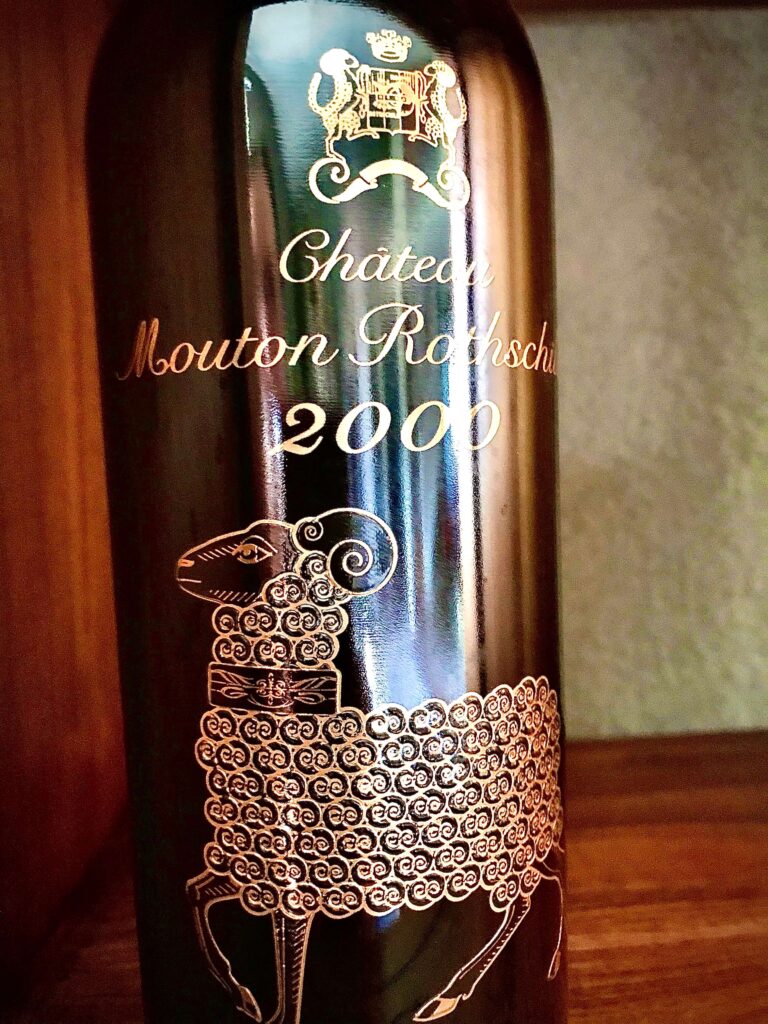
There are many interpretations of the symbolism behind Jason’s journey. But the prevailing one is that the fleece represents the pursuit of power, authority, and, ultimately, leadership. Were it told a couple of thousand years later, this might have made an apt parable for the journey of Baron Philippe de Rothschild, who was also 20 years old when he accepted his own such quest.
Curiously, the “Mouton” part of Château Mouton Rothschild’s name is not sheep-related, as a direct French translation might suggest. Rather, it is linked to the land. It is believed to be a play on words relating to the old French term motte or mothon, meaning a mound or hill, highlighting from the get-go the importance of Mouton’s mounds of deep gravel. Managing CEO Philippe Sereys de Rothschild, grandson of Baron Philippe and son of Philippine, corroborates this, informing me that there are historic records of parts of the vineyard carrying the actual name “Mouton,” referencing the lay of the land, in the way parcels were usually named in the 18th and 19th centuries. The “Mouton” barrel of the estate’s double name, in fact, predates the Rothschilds’ ownership entirely.
1700-1855
Vines were first planted in the early 1700s on the land that is now the backbone of Mouton Rothschild’s vineyards. The estate was part of a collection of high-profile holdings across Pauillac and Saint-Estèphe owned by Nicolas-Alexandre, marquis de Ségur (1695–1755), which included not only Mouton but also Lafite, Calon-Ségur, Latour, and Pontet-Canet. He is credited with delineating Lafite from Mouton, acknowledging their very different terroirs — a distinction that remains obvious to anyone who has ever put the two neighbors side by side in the glass.
In the early 1800s, the estate belonged to Hector de Brane, who named it Brane-Mouton and eventually sold it to a Parisian banker, Isaac Thuret, for what was then a vast sum, in order to purchase Brane-Cantenac. That ownership did not last long, and it is reputed that Thuret did the vineyard no favors, allowing it to fall into a state of disrepair that would no doubt affect its standing in the forthcoming 1855 Classification.
Nathaniel de Rothschild — of the English branch of the family — bought the property at auction in 1853 and renamed it Château Mouton Rothschild. Two years later, the brokers of Bordeaux, working to Napoleon III’s decree and to a ledger of average selling prices, ranked it a Second Growth. Why is still argued over. The neglect under Thuret is one theory. The awkward fact that the estate had just passed into foreign hands is another. Whatever the cause, the ranking would take 118 years to put right, and the effort to do so would define the character of the man who inherited it.
The Baron who would not be told
The party did not really start at Mouton until Baron Philippe de Rothschild took over its management in 1922, when he came of age at 20 and because none of his siblings were particularly interested in it. By all accounts, Baron Philippe had, to the chagrin of his father, something of an unruly, bohemian side. A poet, a Grand Prix racer (he competed in Bugattis under the pseudonym Georges Philippe), a playwright, a theater director and a film producer, his greatest passion, vision and achievements were nonetheless devoted to making something of the family’s wine estate in the Bordeaux countryside, which until then had been of only passing interest to everyone else who owned a share of it. Upon the death of his father in 1947, Philippe would put his stake firmly in the Pauillac ground and buy out his siblings, becoming sole owner of his treasured Mouton.
As a fun aside relating back to that golden sheep, it was the Baron who first associated the château’s now iconic ram with the name “Mouton,” which of course means “sheep” in French. The family had been collecting sheep-themed art for many years prior to this, so the connection apparently had more significance than a simple adoption of the literal meaning of the name. And the fact that Baron Philippe was an Aries no doubt influenced his decision to create a coat of arms encompassing the pre-existing five-arrow Rothschild symbolism within the grasp of two ornate golden rams.
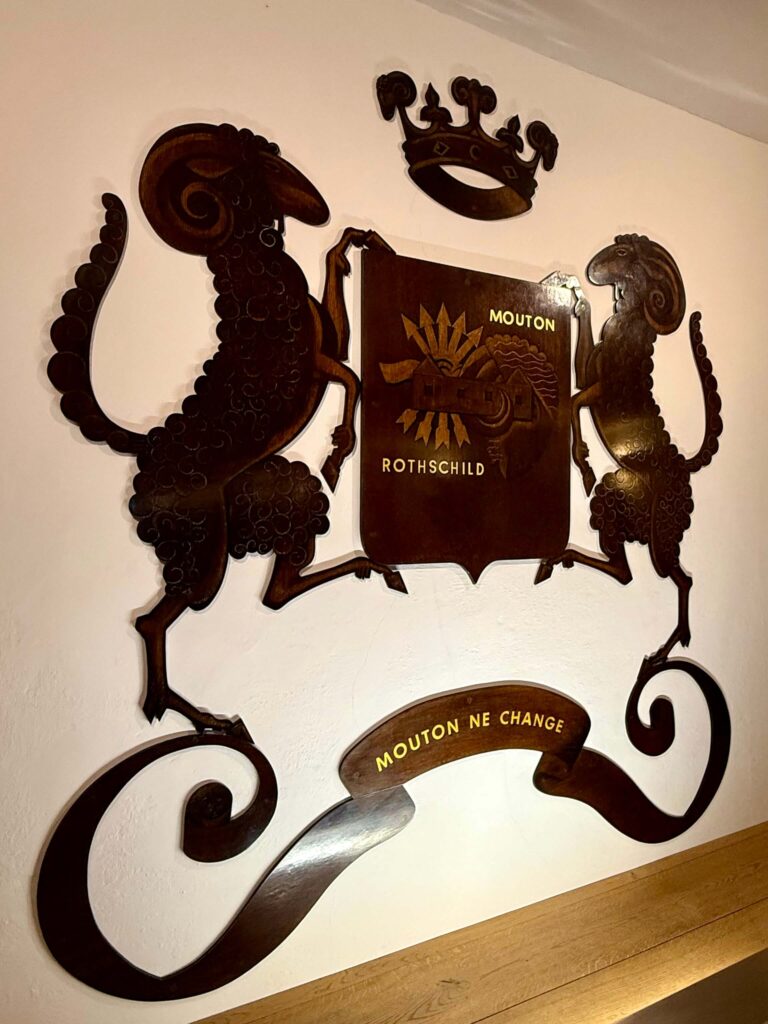
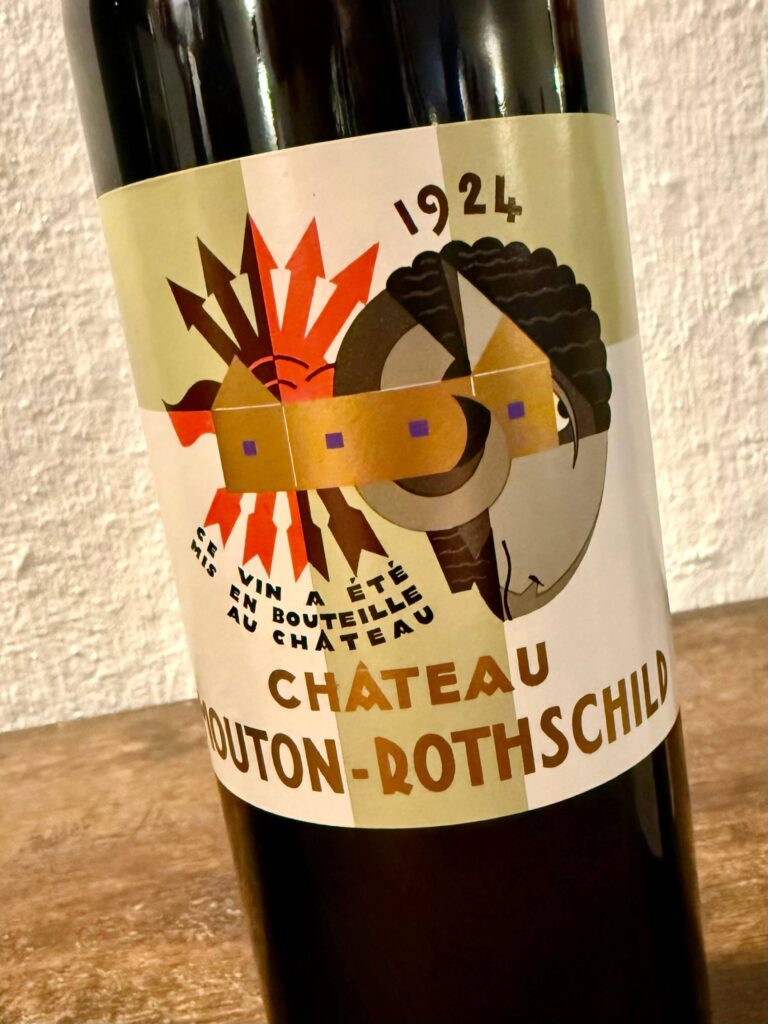
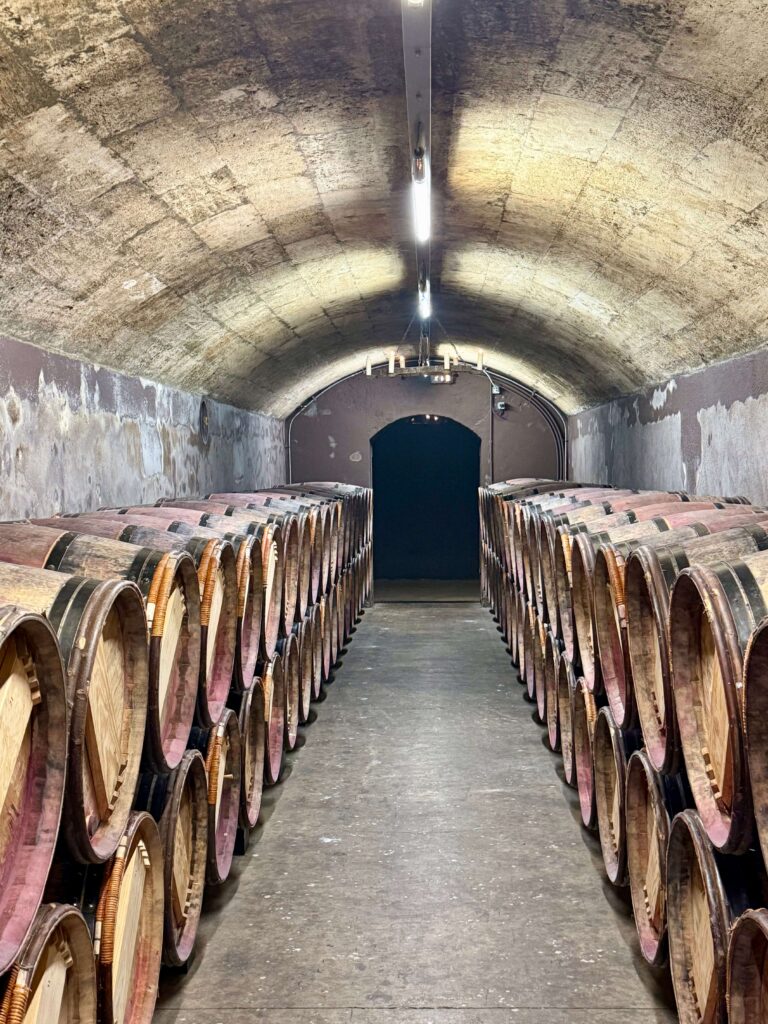
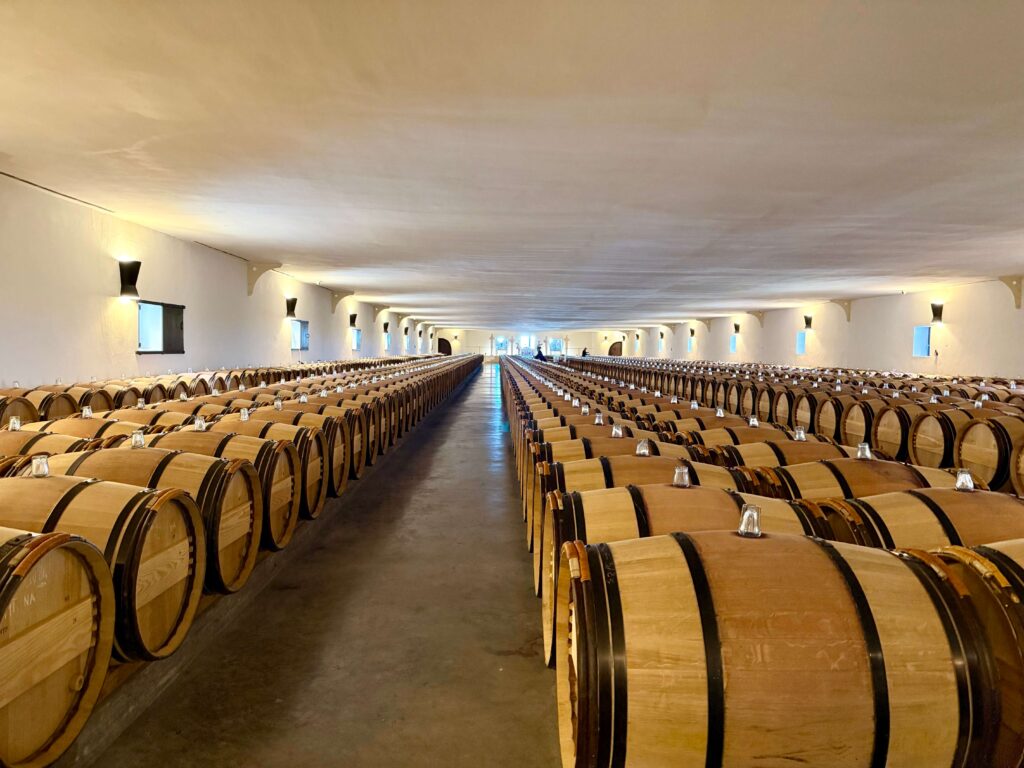
It did not take long for him to embark on a series of visionary changes that would transform the quality and reputation of the estate. Notably, from the 1924 vintage he became the first major Bordeaux château to insist on bottling the entire production at the property — and to say so on the label. (Previously it was common for wines to be shipped in barrel and bottled by négociants and merchants abroad, during which time quality could be compromised and blending with other wines could occur.) To announce this radical move, he commissioned the poster artist Jean Carlu to design the label, who delivered a Cubist ram. The public did not know what to make of it, and the label experiment was shelved for twenty-one years. Bottling at the property, however, created a storage problem, and in 1926 the Baron solved it with the Grand Chai: a single, unbroken, 100-meter barrel hall designed by the architect Charles Siclis, still one of the most theatrical spaces in Bordeaux and, I would argue, the first great piece of wine architecture anywhere.
He was not finished. Mouton Cadet arrived in 1930, born of a difficult run of vintages and a decision to declassify rather than dilute, and went on to become the most successful Bordeaux brand in the world. In 1933 he acquired neighboring Château Mouton d’Armailhacq — which came with a small Pauillac trading house that would grow into Baron Philippe de Rothschild S.A. — and in 1970 he added Château Clerc Milon.
1945
Baron Philippe had just one child, Philippine, born in 1933 to his first wife, Elisabeth Pelletier de Chambure, a Catholic aristocrat. True to his passionate, untamable nature, the marriage was not without scandal, and it was not long before they separated. When the Germans occupied France, both were arrested, and Mouton was sequestered. Philippe escaped, made it to England, and joined de Gaulle’s Free French. Elisabeth believed she and their young daughter would be safe in France, since she was Catholic and had reverted to her original name. When the Gestapo came for her in 1941, Philippine, then a child, was spared by an unexpected twist of fate. Elisabeth was deported to Ravensbrück, where she died on 23 March 1945 — the only member of the Rothschild family to be murdered in the Holocaust.
I mention this dark period in Mouton’s history because I cannot imagine the impact it must have had on Philippine growing up, and how it would have shaped the woman she was to become. I met her just once, in 2001, at a small luncheon at the château hosted for the visiting staff of the UK distributor I was working for at the time. I recall marveling at the seamless execution of this small but nonetheless formally managed event. The Baroness’ impeccable composure was mesmerizing. A complete nobody, I must have come across as the French equivalent of a bumpkin, but Philippine assumed nothing, taking the time to ask me questions about who I was and how I had fallen into this life. Amidst all that assumed duty and ceremony, I was taken by how she seemed irrepressibly drawn to the drama and overwhelming power of the unexpected.
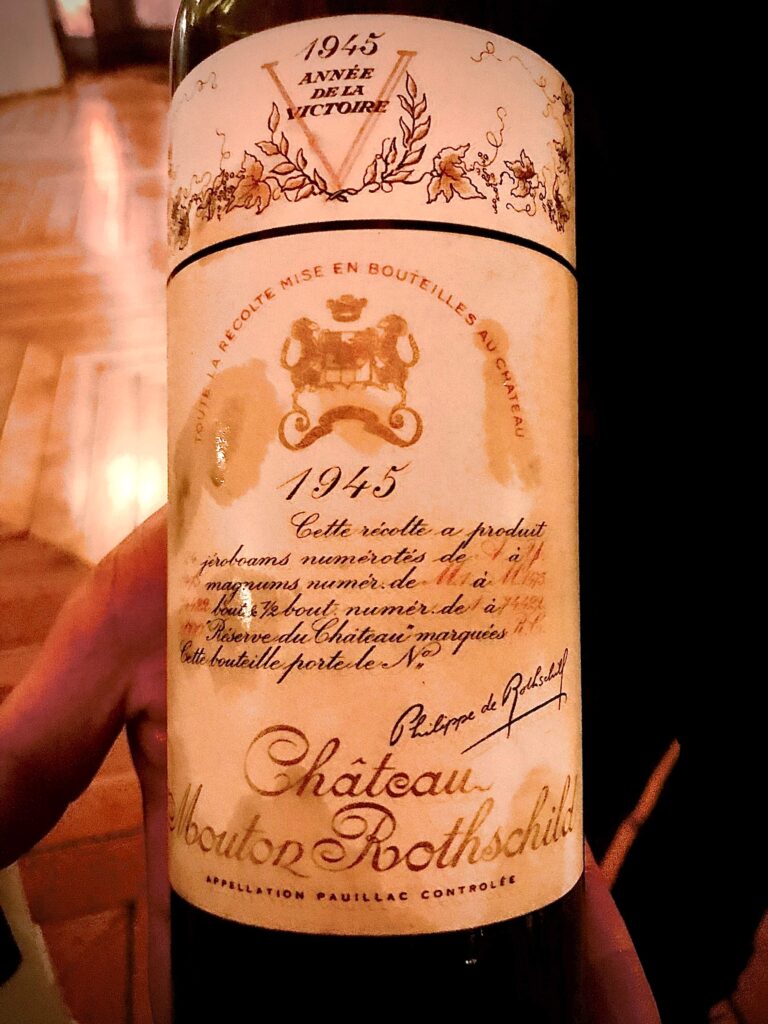
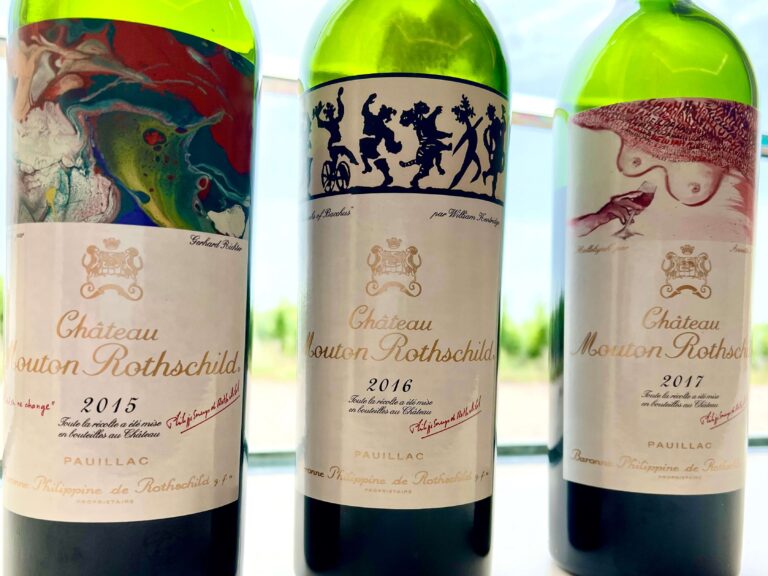
The estate was returned to the family late in 1945, the same year that produced what is still, by common consent, the greatest wine Mouton has ever made. May frost cut the crop savagely; a hot, dry summer and an untroubled harvest did the rest. To mark both the vintage and his return, the Baron commissioned a label from Philippe Jullian, a young and then-unknown artist he had met in England during the war. Jullian submitted several designs, some heavy with tricolores. The Baron chose the one built around Churchill’s V for Victory, because he wanted to thank the Allies rather than congratulate France. The response was such that the idea he had abandoned in 1924 became permanent policy: since 1945, every single vintage of Château Mouton Rothschild has worn an original artwork.
“We’ve done it”
Perhaps the Baron’s greatest achievement, though, was persuading the French state to amend an unamendable document. Mouton had been ranked a Second Growth in 1855 and Baron Philippe firmly, passionately believed it was of First Growth standard. He called the ranking a monstrous injustice. Once he had decided it had to be corrected, he was relentless, even though the rigid 1855 Classification had never been meaningfully altered since its inception — and, to this day, still never has been again.
“He started in 1963 — when I was born — to lobby for the First Growth,” Philippe Sereys de Rothschild told me. “They had a whole administrative process — exactly as it was done in 1855 — they recreated the whole thing. All the tastings, visits to the property, up through the INAO — the whole process was very long. My grandfather knew it would happen before it was official, before 1973. President Jacques Chirac was the guy who actually signed the document.”
Chirac was, at the time, Minister of Agriculture; the presidency was still two decades away. The decree took effect on 21 June 1973, and in the 170 years since the brokers drew up their list, Mouton remains the only château ever to have its rank formally changed.
When I asked Philippe Sereys how his grandfather felt when he had finally succeeded, he laughed. “He was relieved, but everybody was relieved, because he was harassing EVERYONE! It was a relief for everyone. He was calling people again and again — it was relentless. They were lucky there was no iPhone or WhatsApp at that time. Afterward, so many people told me they were relieved.”
“Did he throw a huge party?” I asked. “No,” replied Philippe Sereys. “I remember my grandfather came into the room, and he simply said, ‘We’ve done it.’ That was it. He was like that. Then he would just say, ‘What’s next?’”
The victory was recorded on the label, of course. Until 1973, Mouton’s motto had been a magnificent piece of aristocratic sulking: Premier ne puis, second ne daigne, Mouton suis — first I cannot be, second I do not deign to be, Mouton I am. It was replaced with Premier je suis, second je fus, Mouton ne change: first I am, second I was, Mouton does not change. The artwork chosen to carry it was a Picasso Bacchanale from the Baron’s own collection, used in tribute after the painter’s death that April. There is something perfect about the fact that Mouton’s most famous declaration of constancy was minted in the year of the single greatest change in its history.
Philippine, and the art of collecting artists
By the early 1970s, Philippine had three children by two marriages and was becoming more and more involved in her father’s wine business. Upon Philippe’s death in 1988, his daughter shifted gears from accomplished actress and lover of the arts to formidable wine empire heiress. She was now responsible for Château Mouton Rothschild, Château d’Armailhac and Château Clerc Milon, as well as Mouton Cadet, and partner in the joint ventures Opus One, Almaviva and, later, Domaine de Baronarques.
Her own additions to the Mouton range were both quietly radical. In the early 1980s she revived a nearly extinct Médoc tradition by planting white varieties, and in 1991 released the first Aile d’Argent — seven hectares of Sauvignon Blanc, Sauvignon Gris, Sémillon and a whisper of Muscadelle, an island of white in a sea of red. The name comes from a story her father wrote for her while he was imprisoned during the war, published by Gallimard in 1947, which I find almost unbearably moving as a way to christen a wine. Then, in 1993, came the second wine, initially released simply as Le Second Vin and from 1994 as Le Petit Mouton de Mouton Rothschild, named for the small house on the estate where Philippine lived.
Perhaps her greatest contribution to the Mouton legacy, though, was significantly upping its artistic game. Philippine clearly saw the historical relevance and brand value behind the vintage-specific labels. While the first few commissioned by her father were created by relatively unknown artists, as the reputation of the wine grew, so did the caliber of the names: Miró, Chagall, Braque, Dalí, Picasso, and then Warhol, Keith Haring, Francis Bacon, Lucian Freud, Jeff Koons, David Hockney. In 1981 she organized the first exhibition of the original paintings, and it became her responsibility to find the next iconic artist each year. Artists are not paid in money, incidentally, but in wine: five cases of the vintage they illustrated, and five of any vintage they care to choose from the cellar.
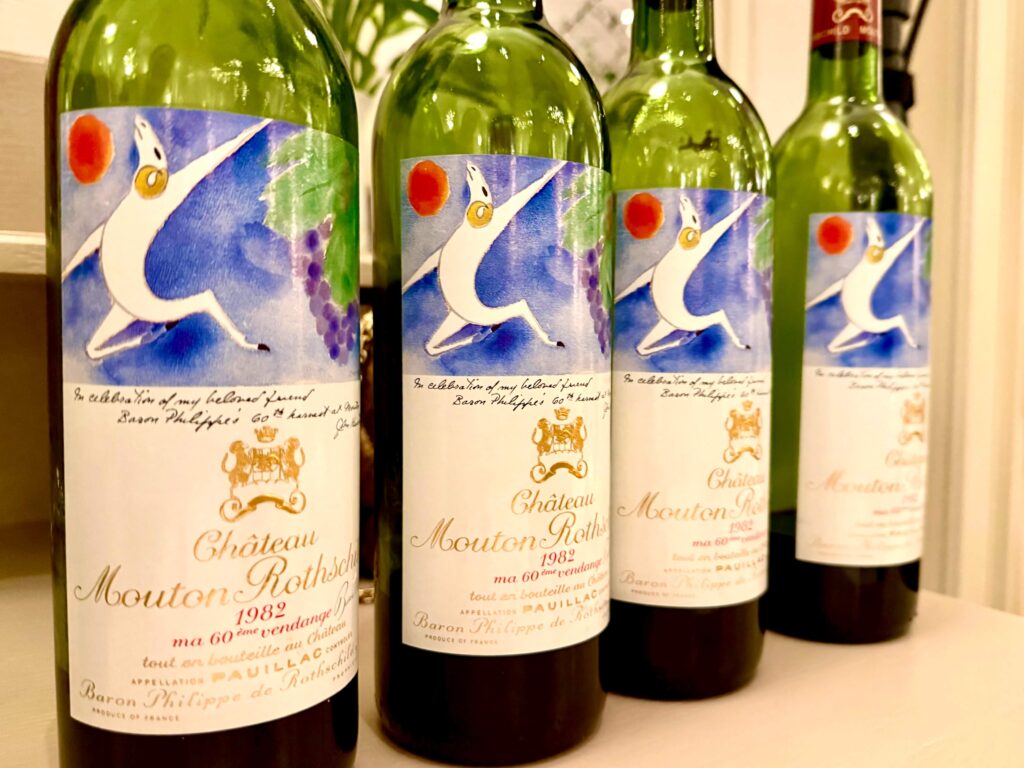
Equally as intriguing as the works of art themselves — at least for story gannets like me — are some of the tales of Philippine’s adventures retrieving the commissioned labels from the artists. Because artists can be, well, notoriously eccentric at best, if not downright difficult. Julien de Beaumarchais de Rothschild, Philippine’s youngest child by her second marriage, now Vice-Chairman of Baron Philippe de Rothschild S.A. and largely responsible for the label commissions as well as new art procurement, shared a few of these with me. When I told him my favorite Mouton label was the wantonly leaping sheep on the 1982 — perhaps also because I love the contents so much — he laughed and told me it was one of the few not done by a dedicated, professional artist. It had not occurred to me until then that the painter, John Huston, is the same John Huston who directed The Maltese Falcon, The African Queen and The Man Who Would Be King. Philippine was charged with collecting the artwork from Huston, where he was then staying in Mexico. Once she arrived, she was informed she would have to wait until he had finished it. A number of days passed, and still she found herself stuck in Mexico by herself, doggedly unwilling to leave until she had the 1982 label in her possession. Eventually, she did. I like to imagine she felt a bit like that joyous sheep, leaping to escape Mexico, making off with what was to be one of Huston’s last paintings.
Philippine died in 2014. The estate is now shared between her three children — Camille, Philippe and Julien — and chaired by her eldest son from her first marriage, to the actor and theater director Jacques Noël Sereys.
The mound itself
For all the art and the argument, none of it would have amounted to anything without the gravel. Mouton’s roughly 84 hectares of vines sit almost entirely on the plateau de Mouton, a croup rising to a positively Alpine 27 meters above sea level. Beneath the vines lies several meters of deep Günzian gravel — stones carried down from the Pyrenees by ancient glacial rivers — over a base of clay and limestone with pockets of sand and marl. It is poor, thin, savagely well-drained soil that offers a vine almost nothing and therefore forces it to go looking, sometimes many meters down.
The Médoc, as its name suggests, sits in medio aquae: amid the waters, with the Gironde estuary to the east and the Atlantic to the west, on a narrow strip of land some 80 kilometers long and rarely more than 10 wide. The estuary irrigates the soil at depth and moderates temperature swings; the Landes forest to the west blunts the ocean’s worst behavior. It is a set of accidents that happens to suit Cabernet Sauvignon better than almost anywhere on earth, which is why Mouton is planted to roughly 81% of it, with 15% Merlot, 3% Cabernet Franc and 1% Petit Verdot. Those proportions are never the proportions in the bottle; the blend answers to the vintage, though Cabernet always leads. Density is a very high 10,000 vines per hectare, the average vine age hovers around 44 years, and a handful of parcels still carry vines planted in the 1890s. When old vines die, they are replaced from the estate’s own massal selection, which is to say Mouton replaces Mouton with Mouton.
Winemaking
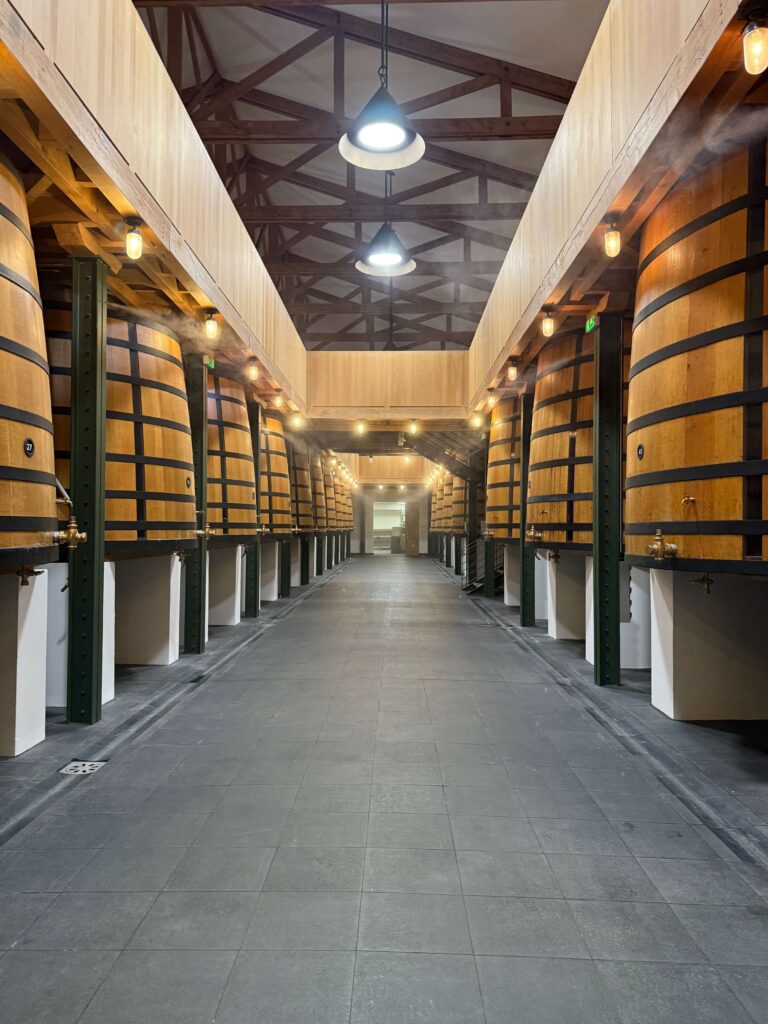
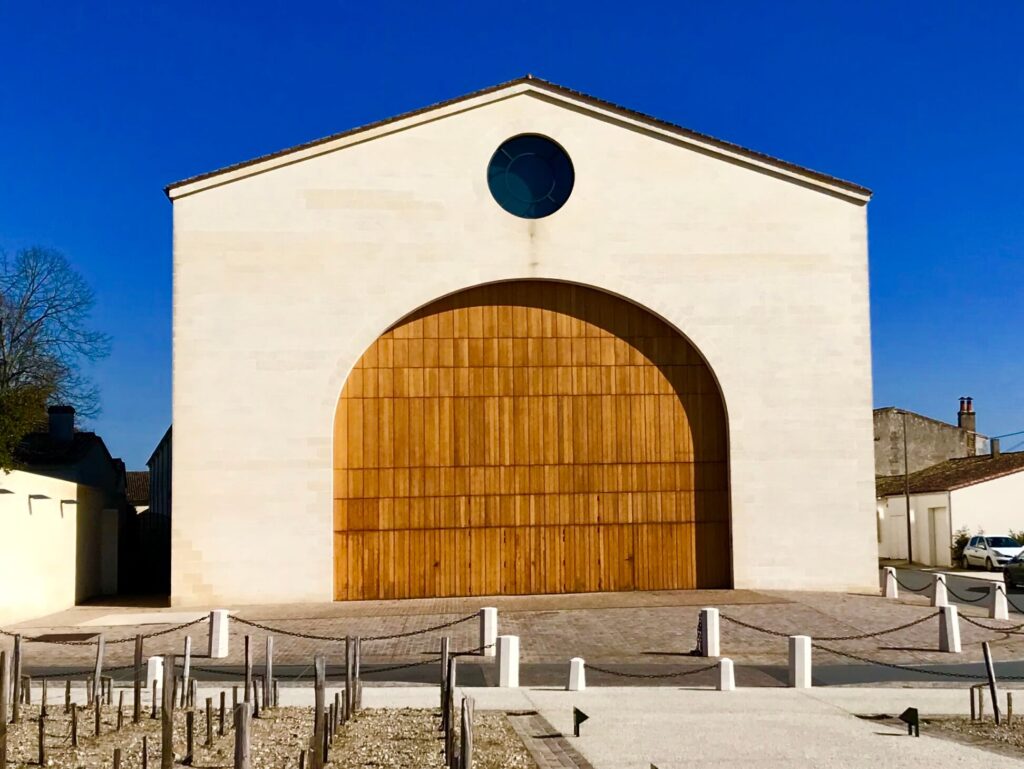
Picking is by hand into small open baskets that keep the bunches intact, followed by manual and optical sorting. The fruit then goes into the cuvier inaugurated in 2013, which is the most consequential piece of building the estate has done since the Grand Chai and, characteristically, also a piece of theater. It works by gravity across two levels, joined by slim metal columns, and it holds oak vats sized to match individual parcels rather than to match each other — the point being that selection at harvest and precision at blending both begin with not mixing things that should not be mixed. Some vats are fitted with transparent staves, so that a winemaker can watch a fermentation instead of inferring it. It is a very Mouton solution: the traditional material, the immodest transparency.
Aging is 18 to 20 months in 100% new French oak, with the barrels regularly topped and the wine fined with egg white before bottling. What most people underestimate is the severity of the selection. In 2020 the grand vin was drawn almost entirely from the core gravel parcels at the heart of the estate; in 2023 it represented only around 40% of the crop. The rest goes to Le Petit Mouton, which is a large part of why that wine has become as good as it has.
The generation now holding the spot
The estate changed hands technically, if not familially, in 2020. Philippe Dhalluin retired after fifteen years, and Ariane Khaida — an engineer by training, a Champenoise by birth, and the first woman to head a major Bordeaux négociant house when she took over Duclot in 2014 — became Executive Director of the group’s Châteaux Wines. A new role was created beneath her, technical director of all three Pauillac properties, and it went to Jean-Emmanuel Danjoy.
Danjoy’s route to one of the most coveted jobs in wine is not the one you would guess. He was born in Gabon to French parents and raised across Africa, with no family connection to wine at all; the hook was set during agribusiness studies, and again by a talk from Jean-Claude Berrouet. A research project on phenolic ripeness in Cabernet Sauvignon earned him six months at Opus One, the Napa venture Baron Philippe founded with Robert Mondavi in 1979. He returned the following year to run the 2000 vintage there, aged 23, after the technical director left. He stayed a decade, much of it under Michael Silacci, whose instruction he still quotes: the best thing you can put in the vineyard is your own two feet. In 2009 he came back to France to run Clerc Milon, and in 2020 he took Mouton.
Napa readers will enjoy the symmetry — the man now making Pauillac’s most flamboyant First Growth learned his trade on the Oakville bench. It shows, I think, in the way he talks about ripeness. Just because you can ripen further, he says, does not mean you should, which is a large part of how a wine as fresh as the 2022 came out of a record-breaking heat and drought.
Mouton ne change
I asked Philippe Sereys once what was left for him and his siblings to achieve, given everything his grandfather and mother had accomplished in such a short space of time. He considered carefully before replying with a somewhat wistful sigh: “The world has changed — hugely — in just a few years. Even in the last ten years. The question about what you do today, it is about holding your spot.”
Anyone who knows Mouton knows the ne change motto that adorned the Picasso label of 1973. The land remains fixed, solid, as it was and always will be. And yet everything around it changes — the people, the classification, the labels, the art, the wine — all in a state of flux, all striving. Looking again at that gold-enameled etching of the Augsburg Ram on the 2000, a work of art based on a work of art and housing a work of art, reminds me that art is as much a luxury as it is a necessity. Whether in the form of literature, music, a painting, or indeed a wine, whenever we are in doubt, art reminds us that we are constantly striving. Striving to create, striving to make our own marks, striving to be better.
Above and beyond intrinsic quality, the concept of flawlessness, classified growths and, dare I say, scores, the history, the art and the wine that is Château Mouton Rothschild evoke this message of the striving nature of mankind with striking clarity. Mouton may never change. But perhaps even more important are the changes it has made, and the ones it can still go on to make.
Winery Information
Region: France, Bordeaux, Pauillac
Address: Le Pouyalet, 33250 Pauillac, France
Open for Tastings: By Appointment Only
Major Grapes: Cabernet Franc, Cabernet Sauvignon, Merlot, Petit Verdot, Sauvignon Blanc
Vineyard Size: 220 acres
Own Winery: Yes
DTC Mailing List: No
Vineyard Sustainability: NA
Year Established: 1853
Owner: The Rothschild Family
Winemaker: Jean-Emmanuel Danjoy
Most Recent Reviews for this Winery
Published: July 2026