
Winery Story
Delas Frères
The wines of Delas Frères have recently found their voice. Behind the impressive quality improvements sits a story — of a 19th-century Tournon négociant, a Champagne family's willingness to invest, and a technical team that has spent the last five years dismantling and rebuilding almost everything it does.
The Renaissance
The commonly repeated version of the founding story compresses two events into one. Delas’s own archive is more precise: the wine trading house Maison Junique was established in 1835 by Jean Junique at 18–20 Avenue Maréchal Foch in Tournon-sur-Rhône. In 1870, Philippe Delas and Charles Audibert became partners and acquired it, giving the enterprise the family name it would eventually carry and a founding brief that has barely shifted since: to champion the wines of the Hermitage hill and the great terroirs surrounding it. The Tournon address became the Delas family home and the headquarters of everything that followed.
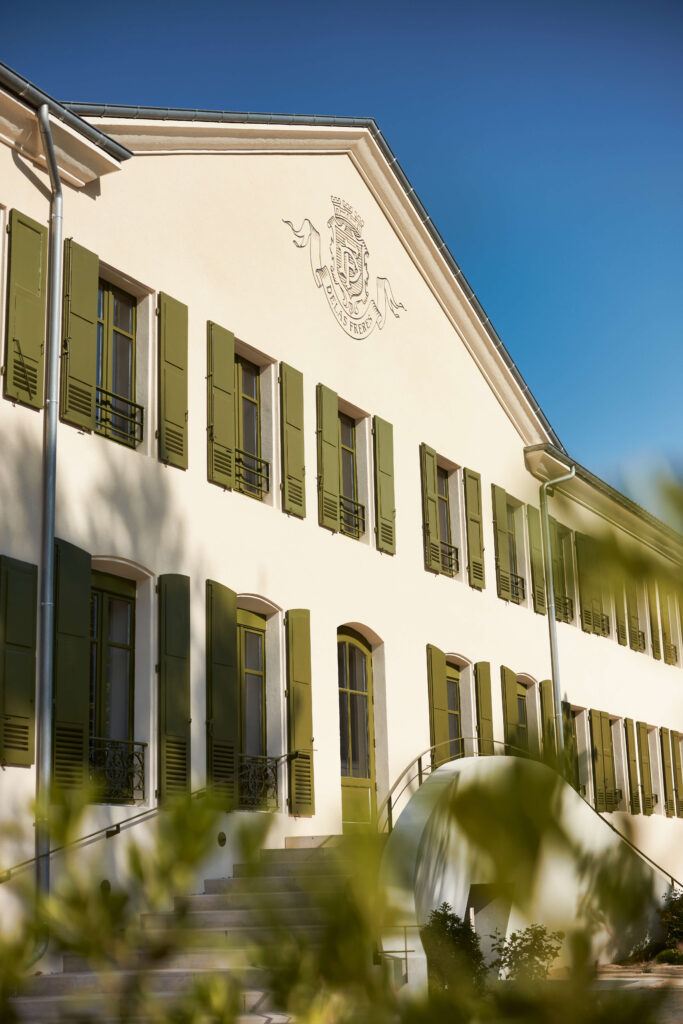
Photo by S. Chapuis
Recognition came quickly. Audibert & Delas took medals at the Paris Universal Exposition of 1878 and the Sydney International Exhibition the following year — a reminder that the Northern Rhône was already exporting confidence in the era when Hermitage was routinely ranked among the world’s most expensive wines. In 1924, Philippe’s sons Henri and Florentin assumed control and renamed the house Maison Delas Frères. The bond between the founding families had by then been doubled: Florentin married Charles Audibert’s daughter.
Michel Delas took over in 1960 and internationalized the business, building representation in the United States, London, Geneva, Amsterdam and Brussels, and — crucially for the modern range — acquiring plots in Côte-Rôtie and the Clos Boucher in Condrieu. Independence ended in 1977, when Champagne Deutz acquired the house. Sixteen years later, in 1993, the Rouzaud family’s Maison Louis Roederer acquired both Deutz and Delas together.
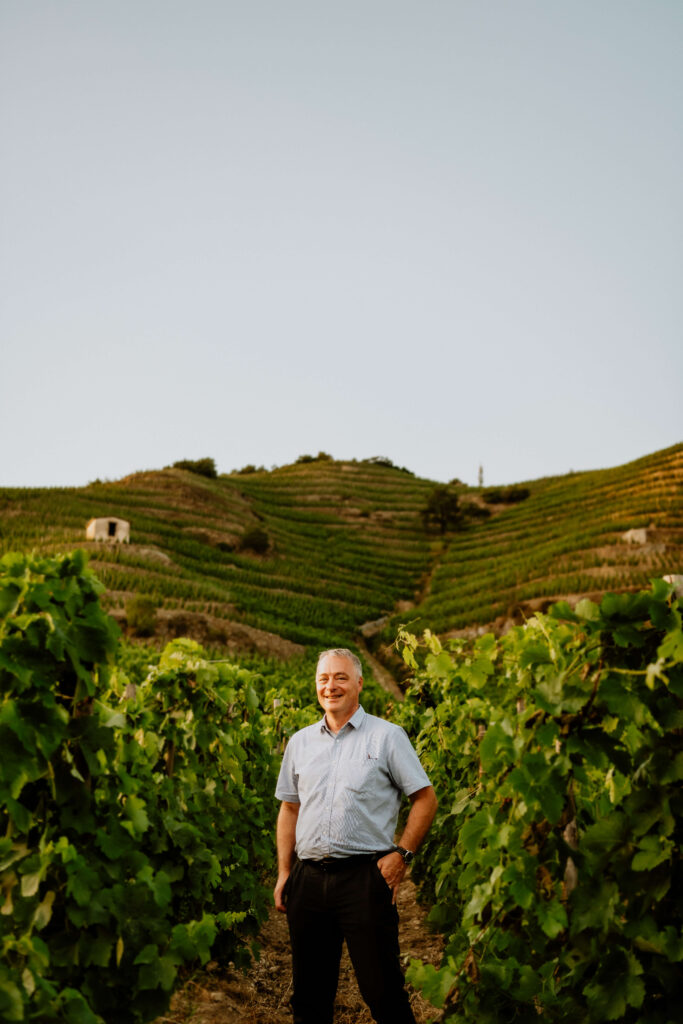
Nothing much happened immediately. The transformation began in 1996, when Fabrice Rosset was appointed to run both houses, and in June 1997, when he hired a Burgundy-trained oenologist named Jacques Grange as technical director. Grange remains in the role today, coming up on thirty vintages.
The Roederer Era
What Roederer ownership bought Delas was time and capital deployed in the least glamorous places first. Before there was an architectural showpiece, there were harvest-reception facilities, a purpose-built vat house, new aging cellars at Saint-Jean-de-Muzols, the rebuilding of drystone terrace walls on the Hermitage hill, and the replacement of thousands of vines. Roughly €30 million went into the business over two decades, most of it invisible in the glass and all of it audible.
Vineyard consolidation ran alongside. The acquisition of close to 20 hectares in Crozes-Hermitage in 2006 roughly doubled the estate holding and gave Delas the critical mass it needed to bottle serious wine from its own fruit rather than relying on purchases. In 2015, the house’s 180th anniversary year, it bought a dilapidated manor house and garden in the center of Tain-l’Hermitage — a place that came to symbolize its renaissance, and one that anchored the house physically at the foot of the hill it had spent 180 years interpreting.
Leadership changed hands at the start of 2023, when Marc Hoellinger — previously CEO of The Glenmorangie Company and chief commercial officer at Moët & Chandon — succeeded Rosset, who had led both Deutz and Delas for 26 years. Frédéric Rouzaud, who heads the Roederer group, framed the appointment as continuity along a path of ambitious but sustainable development. Three years in, that reads accurately: nothing at Delas has been torn up, but the pace of refinement has visibly quickened.
The Vineyards
Delas today farms 36.5 hectares, all in the Northern Rhône — a figure that has grown steadily and that still understates the house’s reach, since a substantial négociant business supplies the Southern Rhône range from Châteauneuf-du-Pape, Gigondas, Vacqueyras and Ventoux through long-term grower agreements.
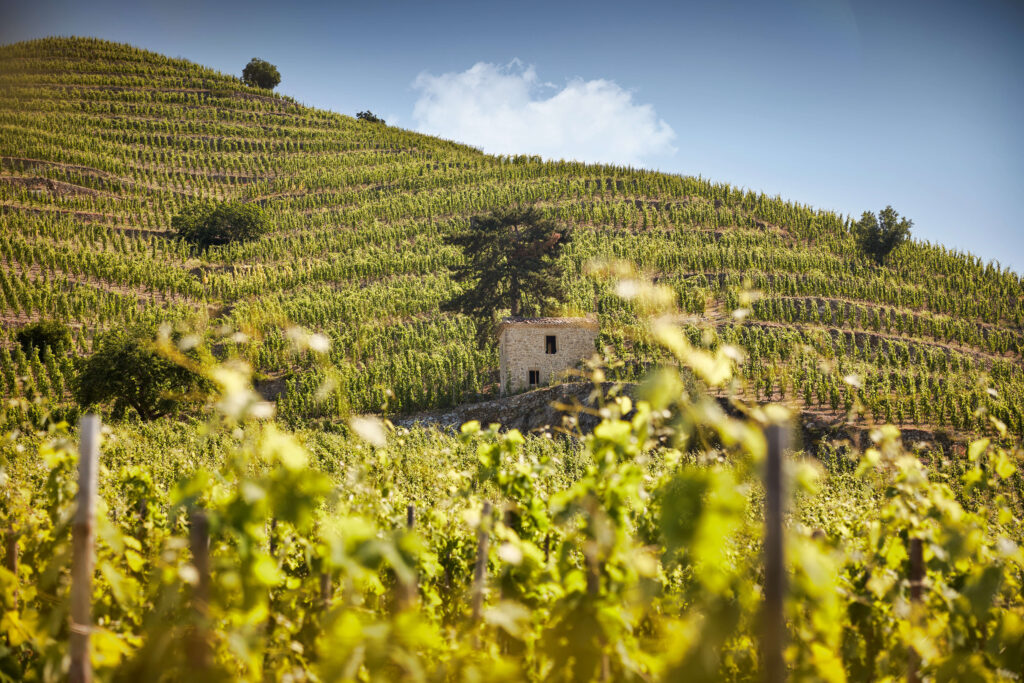
Photo by S. Chapuis
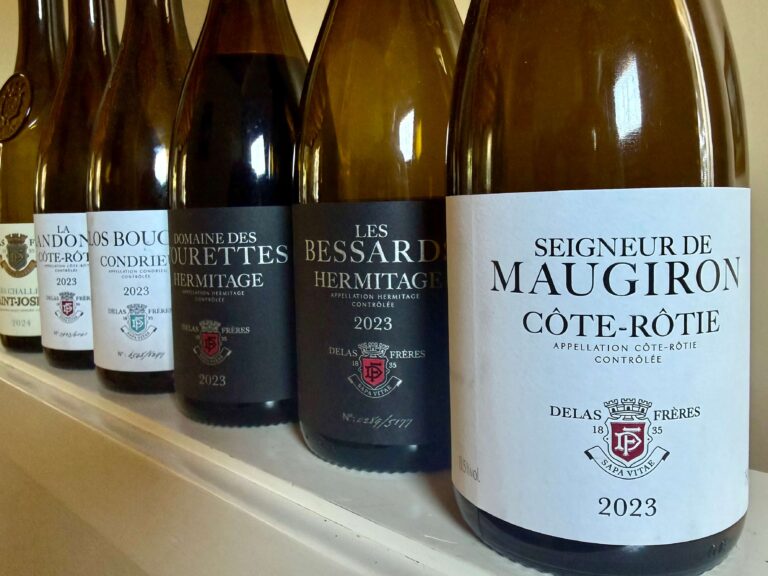
The estate holdings are the point, though, and they are unusually good. The house names five sites as the core of its heritage: Les Bessards in Hermitage, La Landonne in Côte-Rôtie, Clos Boucher in Condrieu, Sainte-Épine in Saint-Joseph and Clos Saint-Georges in Crozes-Hermitage.
Les Bessards is the granite heart of the Hermitage hill — decomposed granite mixed with alluvial deposits, poor in organic matter, savagely well-drained. Delas’s vines here are spread across some 75 terraces between roughly 120 and 263 meters of altitude, which is less a vineyard than a filing system for microclimates. It is also the house’s flagship, and the wine that first signaled the modern era: the debut Les Bessards vintage was 1990.
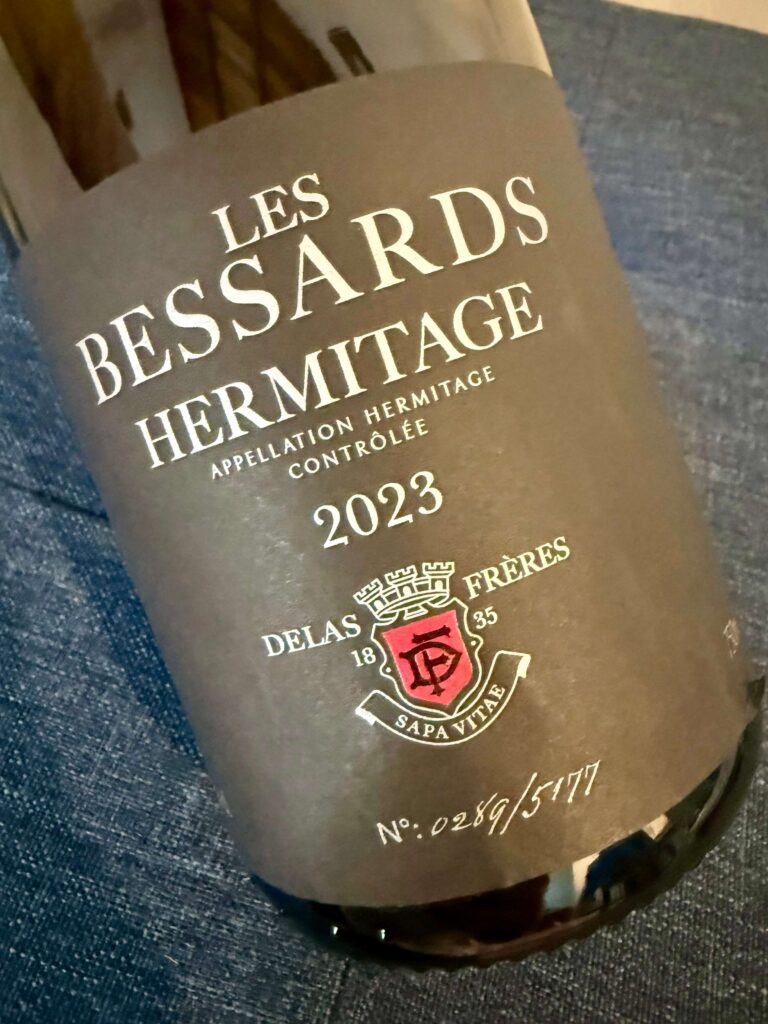
Higher still sits Les Grandes Vignes, at around 325 meters near the summit of the hill, a natural amphitheater of semi-circular terraces that faces predominantly south. Delas began bottling it separately as Ligne de Crête with the 2015 vintage. In a period when altitude and freshness have become the defining preoccupations of Northern Rhône Syrah, the timing looks less like luck than like attention.
Across the river in Saint-Joseph, Sainte-Épine is a roughly one-hectare, south-facing slope at Saint-Jean-de-Muzols, on decomposed granite laced with metamorphic schist — a soil composition that deliberately echoes Les Bessards. The site’s name descends from the Commanderie de Sainte-Épine-lès-Tournon, once held by the Order of Saint John of Jerusalem. Production is capped at around 4,000 bottles and made only in years the house considers worthy.
In Côte-Rôtie, La Landonne sits on the Côte Brune, where extremely steep terraces are built on ferruginous mica schist covered in the local schistous sand known as arzel — iron-rich, dark-fruited, structurally severe by comparison with the gneiss and granite of the Côte Blonde to the south. Delas’s first La Landonne was 1997, Grange’s first year.
Clos Boucher, Michel Delas’s 1960s acquisition, lies on a south-facing Condrieu slope adjacent to Château Grillet — arguably the most privileged address available to Viognier anywhere. And in Crozes-Hermitage, the estate’s clos on the Chassis terraces, on the alluvial left bank near the confluence of the Rhône and the Isère, yields a bottling deliberately restricted to around 7,000 bottles.
All Delas vineyards have held HVE Level 3 certification since 2018. Conversion to organic viticulture began in 2021, with certification achieved across the entire estate in 2024.
The Cellar
The winery, completed when Delas moved to Tain in 2019 and inaugurated in 2020, cost some €18 million and was designed by the Paris-based Swedish architect Carl Fredrik Svenstedt. It is the rare wine building that is genuinely famous outside the wine world: an undulating load-bearing wall of Estaillade stone, 80 meters long and seven meters high, built from blocks half a meter thick and weighing more than two tons each, robot-carved and post-tensioned to the foundations. The wall frames the restored manor house and its garden; a belvedere on top looks straight at the Hermitage slopes.
Technical Director Jacques Grange (Photo by Lucy Beaugard)
The romance is real, but the functional brief is the interesting part. The stone is thermally inert and porous, which makes it an excellent cellar. The building works by gravity. The vats are custom stainless steel. And the whole facility was conceived around one operating principle: single-parcel vinification.
That principle is where the Delas renaissance lives. Each plot is vinified according to its own character, allowing a much more detailed understanding of the soils — particularly granite soils — and to translate the nuances of each terroir with greater accuracy.
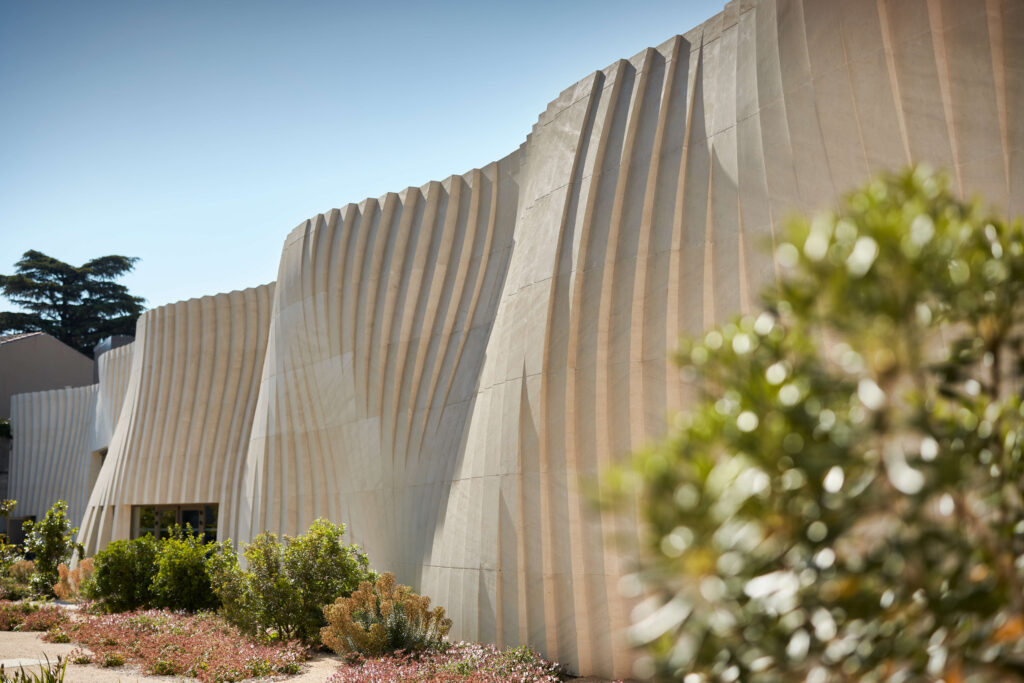
Photo by S. Chapuis
The Style
Ask Delas to characterize its winemaking now, and the answer is a catalog of things done less. Slower fermentations. Carefully controlled extractions. Limited racking. A predominance of stainless steel for aging. The house does filter before bottling, for stability, and says so plainly rather than hedging.
The most consequential retreat is from oak. New barrels today generally represent less than 30% of the aging program — and, notably, that ceiling applies to the prestige cuvées as well, which is where houses usually make an exception for themselves. Aging is tailored cuvée by cuvée, and the house is now working with foudres and ceramic eggs alongside barrels, chasing texture and aromatic complexity without the flavor tax.
Anyone who tasted Delas’s top reds in the early 2000s will recognize how large a change this is. The house that once pursued color, density and extract now describes its objective as wines in which the natural structure and concentration of the Northern Rhône are expressed with finesse rather than overshadowed by technical intervention.
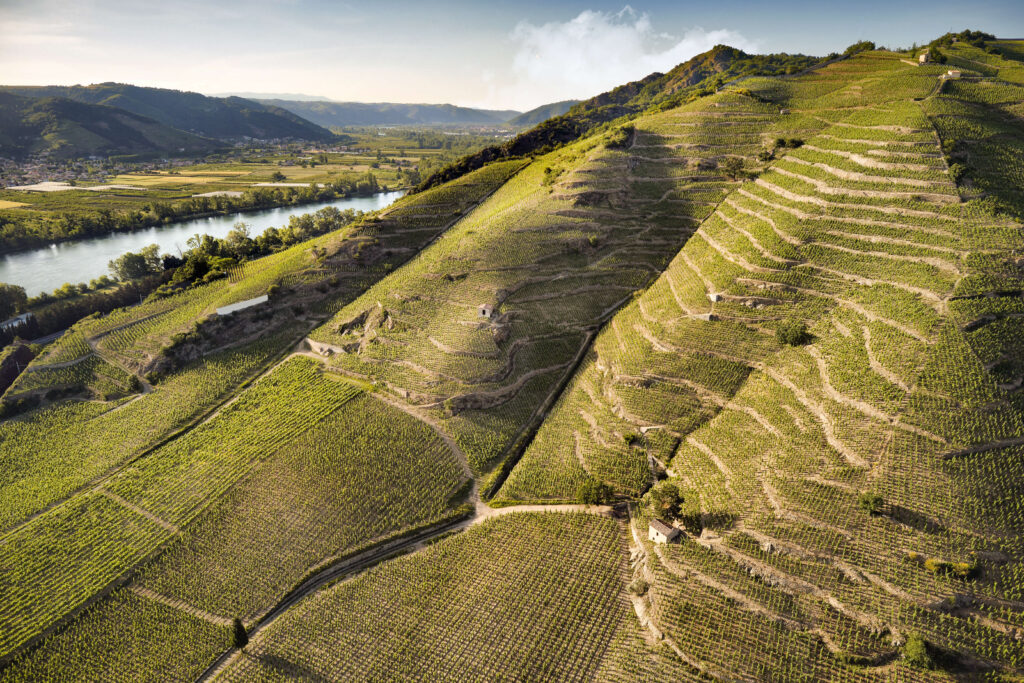
Photo by S. Chapuis
The whites follow the same logic. Gentle vinification, controlled fermentation, aging adapted to site, with freshness and purity as the objectives rather than any imposed house signature. On Condrieu, Delas offers a usefully unsentimental drinking window: in general, these wines show their best balance and expression within around five years of the vintage, when aromatic intensity, texture and freshness are all simultaneously available.
The Rhône has no shortage of houses that have been rescued by outside money. What distinguishes Delas is the sequencing. The capital went into terraces, drainage, vats and cellars for twenty years before it went into architecture. The vineyard expansion preceded the ambition to make single-vineyard wines from it. And the reduction in new oak came only once parcel-by-parcel vinification had given the team enough resolution to know what they would be revealing.
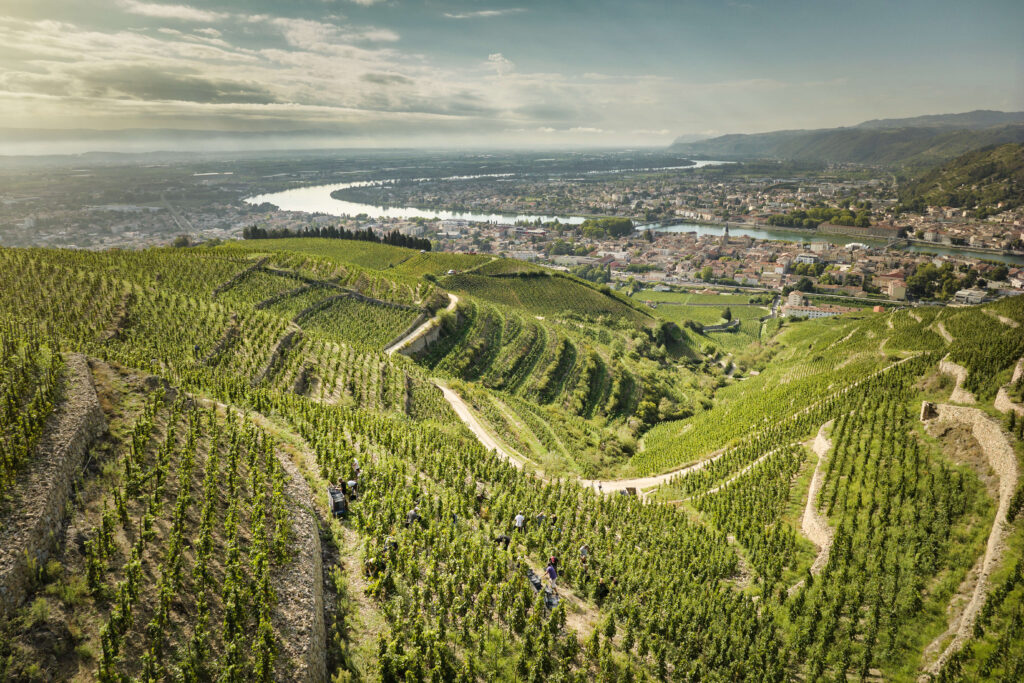
Photo by S. Chapuis
That is a slow way to run a renaissance, and a persuasive one. Delas frames its current chapter as tradition and innovation guiding the course together. In practice it looks more like a house that has finally acquired the tools to make the wines its vineyards were always capable of — and, having acquired them, has had the confidence to use fewer of them.
Winery Information
Region: France, Rhône, Northern Rhône
Address: 40 Av. Jules Nadi, 26600 Tain-l'Hermitage, France
Open for Tastings: By Appointment Only
Major Grapes: Marsanne, Roussanne, Syrah, Viognier
Vineyard Size: 75 acres
Own Winery: Yes
DTC Mailing List: Yes
Vineyard Sustainability: Organic
Year Established: 1835
Owner: Maison Louis Roederer (the Rouzaud family)
Winemaker: Jacques Grange
Website: https://delas.com/
Most Recent Reviews for this Winery
Published: July 2026