The Judgment of Singapore
The first Judgment of Paris was essentially a beauty pageant corrupted by a compromised judge. Zeus asked the Trojan prince Paris to award a golden apple inscribed “to the fairest” among the contestants: Hera, Athena, and Aphrodite. Each goddess offered him a bribe: power, wisdom, or the most beautiful woman on earth. Being a man, of course, he awarded the apple to Aphrodite, who sent him Helen, followed by a thousand ships, and, ultimately, a decade-long war.
Greeks knew what modern people in the world of wine often forget: a judgment is only as good as the judge.
When Ronan Sayburn, MS, and I agreed to be the Co-Lead Moderators of the new Judgment of Singapore, we decided on one thing: honor the spirit of 1976 while changing the aspects of its approach that have led to doubts over the past fifty years.
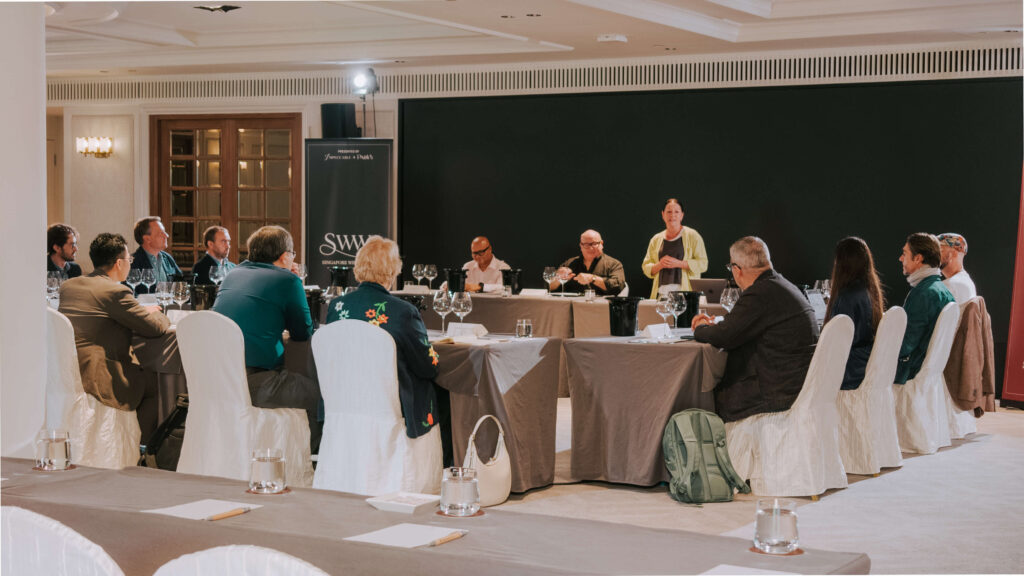
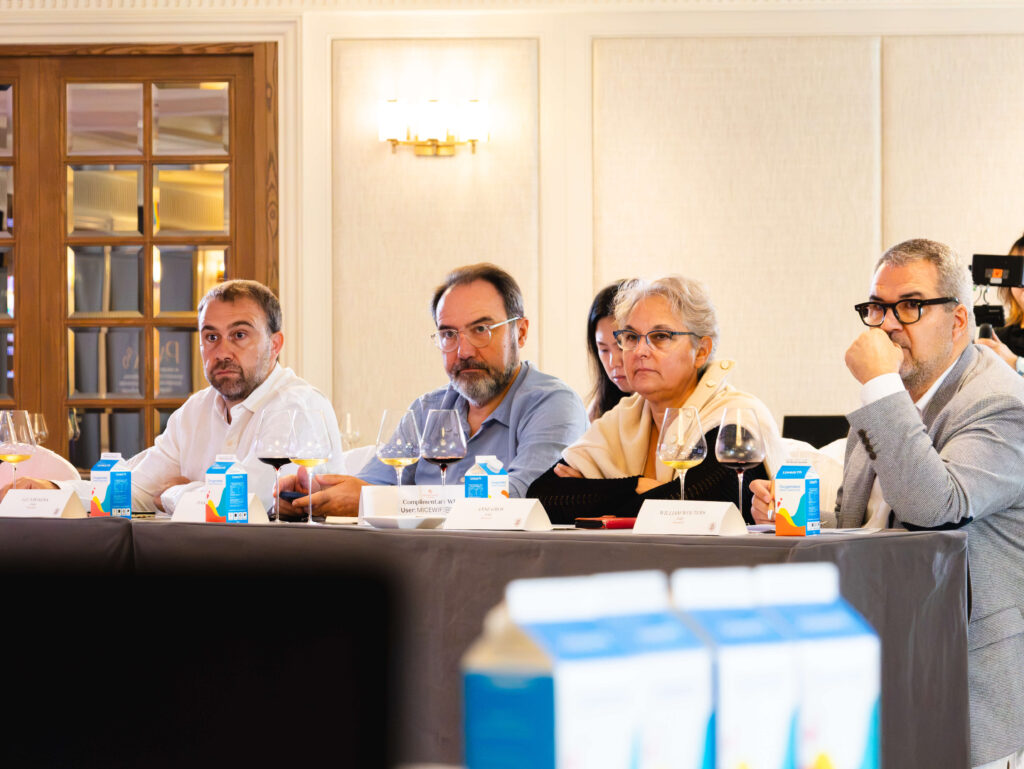
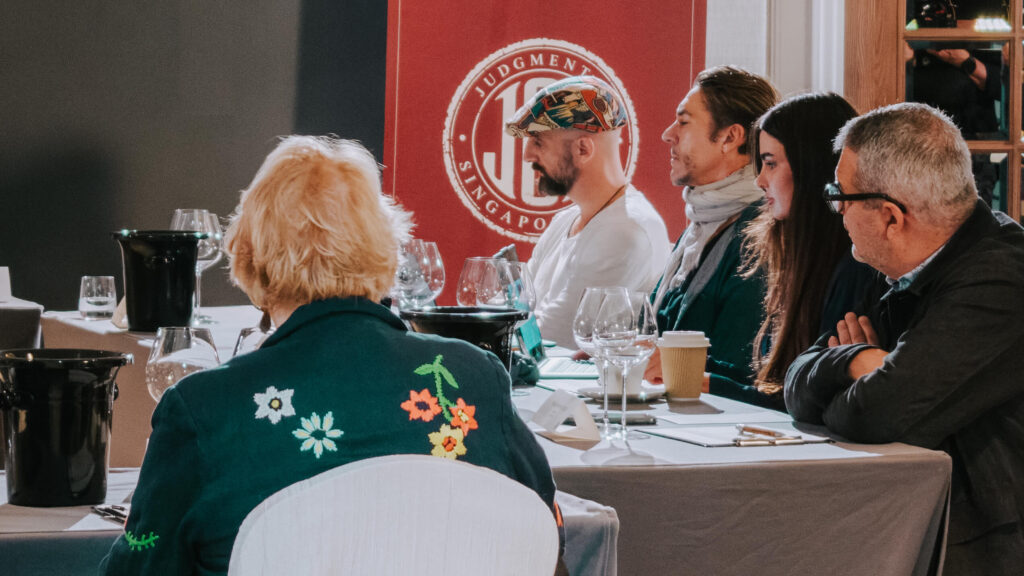
On the morning of October 2nd, 2026, fourteen wine judges from eleven countries, representing a broad range of industry professions, gathered in a room at Resorts World Sentosa in Singapore. In front of us were pre-poured flights in identical glasses, a scorecard, and a spittoon. In a separate room, independent sommeliers prepared, decanted, and poured all wines in a random order. The judges knew only the grape variety and that the wines were from the 2019 vintage, or the nearest similar vintage, depending on the region.
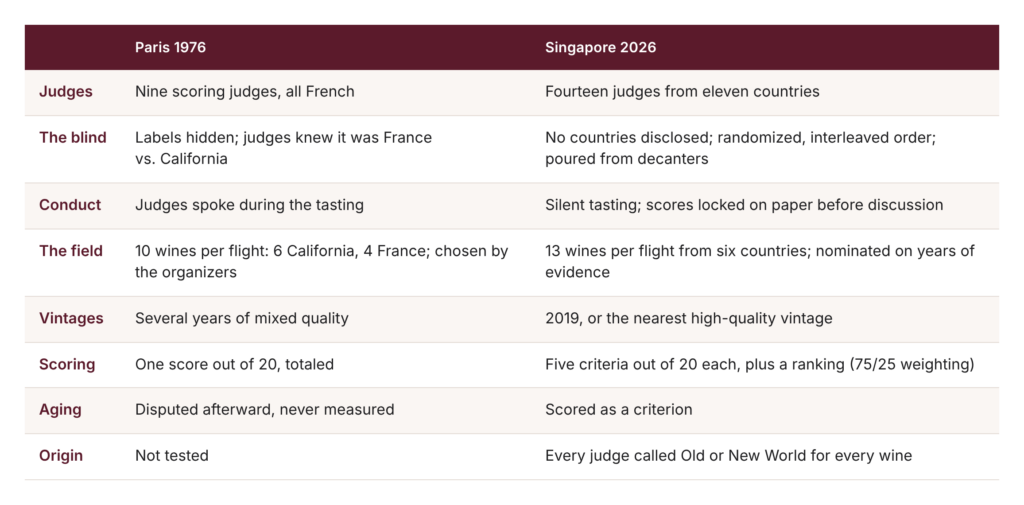
Fifty years ago, Steven Spurrier organized a tasting in Paris that delivered one of the most important judgments in the wine world’s history. It also sparked highly debatable results. Over those fifty years, many arguments against his choice of wines, vintages, and judges have been tossed about, some reasonable and others simply sour grapes.
Steven Spurrier’s France vs California competition was held on May 24th, 1976. Stag’s Leap Wine Cellars 1973 ranked highest among the reds; Chateau Montelena 1973 topped the whites. Thanks to George Taber’s famous/infamous article for The New York Times — the only journalist who accepted the invitation to attend — the wine world tilted on its axis that day. One of the winning bottles now resides in the Smithsonian, and a film was made: Bottle Shock.
However, Spurrier was simply a merchant staging a promotional tasting. The lack of rigor in his experiment has been a talking point ever since.
The first problem was the jury. The scores that counted came from nine French judges — sommeliers, restaurateurs, winemakers, and officials — tasting on home ground. Several later admitted they had little prior experience with Californian wine. The verdict carried authority because the establishment delivered it against itself, but a panel drawn from a single wine culture remains a very limited point of reference.
The second problem was the blind element, which was only half-blind. The labels were hidden, but the judges knew they were tasting France against California. The exercise quickly became a guessing game, with judges trying to spot the French wines and reward them. Remarks about which glass was “surely” Burgundian or Californian were reportedly made aloud. Once the room starts talking, the room starts agreeing.
The third problem concerned the field. Each flight featured ten wines: six from California and four from France, selected by the organizers and spanning several vintages. The comparison was neither balanced by origin nor tied to a single vintage or even similar vintages, making it impossible to separate the quality of a producer or region from the quality of a growing season.
The fourth problem was the scoring system. Each judge gave a single score out of 20, with no criteria to explain it, and the final order came from adding those scores together. Statisticians who revisited the results in later years pointed out that the margins were slim and that a single judge’s outlying scores could shift the order. A score with no reason attached is an opinion; a ranking built from unexplained opinions is fragile.
And finally, there was the question the French raised the moment the results came out: these were young wines, and Bordeaux and Burgundy are built to age. Nothing in the 1976 method measured that claim. The rematches of 1986 and 2006 went some way toward answering it — California fared well again — but the original tasting didn’t consider ageability.
Setting the Record Straight
Fifty years on, nobody seriously asks whether the New World can make great wine. So we asked a harder question: with every clue removed, does origin still reveal itself in the glass? Answering that honestly meant taking each of Paris’s weaknesses in turn.
We began with the jury. Our fourteen judges came from eleven countries — Singapore, the United States, the United Kingdom, France, Germany, China, Taiwan, India, Australia, Italy and Belgium — and included Masters of Wine, Master Sommeliers, working winemakers, a leading négociant and the President of the Association de la Sommellerie Internationale. A winemaker, a sommelier, a critic and a négociant do not look for the same things in a glass, and the disagreement between them is information, not noise. Even the venue was chosen for neutrality. Singapore is now a commercial hub for fine wine, yet it has no domestic industry to defend. Paris, both the prince and the city, had a stake in the outcome. Singapore does not.
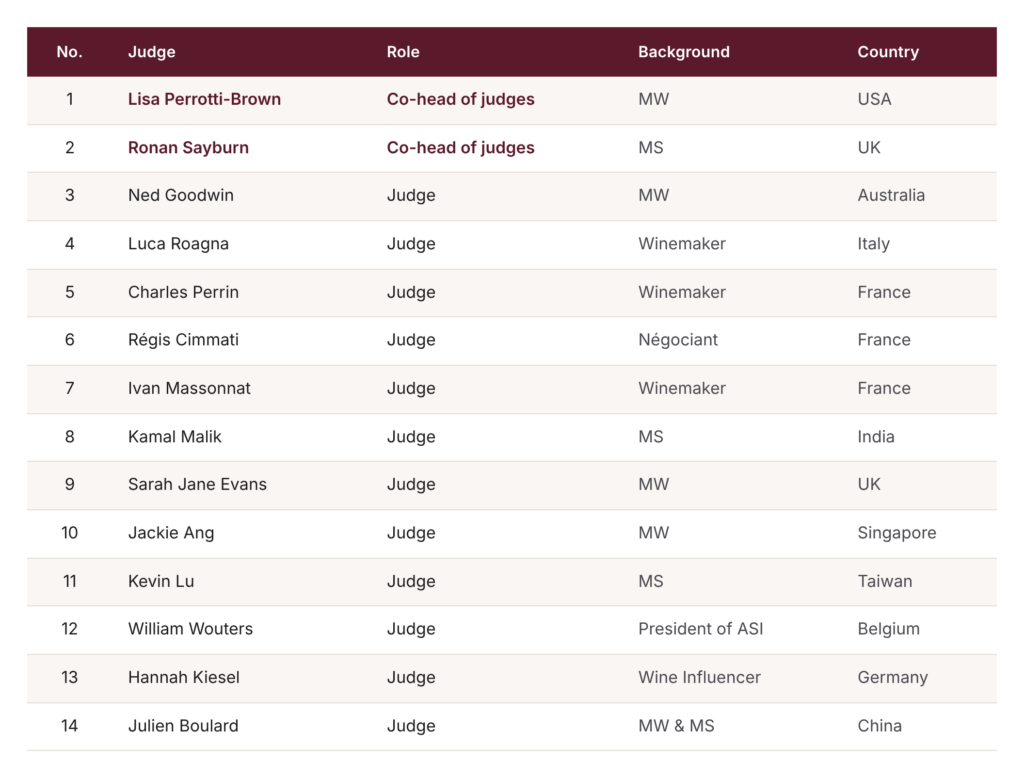
Judgment of Singapore Judging Panel
Then we drew the blind all the way. Our judges did not know which countries were represented, how many wines came from any region or where any glass sat in the order. Old and New World wines were interleaved, poured from decanters into identical glasses, with temperature and aeration equalized. The room was silent — no conferring, no asides, no raised eyebrows — and scores were written on paper and locked before any discussion began. Each flight opened with two calibration wines to align our vocabulary without homogenizing our opinions.
The lineup was shaped by our expertise in the categories and the wine’s track record. No winery was allowed to nominate itself, and there were no entry fees. Every wine was chosen by our judging committee based on years of sustained excellence, market demand, and true representativeness of its region. We left out the ultra-cult bottlings, whose mythology is so loud that a room can sense them even blind. And we threw in one wild card for both the Chardonnay and Cabernet Sauvignon flights — a high-quality, up-and-coming wine with a limited track record.
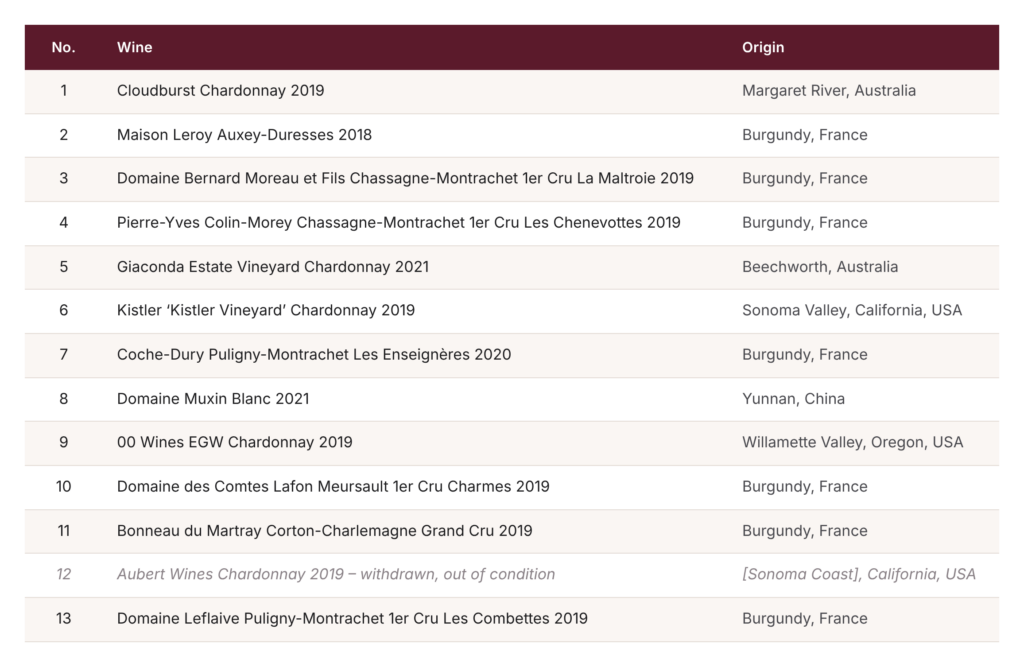
Chardonnays – Complete List of Wines Tasted (in the order they were tasted)
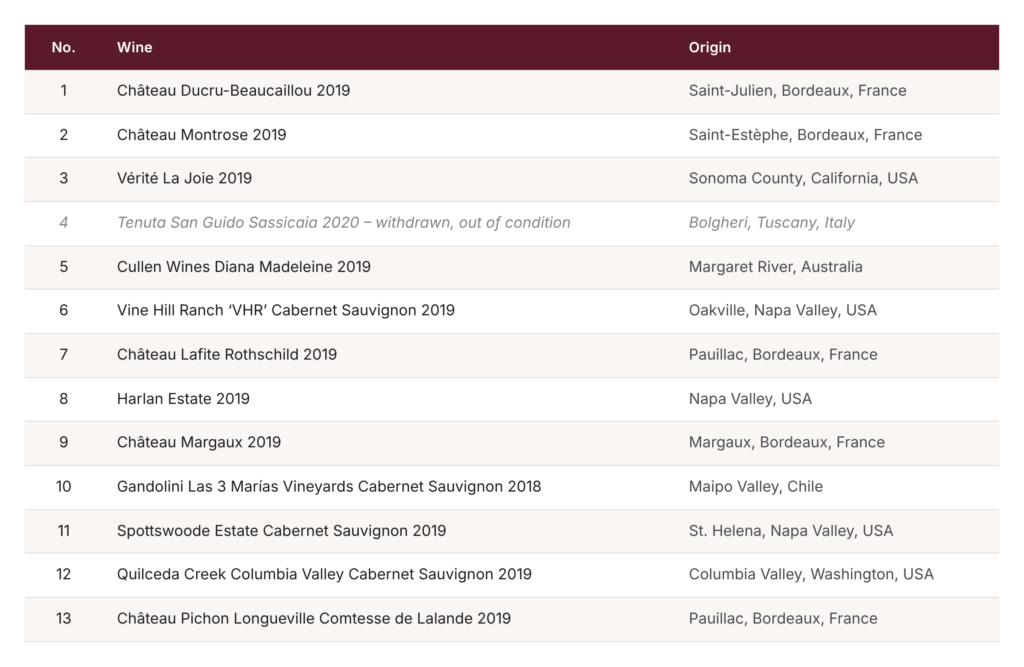
Cabernet Sauvignons – Complete List of Wines Tasted (in the order they were tasted)
To minimize vintage variation, we targeted the 2019 vintage — an outstanding and very similar growing season in France and California — accepting a neighboring year only in regions where 2019 was dissimilar or unavailable. Twenty-six wines from six countries came to Singapore: thirteen Chardonnays and thirteen Cabernet Sauvignons and Bordeaux-style blends.
We also gave every overall quality score a well-defined set of criteria. Each judge marked every wine out of 20 on five attributes — balance, intensity, complexity, aging potential and singularity — for a total out of 100. They also ranked the flight from first to last based on their own personal preferences, which was often not the same as highest to lowest quality score. Lastly, everyone wrote a tasting note, detailing what made the wine unique and justifying the quality marks. The final results weighted the panel’s average score at 75% and its combined ranking at 25%. Aging potential, the very claim the French had raised in 1976, was now something we measured. And we added the question Paris never asked: for every wine, each of us had to commit to Old World or New.
Two bottles — Aubert Chardonnay 2019 and Tenuta San Guido Sassicaia 2020 — were out of condition, most likely heat-affected. Ronan, the organizers, and I agreed that neither reflected the wine fairly, and we withdrew both, leaving twenty-four wines in the final reckoning.
My Take: The Chardonnays
If one thread ran through the white flight, it was struck flint. The reductive, struck-match signature that was once a calling card of a handful of Burgundy’s top cellars now turns up everywhere, and it ran through glass after glass, from Puligny to Beechworth to Yunnan. In the best wines, it was a seasoning — a flinty spark lifting the fruit. In others, it was the whole meal. The Giaconda Estate Vineyard 2021 was so marked by sulfides on the nose that it buried the preserved lemon and wet slate beneath. The Domaine Muxin Blanc 2021 showed a similar sulfide restraint over delicate yuzu and grapefruit notes. It was our wild-card from Yunnan, in China — and frankly, it held its own, finishing level with a fine Oregon Chardonnay on my card.
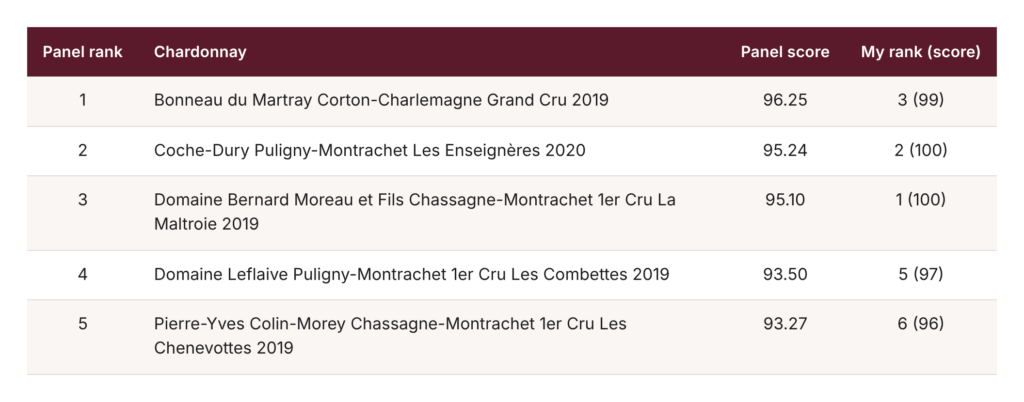
At the top, three wines stood out. The one I placed first opened with wet pebbles and struck flint, then gave way to ripe pears, juicy peaches, and a touch of jasmine on a racy, creamy, quietly intense palate — Domaine Bernard Moreau’s Chassagne-Montrachet 1er Cru La Maltroie 2019. My second was all lemon tart, key lime pie, and chalk dust, bright and energetic with a zippy finish: Coche-Dury’s Puligny-Montrachet Les Enseignères 2020. My third, at 99, was Bonneau du Martray’s Corton-Charlemagne 2019, with cedar, cloves, ripe pears, and golden apples, crisp and intense with a citrus lift. I called all three Old World, correctly. As it turned out, they were also the panel’s top three, though in a different order.
The wine that made me write “Wow” was the next one down. A super-intense nose of struck flint, pineapple, guava and ginger, a rich, satiny palate with a lively backbone — 98 points. I was certain it was New World: Cloudburst Chardonnay 2019 from Margaret River. It was the highest-placed New World white with the panel, too, finishing just outside the top five.
I scored Domaine Leflaive’s Les Combettes 2019 at 97 for its struck match, yuzu, lemongrass and green mango — and called it New World, as did nine of my fellow judges, which was an interesting result for this Burgundian classic.
My Take: The Cabernets
My top red featured fragrant notes of lilacs, licorice, and tilled soil over warm cassis and blackberry preserves. The palate was medium-bodied, with a firm frame of fine-grained tannins and an impressive tension that carried it to a long, mineral finish. Everything about its restraint said Left Bank to me, and I wrote “Old World”. It was Spottswoode Estate Cabernet Sauvignon 2019, from St. Helena in the Napa Valley — a wine I have long admired for its elegance and energy.
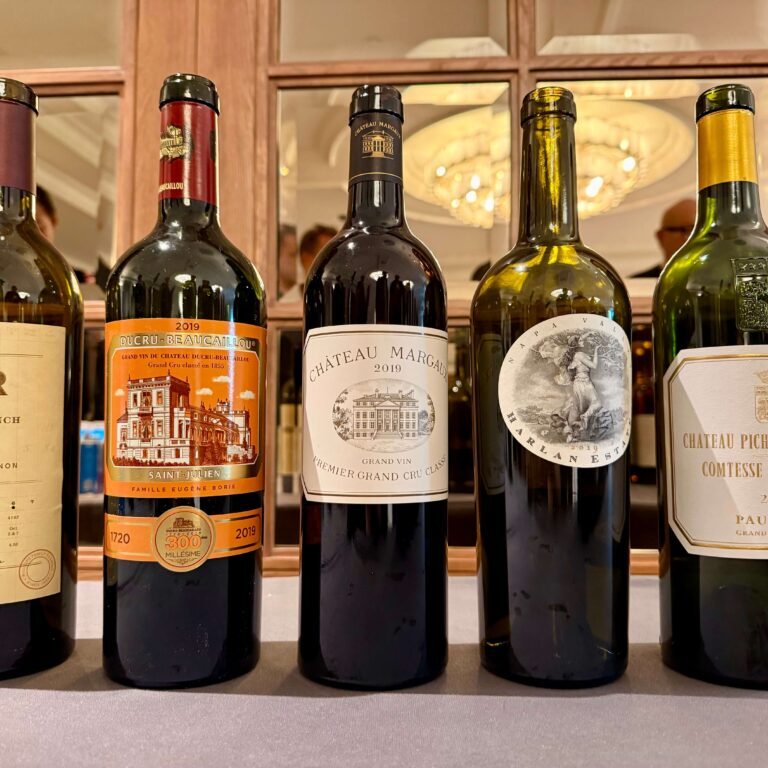
My second-placed wine, at 99, began shy before unfurling into cassis, juicy blackberries, bay leaves and violets, taut and muscular with firm, ripe tannins. This one I did place in the New World, correctly: Harlan Estate 2019. Just behind it, at 98 apiece, came two wines I identified as Bordeaux and that were. Château Margaux 2019 needed coaxing to reveal black and red currants, mulberries, dusty soil and black pepper, and it was restrained, elegant and refreshing — a textbook Margaux, as twelve of the fifteen judges recognized. Château Ducru-Beaucaillou 2019 was denser and more muscular, with cassis, wild blueberries, pencil shavings and crushed rocks over firm, grainy tannins. Château Montrose 2019 — a returning name, for the 1970 placed among the top reds in Paris in 1976 — followed at 97, all black currants, graphite, bay leaf and menthol with a savory lift.
Vine Hill Ranch’s VHR 2019, the wine that went on to top the panel’s rankings, scored 95 on my card, placing sixth in the flight. It was perfumed and beautiful — cedar chest, violets, and wild thyme over cassis, blueberries, and forest floor, with a racy line through dense black and blue fruit. I was incredibly excited that this wine shone so brightly among the other judges and wound up taking first place in the overall ranking. It comes from what is unquestionably one of Napa Valley’s Grand Cru vineyards. Owned and managed by Bruce and Heather Phillips, this 70-acre site supplies over a dozen top wineries, including BOND for their Vecina label. The story of this incredible vineyard and wine can be read here. I called it New World, correctly, though six of my colleagues were convinced it was a Bordeaux.
The Judges’ Verdict
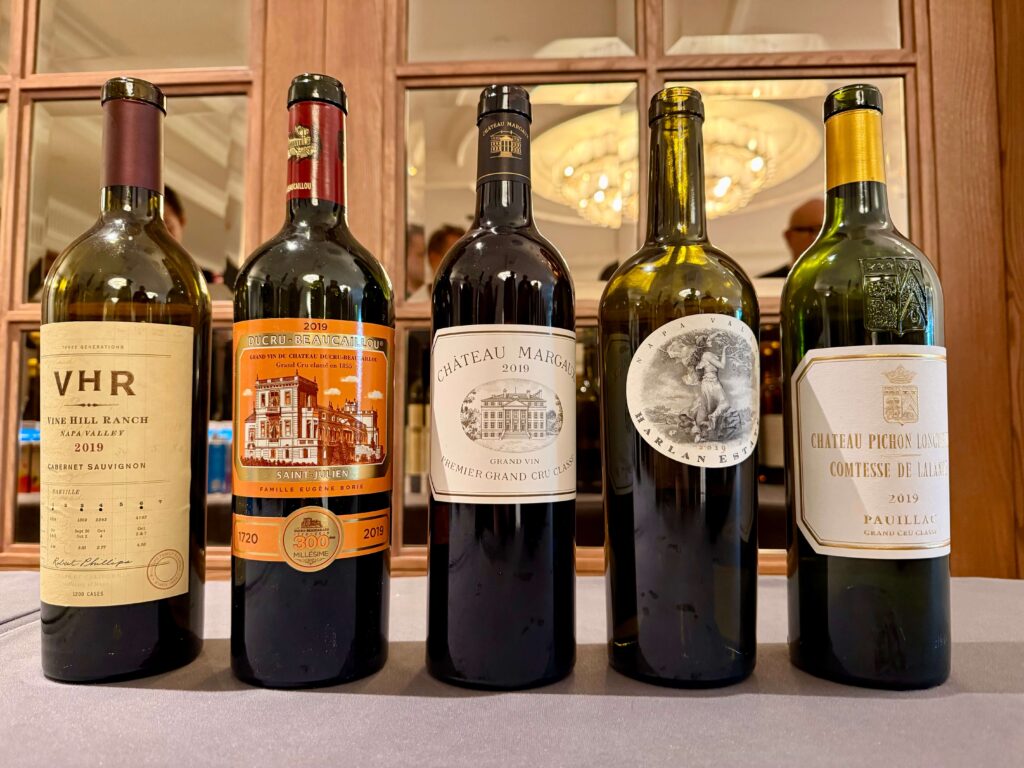
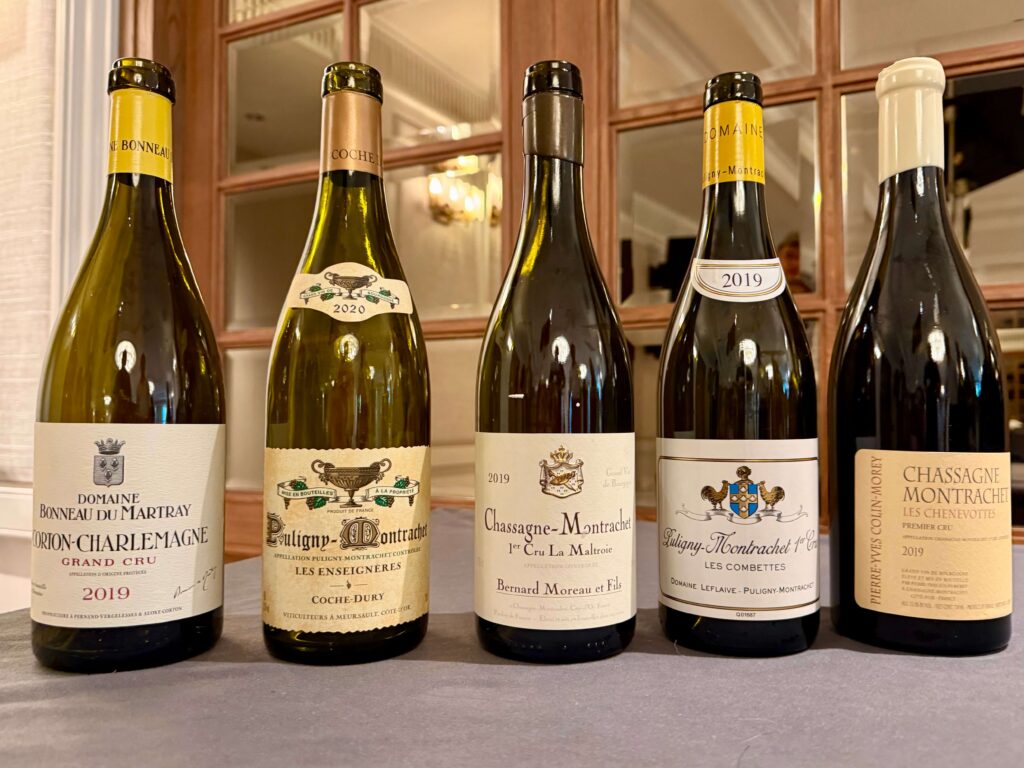
We revealed the results on the morning of October 4th, the final day of Singapore Wine Week. As mentioned, a small-production (around 1200 cases) Napa Valley Cabernet finished first: Vine Hill Ranch VHR 2019, with a final score of 96.41, ahead of Ducru-Beaucaillou and Margaux. Harlan Estate took fourth and Pichon Lalande fifth, splitting the top five three to two in Bordeaux’s favor. In the whites, Burgundy swept all five places, led by Bonneau du Martray’s Corton-Charlemagne.
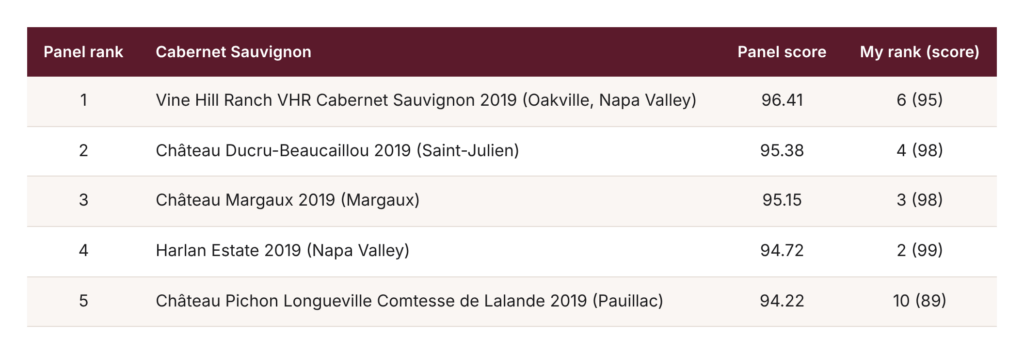
On the whites, my card and the panel’s were close to mirror images: the same top three, and Les Combettes and Chenevottes just behind. On the reds, we parted company more often. My top wine, Spottswoode, did not make the panel’s top five, and Pichon Lalande, which I placed tenth, did. That is exactly as it should be. A panel of fifteen exists so that no single palate — mine included — decides the outcome. Look, too, at the margins: barely two points separate first and fifth among the Cabernets, and under three among the Chardonnays. These are photo finishes, not knockouts, among wines that were all performing at the very highest level.
The two surprising omissions from the top five Cabernet Sauvignons were the 2019 Château Lafite and 2019 Château Montrose. In a way, it makes sense. Both of these wines seldom show well when they are young, even from a riper, more flamboyant vintage like 2019. The Montrose was, in fact, one of my top five wines. However, the Lafite came off as stewy and jammy to me on the day, which, knowing this wine well, I can only put down to being in a rather clumsy phase.
Old World or New World?
The rankings were not the only interesting part of the exercise. What I wanted to know was whether fifteen experienced palates, stripped of every external clue, could still ascertain Old World or New World. The answer is: sometimes.
Across the twenty-four judged wines, the panel placed a wine in the correct world 64% of the time — 69% for the Cabernets and just 58% for the Chardonnays.
Burgundy’s clean sweep of the Chardonnay top five says that place still produces something this panel valued above all else.
In 1976, Paris asked whether the New World belonged at the table, and answered with a method that has been picked over ever since. In 2026, we asked what is left to tell the two worlds apart, and built a method designed to withstand that scrutiny. Nobody threw a golden apple, and no ships set sail. The fairest wine in the room was simply the one in the glass, judged on its own terms, by people who did not know whose it was.
My Scores and Tasting Notes
Below are my own scores and notes from October 2nd, written blind.
Chardonnays
Domaine Bernard Moreau et Fils Chassagne-Montrachet 1er Cru La Maltroie 2019 (100). Notes of wet pebbles and struck flint to start give way to a core of ripe pears and juicy peaches with a touch of jasmine. The medium- to full-bodied palate is wonderfully poised, with a racy line, creamy texture, and mineral-laced orchard fruit flavors, finishing with a quiet intensity. So elegant.
Coche-Dury Puligny-Montrachet Les Enseignères 2020 (100). Begins with struck-flint notes, giving way to a core of lemon tart, key lime pie, and chalk dust, plus hints of shaved almonds and fresh ginger. The medium-bodied palate is bright, racy, and energetic, with citrus and mineral layers and a long, zippy finish.
Bonneau du Martray Corton-Charlemagne Grand Cru 2019 (99). Cedar and clove notes give way to a core of ripe pears and Golden Delicious apples, plus hints of coriander seed and lightly browned toast. The medium-bodied palate is crisp and intense, with mineral-laced orchard fruit layers and a citrusy lift on the long finish.
Cloudburst Chardonnay 2019 (98). Wow — a super-intense nose of struck flint, pineapple, guava, and ginger with a touch of crushed rocks and orange blossoms. Satiny, full-bodied, and rich, with a lively backbone, it finishes long and spicy. Yum!
Domaine Leflaive Puligny-Montrachet 1er Cru Les Combettes 2019 (97). Intense notes of struck match, yuzu, and lemongrass leap from the glass, followed by hints of baking bread and lime leaves with a touch of green mango. The full-bodied palate delivers concentrated citrus and tropical fruit flavors with minerally accents and a crisp line, finishing long and zesty.
Pierre-Yves Colin-Morey Chassagne-Montrachet 1er Cru Les Chenevottes 2019 (96). Allspice and candied ginger notes pop from the glass, leading to a core of apple butter and juicy peaches, plus a hint of almond brioche. The medium-bodied palate is tightly wound, with a crisp backbone and spicy accents to the orchard fruit layers, finishing long and savory.
Kistler “Kistler Vineyard” Chardonnay 2019 (95). Toasted cashew and crème brûlée notes open out to a core of pear tart and apple pie with a hint of chalk dust. The medium- to full-bodied palate delivers a satiny texture and seamless freshness, with bags of orchard fruit flavors and a long, spicy finish.
Maison Leroy Auxey-Duresses 2018 (94). The sulfide/struck-flint character really stands out to start, needing a lot of swirling to bring out notes of fresh lemons and yuzu with touches of chalk and baking bread. The medium-bodied palate is racy and bright, with lots of minerally layers and a chalky finish.
Domaine Muxin Blanc 2021 (93). Offers intense struck-flint and wet slate notes, opening out to an undercurrent of lime blossoms, yuzu, and fresh grapefruit, plus a touch of ginger ale. The medium- to full-bodied palate carries a sulfide note that restrains the delicate citrus fruit flavors, framed by refreshing acidity and a chalky texture, finishing minerally.
00 Wines EGW Chardonnay 2019 (93). Prances out with showy notes of yellow apples and juicy pears, followed by nuances of marzipan, nutmeg, and beeswax with a touch of crushed rocks. The medium- to full-bodied palate has a satiny texture and seamless freshness matching the savory-laced orchard fruit flavors, finishing spicy.
Domaine des Comtes Lafon Meursault 1er Cru Charmes 2019 (91). Cedary overtones lead to a core of lemon meringue pie, orange blossoms, and wet pebbles, plus hints of green apples and shaved almonds. The medium-bodied palate is delicately styled, with a refreshing line and silky texture, finishing whispery.
Giaconda Estate Vineyard Chardonnay 2021 (82). The sulfide/struck-match character is quite overpowering on the nose at this stage, leading to underlying hints of preserved lemons, lime leaves, and wet slate. The medium- to full-bodied palate is racy, though a little subdued by the use of sulfur, with a chalky texture and a white pepper–laced finish.
Cabernet Sauvignons
Spottswoode Estate Cabernet Sauvignon 2019 (100). Waltzes out with fragrant notes of lilacs, licorice, and tilled soil, leading to a core of warm cassis and blackberry preserves. The medium-bodied palate has a firm frame of fine-grained tannins and impressive tension to match the nuanced black fruits, finishing long and minerally.
Harlan Estate 2019 (99). A little shy to start, it unfurls to reveal notes of cassis and juicy blackberries, plus touches of bay leaves and violets. The medium- to full-bodied palate is taut with muscular black fruit, framed by firm, ripe, grainy tannins and seamless freshness, finishing long.
Château Margaux 2019 (98). Needs a little swirling to coax out notes of black and red currants, mulberries, and dusty soil with hints of black pepper and cedar chest. The medium-bodied palate is restrained, elegant, and refreshing, with firm, fine-grained tannins and a long, minerally finish.
Château Ducru-Beaucaillou 2019 (98). Notes of cassis, wild blueberries, and red currants jump from the glass, followed by hints of pencil shavings, underbrush, and crushed rocks. The full-bodied palate is dense with muscular black fruit and firm, grainy tannins, with a refreshing lift on the finish.
Château Montrose 2019 (97). Classic black currant, graphite, and bay leaf notes spill from the glass with wafts of tilled soil and menthol. The medium- to full-bodied palate delivers a firm backbone of fine-grained tannins and plenty of freshness, finishing with a savory lift.
Vine Hill Ranch “VHR” Cabernet Sauvignon 2019 (95). Perfumed notes of cedar chest, violets, and wild thyme lead to a core of cassis, juicy blueberries, and forest floor. The full-bodied palate delivers firm, fine-grained tannins and a racy line to match the densely packed black and blue fruit layers, finishing fragrant.
Vérité La Joie 2019 (94). Charges out with bold notes of red currant preserves, fresh blackberries, and boysenberries, followed by hints of iron ore and wild sage. The medium- to full-bodied palate is intense, with energetic red and black fruit framed by very fine-grained tannins and a racy line, finishing long and minerally.
Quilceda Creek Columbia Valley Cabernet Sauvignon 2019 (93). Starts off with savory notes of dried herbs and tapenade, opening out to a core scented with cassis, red currant jelly, and iron ore. The full-bodied palate is rich and seductive, with lovely brightness and a firm, fine-grained texture, finishing with epic length.
Gandolini Las 3 Marías Vineyards Cabernet Sauvignon 2018 (90). Ripe blackberry, cassis, and tobacco notes pop from the glass, giving way to hints of cedar chest, sautéed herbs, and incense with a waft of stewed plums. The medium- to full-bodied palate is displaying some evolution, with lightly chewy tannins, a refreshing line, and an earthy finish.
Château Lafite Rothschild 2019 (90). Flamboyant notes of crème de cassis and plum preserves prance from the glass, followed by hints of sandalwood, potpourri, fertile loam, and cardamom. The full-bodied palate is jam-packed with stewed black fruit layers, framed by lightly chewy tannins and appealing freshness, finishing spicy.
Château Pichon Longueville Comtesse de Lalande 2019 (89). Leaps out with bold notes of plum preserves, blueberry pie, and crème de cassis, with hints of cedar and spice box. The full-bodied palate is chewy, with seamless freshness and a savory finish.
Cullen Wines Diana Madeleine 2019 (87). Features notes of stewed plums and black cherries, leading to hints of sautéed herbs and crushed rocks with a touch of tapenade. The full-bodied palate is herbal and chewy, with just enough freshness and a savory finish.