Louis Roederer at 250: On Being (and Staying) Family-Owned
While the United States spends 2026 patting itself on the back for 250 years of independence, a family in Reims is marking the same anniversary. All told, I think the family has had the harder job of it. Declaring independence takes an afternoon and a decent pen. Keeping a Champagne house in the family for 250 years — through two world wars fought across your vineyards, a Bolshevik revolution that erased your largest market overnight, an American Prohibition that erased your second, the Depression, phylloxera, and, more recently, the extremely patient and extremely well-capitalized attention of every luxury group on earth — takes seven generations of family members declining to sell.
Champagne Louis Roederer held its birthday party in Reims on June 25. The house is one of the ten oldest in Champagne. Only three of those ten are still in the hands of a family.

The business founded in Reims in 1776 was not called Roederer; it was the wine merchants Dubois Père & Fils. It passed to an Alsatian named Nicolas Schreider, who in 1827 took his nephew, Louis Roederer, into partnership. Upon Schreider’s death in 1833, Louis inherited the firm and renamed it after himself. So the sign over the door is 193 years old rather than 250. But the thread — one family, uninterrupted, no outside equity— runs the full distance, and it is the thread that interests me, because the wine trade is presently littered with families who could not manage a fraction of it.
What makes Roederer so instructive is not that its succession has been elegant like a glass of Cristal. Quite the contrary. It’s a widowed, sideways, improvised, occasionally desperate mess. And yet, the house survived anyway, largely by breaking most of the rules that families in this business believe they are supposed to follow.
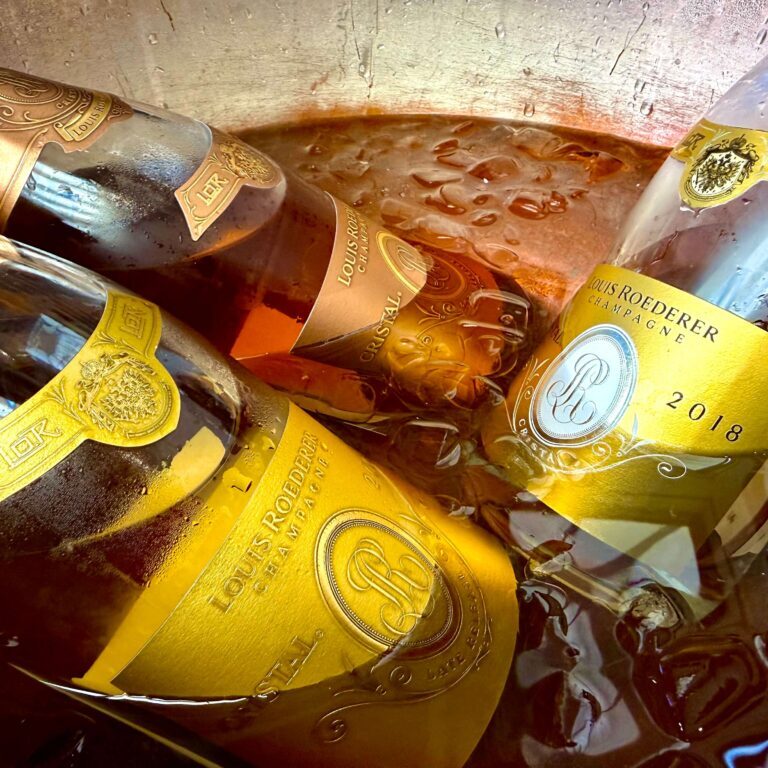
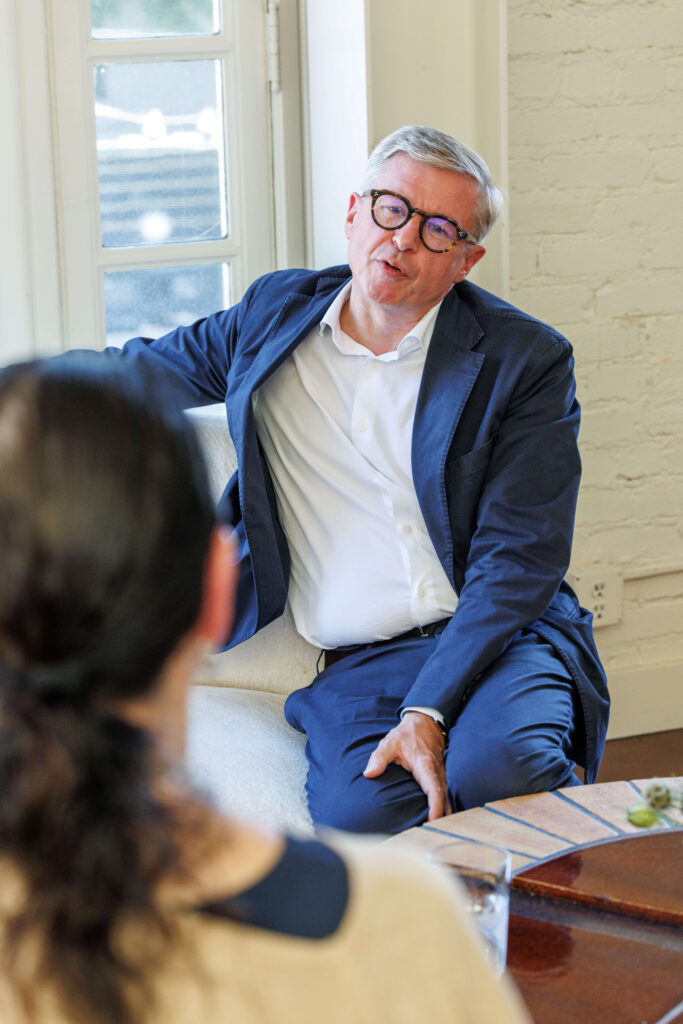
Frédéric Rouzaud is the seventh-generation president and CEO of Champagne Louis Roederer and Roederer Collection. After tasting the latest 250th Anniversary releases, including the 2018 Cristal, 2004 Cristal Vinothéques, and new 2008 Cristal Late Releases, I sat with him to discuss the importance of remaining family-owned and their secret to longevity.
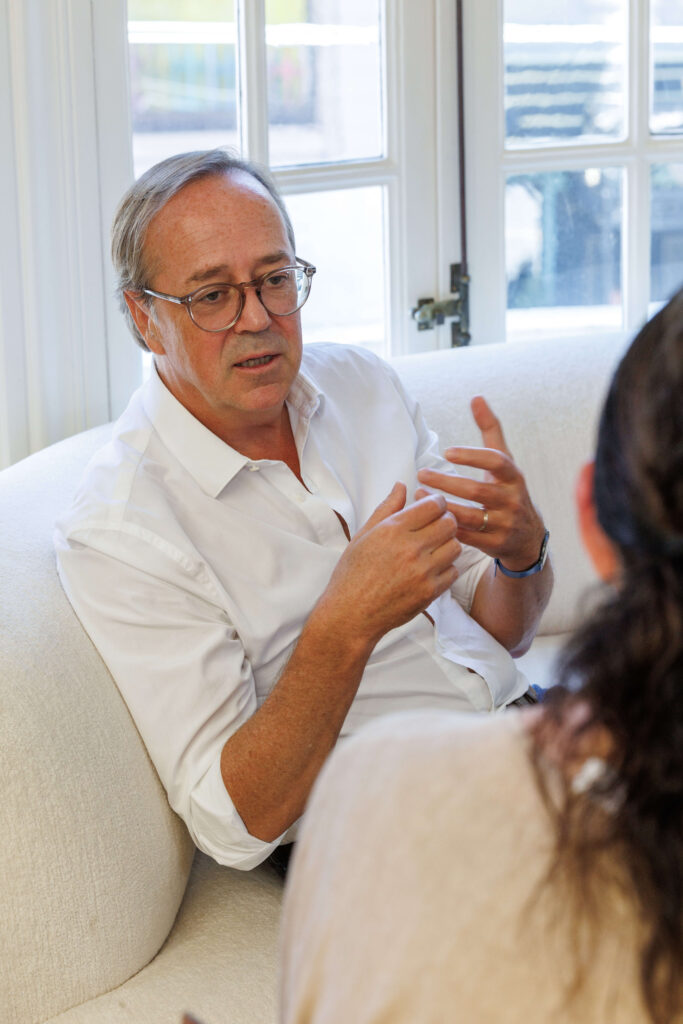
Frédéric Rouzaud (Photo by Frédéric Neema/ Octomedia Productions)
Earn Your Stripes
“I need to pay tribute to my predecessors,” Frédéric Rouzaud told me. “What we have is not only a history; it’s a human adventure. Six generations of owners have gone before me, but there are also six generations of workers. Even some of our best workers transcend generations, and so I also pay tribute to them. Each generation brings new ideas, and this keeps us fresh.”
Frédéric’s father, Jean-Claude Rouzaud, arrived not as an heir with an interest in wine but as a qualified oenologist and agronomist. He remains, remarkably, one of very few heads of Champagne houses ever to hold an enology degree. Frédéric consequently spent years inside the company before taking the chair in 2006. Therefore, the first lesson here is not the vapid one about involving the children. It is that the successor should turn up with a professional competence validated somewhere other than the family dining table, and then serve a long overlap.
Own the Vineyards
Another critical factor in the long-term success of a wine business is land ownership. And if there is one behavior that repeats across the seven Roederer generations, it is to buy when everyone else is selling. Louis Roederer began buying vineyard land in the 1840s, at a moment when Champagne houses simply bought grapes and considered land someone else’s problem. The Olry-Roederers picked up premier cru parcels during the phylloxera crisis of the 1890s. Camille Olry-Roederer kept buying great sites after the war, when prices had fallen through the floor. The compounding result is an estate today of roughly 250 hectares across 420 plots, an anomaly at that scale in Champagne, and one that supplies every one of the house’s vintage wines — Cristal included — entirely from its own fruit. Only the non-vintage requires purchased grapes, and mostly Meunier at that, because Roederer’s holdings sit on chalk in Grand and Premier Cru villages planted to Pinot Noir and Chardonnay.
Land bought in a crisis is what a successor inherits, while brand equity built in a boom is merely what a successor has to defend.
Through Thick and Thin
When Louis II died in 1880, the house went to his sister Léonie, and then to her son Léon Olry-Roederer. When Léon died in January 1932, his much younger widow, Camille, inherited a house that was essentially insolvent: the Russian court had once taken a third of a production running to some 2.5 million bottles a year, and by the early 1930s, with Russia gone, America dry and the world in depression, annual sales had reportedly collapsed to something on the order of a quarter of a million. Camille was not from Champagne. She knew nothing about making wine. She was not warmly received.
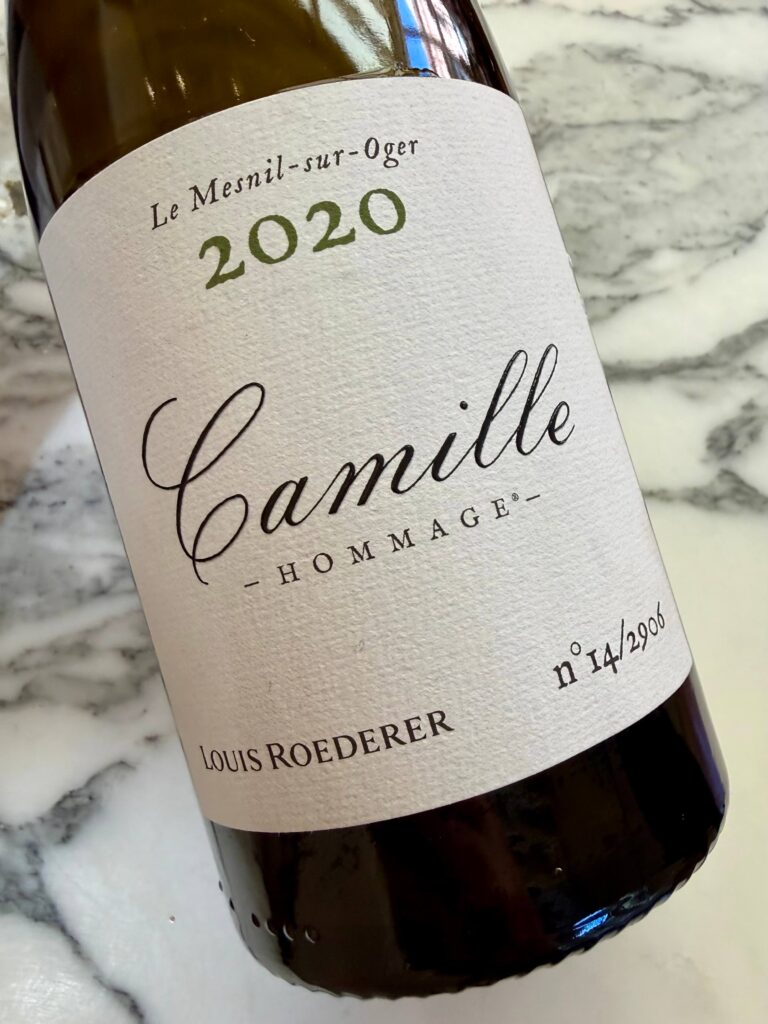
She then ran the house for the next 42 years, through the Depression, the Occupation and the long grey recovery, bought vineyards while her peers liquidated them, put Cristal on public sale for the first time in 1945, and turned the family mansion in Reims into a salon that seduced a fresh generation of royalty into drinking her Champagne. The single most consequential steward in the modern history of Louis Roederer was a widow with no blood claim to the founder whatsoever.
“My grandmother, Camille, navigated the company through the difficult times of the 1930s,” Rouzaud said. “During that period, we almost went bankrupt and lost the company. She could have sold the company. It would have been easier for her. But she held onto it. She would sometimes make a Côteaux Champenois when the grapes could get ripe enough. In recent years, the vintages are getting warmer, and the grapes are riper. So, I reestablished my grandmother’s tradition, as an homage to her.”
Manifest Destiny
In 1980, Jean-Claude Rouzaud bought bare land in Anderson Valley and built Roederer Estate from nothing. It was a greenfield project on another continent, in a region with no track record. The same logic runs through everything that followed — Ramos Pinto in the Douro, Deutz, Delas Frères, Domaines Ott, Château Pichon Longueville Comtesse de Lalande, Merry Edwards, Diamond Creek. Succession friction almost always comes from two generations competing for the same chair. The Roederer answer has been to go out and buy a second chair.
“It was my father who opened our eyes to the possibility of making wine in other regions and countries,” Rouzaud said. “He purchased Ramos Pinto in Portugal, Roederer Estate in Anderson Valley, and Pichon Comtesse in Bordeaux. And this also opened our eyes to a world of different cultures.”
The habit has not slowed. On July 24 this year, in the middle of the anniversary, Roederer completed the purchase of Domaine Pierre Damoy in Gevrey-Chambertin — its first acquisition in Burgundy, bringing nearly eight hectares of grand cru in Chambertin, Chambertin-Clos de Bèze and Chapelle-Chambertin, plus the Clos Tamisot monopole. Grand cru land of that size and pedigree comes to market in the Côte de Nuits roughly never.
“Regarding the wine sales crisis happening today, hey, we’ve been through similar hard times,” Rouzaud said. “With my grandmother and also my father. My father rode through the terrible years of the 1970s. And yet, times of crisis have always been good times to find opportunities. We have just purchased a great estate in Burgundy — Pierre Damoy — it has so much potential.”
Employee Loyalty
Another critical factor to Roederer’s success is not just continuity of family, but also employees. Jean-Baptiste Lécaillon has been at Roederer since 1989 and chef de cave since 1999 — more than three decades of non-family continuity that has already outlasted one generation of owners. Meanwhile, the house has taken no external equity at all, during a time when listed groups are absorbing Champagne houses one after another.
Jean-Baptiste Lécaillon (Photo by Frédéric Neema/ Octomedia Productions)
Stay Independent
Independence is what allows Roederer to hold vast reserve stocks, to run a perpetual reserve on the solera principle, and to release iterations of Cristal twenty years after harvest. Inventory is the shock absorber that makes everything else possible, and no outside shareholder on earth willingly tolerates inventory. Today what the house calls the Roederer Collection employs more than 1,000 people, farms over 1,100 hectares across twelve wineries, and encompasses three distribution subsidiaries under Maisons Marques & Domaines, the négociant Maison Descaves, an arts foundation now in its fifteenth year, and a first hotel, the Christiania in Val d’Isère. All of it privately held.
I asked Rouzaud whether he had ever doubted that he would join the family business. He was refreshingly honest about it.
“Did I ever think for one minute that I wouldn’t continue with this? Yes. When I was twenty, I didn’t want to work with my father at all. This is common for family businesses. But then you go off and work elsewhere. When I was in my twenties, I was working in the real estate business in Bordeaux, and I started to understand how lucky we were as a family. But it was really before that, when I helped with our harvests as a boy. Even then, I felt the energy of harvest, the anticipation and excitement. It’s a stressful time, yes, but there is also so much to celebrate. Champagne is about celebration.”
250th Anniversary Releases
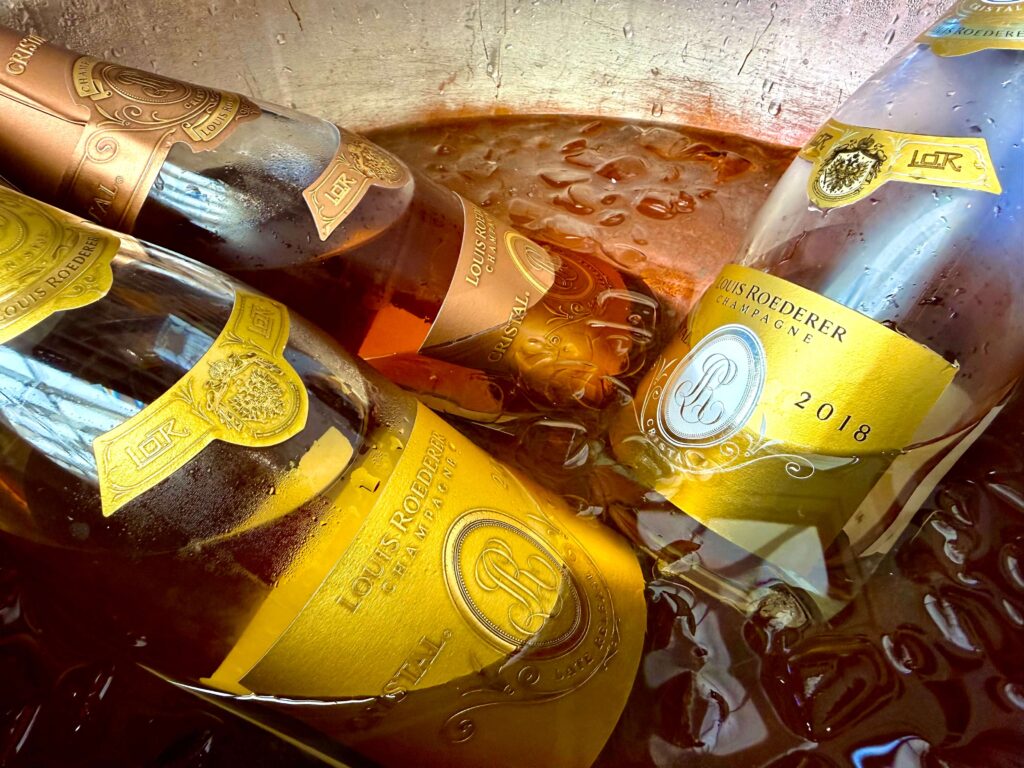 The anniversary has a liquid centerpiece: the newly established “Cristal Late Release” label, kicking off with the 2008 blanc and rosé versions. Eight years after Cristal 2008 was first launched, Roederer has brought the same wine back, and the difference is remarkable. This new iteration sits between the standard release and the Vinothèque, in terms of time before release.
What separates the Late Release from the original, though, is not merely time. Both blanc and rosé 2008 were disgorged in March 2022 after thirteen years on lees, and both were finished at 8 g/L — the same restrained dosage that made the 2008 the lowest-dosed Cristal in the cuvée’s history when it first appeared, down from 9–10 g/L in recent decades and 12 g/L in the 1980s. The more interesting intervention is poignetage: a wrist-flick shaking of every bottle before riddling that re-suspends the lees and pushes texture and openness into the wine. Lécaillon claims this liberates amino acids from the dead yeast cells to conjure salinity and umami, so that the exercise is “not just about aging for longer.” After disgorgement, the bottles rested a further four years on cork before release.
The result adds precisely that extra layer of texture, complexity, and finesse, taking an already remarkable wine to the absolute pinnacle of what it can be. Bravo.
Reviews of Champagne Louis Roederer’s latest releases, including 2018 Cristal, the 2008 Late Releases, the 2004 Vinothéques, and the Camille Côteaux Champenois wines, can be found linked to our Winery Story about Champagne Louis Roederer and our Latest Wine Releases – August 2026 article.

(Photo by Frédéric Neema/ Octomedia Productions)