The 1976 Judgment of Paris: A Reenactment and Reappraisal
On May 21st this year, I moderated a memorable recreation of the 1976 Judgment of Paris red wine tasting, nearly 50 years to the day of Steven Spurrier’s original tasting.
This tasting was presented by collectors Mary and Phillip Riesland, benefiting their charity, The Rare Society Foundation, which supports individuals and families affected by rare diseases—a cause of deep personal resonance for the Rieslands.
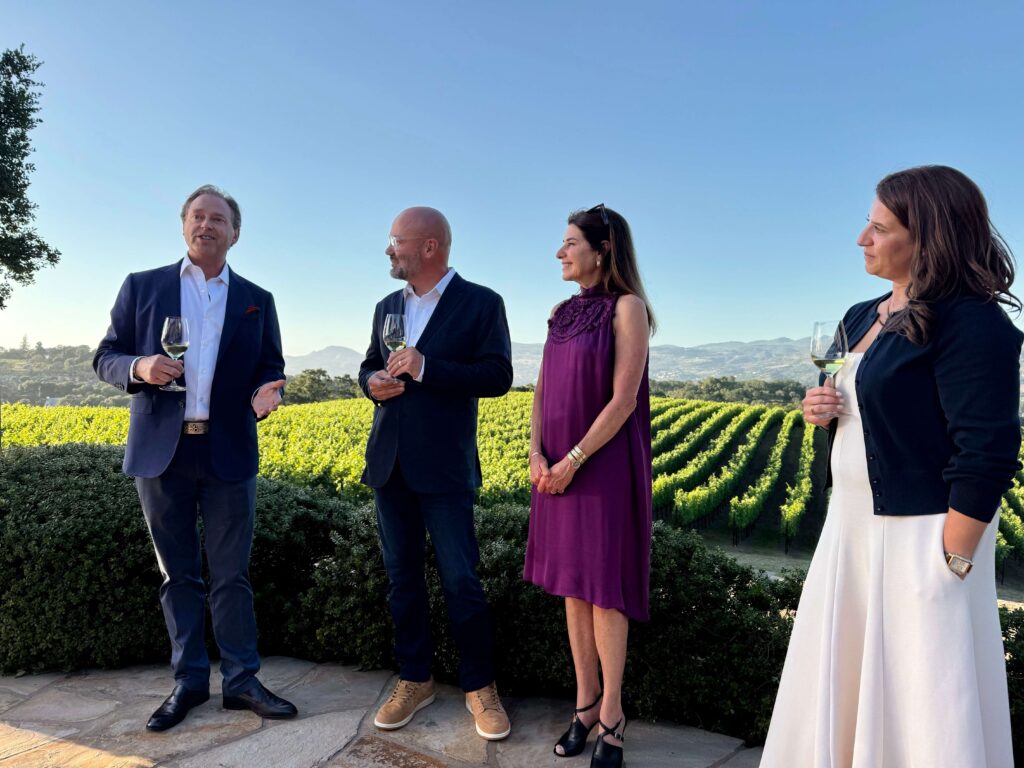
From Left to Right: Shawn Guttersen, Phillip Riesland, Connie Guttersen, and Mary Riesland
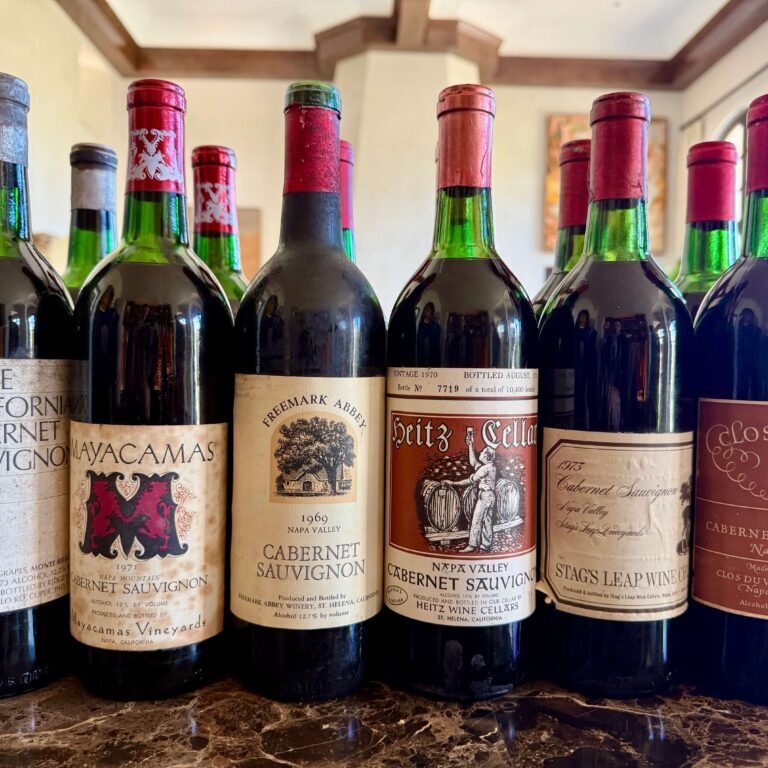
The recreation featured two well-preserved bottles of each original red wine. The tasting was not blind, because, as the adage goes, with wines of this age, there are no great wines, only great bottles. A major benefit of this particular reenactment was having two bottles to compare.
Attendees included Desmond Eschavarrie, MS, vignerons Tor Kenward and Violet Grgich, and Napa-based winemaker Sam Kaplan. Among the 18 tasters, the top 3 favorites were from the USA: 1) 1972 Clos du Val, 2) 1973 Stag’s Leap Wine Cellars, and 3) 1971 Ridge Monte Bello. The ‘72 Clos du Val was a real surprise – elegant yet intense, with impressive red-fruit, floral, and herbal notes, silky tannins, and jaw-dropping length and vitality. It was this estate’s first wine ever made — and from a cold, rainy vintage at that — but, like many Napa Valley 2011s, it has nonetheless aged remarkably. The ‘73 Stag’s Leap maintains a rich mid-palate of black fruit, firm, ripe tannins, and great opulence (my personal favorite). By comparison, the Bordeaux wines were a bit bare-bones, although the 1970 Montrose was fabulously fragrant with lovely finesse. (Full tasting notes for all the wines are at the end of this article.)
Other wines presented at the dinner that followed included a collection of Napa unicorns: 1969 Chappellet Cabernet Sauvignon and 1971 Ridge Eisele Vineyard, as well as 1971 Petrus, Cheval Blanc, and Figeac (all stunning – 1971 was a terrible vintage in the Médoc, but a pretty good one on the Right Bank), and a very spritely-looking 1974 Diamond Creek Volcanic Hill. These could all have been winning contenders had they been selected to participate in 1976!
Special thanks/kudos go to Connie and Shawn Guttersen for hosting the event at their beautiful home at High Ranch Vineyard. Desmond Eschavarrie and James Mobbley did an amazing job preparing the wines.
A Reappraisal of the Methodology behind the Red Wine Tasting in the 1976 Judgment of Paris
On 24 May 1976, Steven Spurrier — an Englishman running the Caves de la Madeleine wine shop and the Académie du Vin school in Paris — assembled a panel of nine eminent French tasters at the InterContinental Hotel and, almost as a Bicentennial diversion, set California Cabernet Sauvignon against the aristocracy of Bordeaux. When the bags came off, the highest-scoring red was the Stag’s Leap Wine Cellars 1973, narrowly ahead of Château Mouton-Rothschild 1970. The result became a founding myth of New World wine. Yet the legend has tended to outrun the evidence, and a closer look at how the red flight was actually built — which wines, and above all which vintages — reveals a contest whose terms were tilted before any cork was pulled.
The first and most obvious problem with the 1976 Judgment of Paris Tasting is one of arithmetic. The red flight comprised ten wines, but they were not evenly split: six were Californian and only four were French. A field that is sixty percent Californian is, before a single score is recorded, a field in which a Californian wine is more likely to finish on top simply because there are more of them competing for the position. The asymmetry did not guarantee a Californian victory, but it loaded the dice toward a Californian headline.
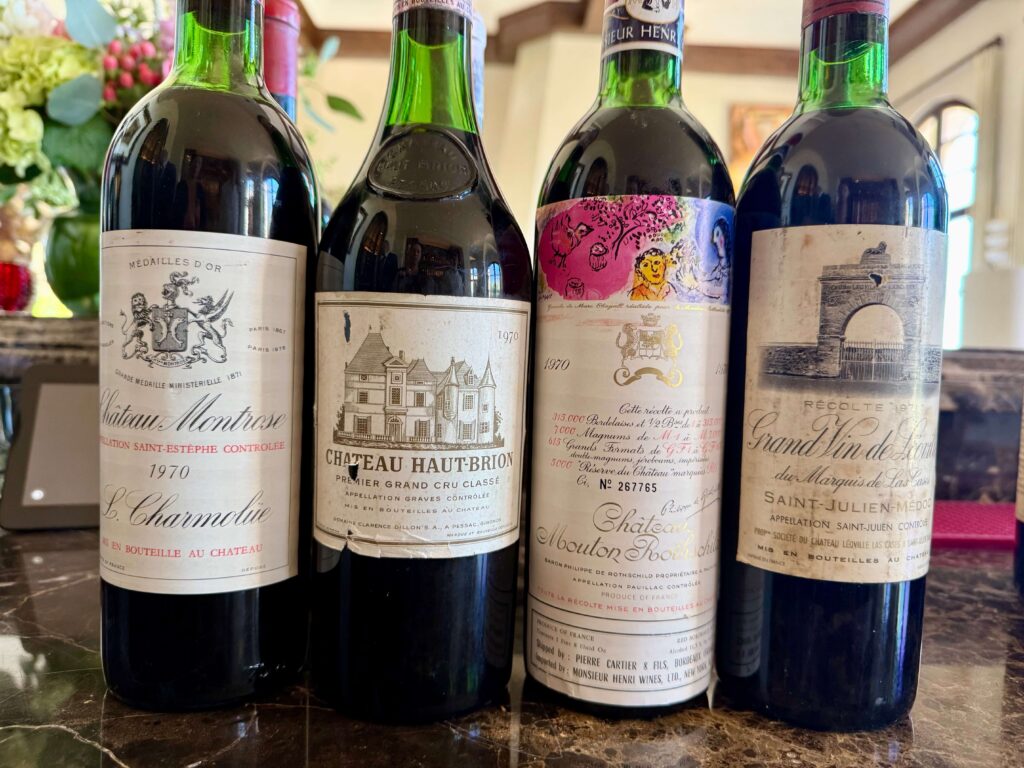
The Bordeaux wines — Château Haut-Brion 1970, Château Mouton-Rothschild 1970, Château Montrose 1970, and Château Léoville-Las-Cases 1971— were chosen as markers, fixed reference points of acknowledged greatness against which to measure the upstart Californians. As benchmarks, they were seemingly beyond reproach, but the devil is in the details.
Crucially, three of the Bordeaux wines were drawn from 1970, an excellent Bordeaux vintage, if a highly structured one. First- and second-growth Bordeaux from a tannic vintage such as 1970 were built to be drunk at fifteen, twenty, or thirty years of age. In 1976, these wines had been in bottle for just under five years: hard, closed, and austere. Meanwhile, the Léoville Las Cases 1971 was an outlier from a notoriously poor Bordeaux vintage plagued by rains at harvest and dilution.
The rather random collection of California reds was drawn from a remarkably uneven run of growing seasons — a great year (1970), a cool, dilute one (1971), an even cooler, rainier growing season and harvest (1972), and a ripe, structured, generally excellent year (1973).
A fairer challenge would have at least ensured that all the wines were from the same vintage, aiming to isolate a vintage with similar growing seasons in both Bordeaux and Northern California.
The two major organizational biases — the asymmetry of regional candidates and vintage variation — taken together, do suggest a structural lean toward the Californians, though not the nationalistic one the question might invite. The numerical imbalance is the first: with six of ten places held by California, probability alone favored a Californian result at the summit. The vintage-and-style mismatch is the second: a young-wine format systematically flattered the more open, fruit-driven Californian palate while penalizing Bordeaux for the very structure that is its long-term virtue. A taster confronted with a closed, austere Mouton beside a plush, aromatic Stag’s Leap is being nudged, sensorially, toward the Californian — not because the judge prefers America, but because one glass is giving and the other is withholding.
And yet the actual 1976 scores complicate any strong claim of pro-American bias. Behind the winning Stag’s Leap, the next three places went entirely to France — Mouton, Montrose, and Haut-Brion — while five of the six Californians clustered in the lower half of the ranking. The margin between first and second was a mere 0.05 of a point, well inside the noise of a subjective twenty-point scale (a fragility later statisticians, examining Spurrier’s averaging method, were happy to expose). This is not the profile of a panel systematically favoring American wine; it is the profile of a panel that, on balance, ranked the French highly and was separated from a French sweep by the thinnest of margins on a single bottle.
The judges expected Bordeaux to triumph and were embarrassed when it did not; several, tasting blind, mistook ripe Californians for French wines and vice versa. The bias, in other words, was baked into the design — the count of wines and the age at which they were shown — rather than residing in the palates of the tasters. The thirty-year reenactment of 2006, organized again by Spurrier with simultaneous panels in London and Napa, is the decisive rebuttal to the simpler “the Californians only won because they were young” story: tasting the same reds at over thirty years, the panels placed the Ridge Monte Bello 1971 first by a wide margin and filled the top five entirely with Californians.
Whatever advantage youth conferred in 1976, the Californian wines also possessed the structure to age, which argues that the original results, however imperfectly arrived at, were not pure illusion.
How young the vineyards really were
What makes the red result genuinely astonishing — and what sharpens the critique of the format — is the sheer infancy of the Californian estates. The winning Stag’s Leap Wine Cellars 1973 was drawn from vines planted only in 1970; they were three years old at harvest, and 1973 was the winery’s first commercial vintage, made by Warren Winiarski in a property whose cellar had been built barely a year earlier. The Clos Du Val 1972 was even greener: it was the debut vintage of a winery founded that same year by Bernard Portet, and the fruit was not even estate fruit — the estate vines were still immature, so the grapes were sourced from a neighboring vineyard a quarter-mile away and crushed at borrowed facilities. Heitz Wine Cellars’ Martha’s Vineyard 1970 came from somewhat older stock — the Oakville vineyard had been planted around 1961 and was roughly nine years old by that vintage — but Heitz had only been bottling it as a single vineyard since 1966. Ridge is the instructive exception: its Monte Bello 1971 included Cabernet planted by a previous owner in 1949, the oldest vines in the entire Californian flight, supplemented by 1960s plantings, though even here the modern winery dated only to 1959 and Paul Draper had joined as winemaker in 1969.
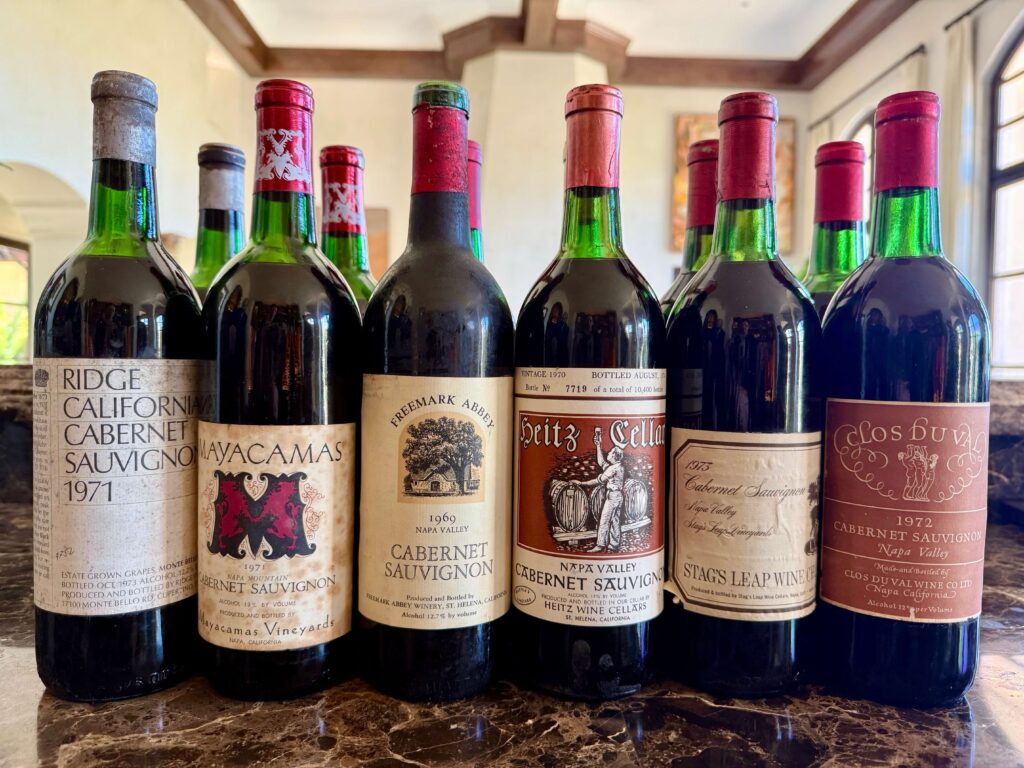
Set against Bordeaux châteaux with centuries of unbroken viticulture and the accumulated wisdom of old vines, the Californian contingent, with the partial exception of Ridge, was a collection of adolescents and one literal newborn. By every received assumption — that old vines yield depth and complexity, that great terroir reveals itself only over generations — these wines should have been outclassed. That they were not is the revolution, but it is also a reminder that the young-wine format neutralized exactly the maturity advantage that should have overwhelmingly favored the French.
The Time Magazine Article’s True Impact
The lone journalist in the room was George M. Taber, whose brief dispatch, published in Time on 7 June 1976, gave the event its enduring name.
The tasting did relatively little, in the short term, to open foreign or export markets to California wine; volumes were tiny, and the European trade remained skeptical for years. The article’s real work was done at home, on American consumers themselves. The American wine snobbery of the mid-1970s was a peculiarly colonial cringe: serious collectors equated quality with French provenance, regarded Bordeaux and Burgundy as the only legitimate fine wines, and filed Napa somewhere between a curiosity and a joke. What Taber’s article delivered to that audience was not a foreign endorsement but a domestic permission slip — the news, in a mass-circulation American magazine, that nine French experts, tasting blind, had ranked a Napa Cabernet above first-growth Bordeaux.
For all the methodological problems detailed above, that single fact dissolved a prejudice that consumption alone had never budged. Americans began to take their own wine seriously because the French, of all people, had been caught doing so first. The Judgment of Paris was technically a flawed experiment, but as an instrument for curing a nation of its own snobbery, it was very nearly perfect.
Tasting Notes on the 1976 Judgment of Paris Wines Today
Very pale brick colored, the 1969 Freemark Abbey Cabernet Sauvignon has a very minty nose, leading to a core of dried cranberries and red currants, plus fragrant wafts of dried herbs and potpourri. The light- to medium-bodied palate is crisp and chewy with a minty finish. 92 points.
Pale to medium brick colored, the 1970 Heitz Cellar Martha’s Vineyard Cabernet Sauvignon opens with mature tobacco, leather, and tilled soil notes, giving way to a core of prunes, Chinese five spice, and dried sage. The light- to medium-bodied palate is tiring, offering faded fruits and chewy tannins with a lifted finish. 89 points.
Pale brick colored, the 1970 Mouton Rothschild gives up whispery notes of dusty soil, new leather, and dried cranberries, plus touches of dried Provence herbs and lavender. The light-bodied palate is crisp and chewy with delicate, mature flavors and an herbal lift on the finish. It’s a touch attenuated and short on the finish, yet it remains deliciously refreshing. 91 points.
The 1970 Montrose is pale to medium tawny in color. Fragrant notes of Jasmine tea, dried cherries, and cranberries spill from the glass, leading to touches of rose oil, tobacco, and leather. Light to medium-bodied, the palate is lively and layered, featuring a whole firework display of mineral sparks with a powdery texture and perfumed finish. 96 points.
Pale brick colored, the 1970 Haut-Brion is a little shy to start off, yet after around 15 minutes in the glass, it blossoms into notes of raspberry preserves and dried blueberries, followed by hints of potpourri, powdered cinnamon, unsmoked cigars, and fallen leaves with a waft of sweaty leather. Light-bodied, the palate is delicate and chewy with mature savory layers and a refreshing ferrous lift on the finish. 91 points.
Pale brick colored, the 1971 Mayacamas Cabernet Sauvignon sings of red cherry preserves and fruit cake, followed by hints of rose bud tea, cinnamon toast, Provence herbs, and forest floor. Light to medium-bodied, the palate is crisp and delicate with lightly chewy tannins and a floral lift on the finish. Beautiful! 93 points.
Medium brick colored, the 1971 Ridge Vineyards Monte Bello was tasted from two separate bottles, showing considerable bottle variation, with one being oxidized from what appeared to be a compromised cork. The best bottle reveals bright notes of dried cranberries, kirsch, sassafras, and vanilla with an earthy undercurrent. The medium-bodied palate is rich and spicy with a velvety texture and refreshing backbone, finishing long and opulent with a touch of coconut. 94 points.
Medium brick colored, the 1971 Leoville Las Cases is a train wreck of dried-out fruit, Brettanomyces, and sautéed herbs. With a skeletal palate of tart acidity and rugged tannins, it has very little remaining fruit-inspired flavors, though plenty of faults. 78 points.
Medium brick colored, the 1972 Clos du Val Cabernet Sauvignon pops from the glass with spritely notes of dried cherries, raspberry pie, new leather, and dried sage. The light to medium-bodied palate is refreshing with lightly chewy tannins and a good intensity of herbs laced red berry flavors, finishing with wonderful purity and length. Impressive! 95 points.
The 1973 Stag’s Leap Wine Cellars S.L.V. Cabernet Sauvignon—the notorious winner of Steven Spurrier’s 1976 Judgement of Paris—is all that. Pale to medium brick colored, it waltzes out with showy notes of kirsch, red currant preserves, and stewed plums, leading to an undercurrent of tobacco leaf, baking spices, and incense, with a compelling waft of caramel. The medium-bodied palate is filled with opulent spice and red fruit layers, supported by firm, grainy tannins and a refreshing line, finishing with jaw-dropping length. Tasted alongside the entire line-up of ’76 Judgement of Paris wines, this wine stands apart as clearly possessing more density and structure than the other candidates, which is no doubt why it deservedly won the contest. Bravo to the late Warren Winiarski! 97 points.